V1500 Cygni
Second intrinsically brightest nova of the 20th century.
Last updated
V1500 Cygni, called Nova Cygni 1975, is a star system in the constellation Cygnus. It was the second intrinsically brightest nova of the 1900s, behind only CP Puppis from 1942. The nova was first reported by Minoru Honda in Kurashiki, Japan, at 13:40 UT on August 29, 1975, with an apparent magnitude of 3.0.
However, Kentaro Osada had actually spotted it earlier that same day, at 11:30 UT. By the next day, it had brightened to magnitude 1.7, then faded quickly. It stayed visible to the naked eye for roughly a week, and 680 days after peak brightness, it had dimmed by 12.5 magnitudes.
The system is an AM Herculis type star, where a red dwarf secondary feeds material onto a highly magnetized white dwarf primary. In 1977, the McDonald Observatory calculated its distance at 1.95 kiloparsecs (about 6,360 light-years). More recently, the Gaia space observatory measured it at roughly 5,100 light-years.
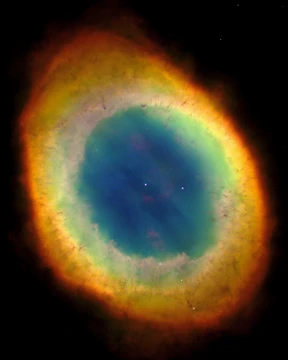
V1500 Cygni was the first asynchronous polar discovered, meaning the white dwarf’s spin period differed slightly from the binary’s orbital period. But by 2016, X-ray observations strongly indicated that the white dwarf’s rotation had returned to normal synchronization with the orbit. Its remnant, typical of very fast novae, consists of some clumps and some spherically symmetric diffuse material.
Quick Facts
- Discovery date
- 29 August 1975
- First reported by
- Minoru Honda
- First discoverer in time
- Kentaro Osada
- Apparent magnitude at discovery
- 3.0
- Peak magnitude
- 1.7
- Distance gaia
- approximately 5,100 light years
Facts from the source article.
Lore & Background
V1500 Cygni was first reported by Minoru Honda of Kurashiki, Japan at 13h40m UT on 29 August 1975, shining at magnitude 3.0. However, the first discoverer in time was Kentaro Osada, who observed it at 11h30m UT on the same day. The nova brightened to magnitude 1.7 the following day and then faded rapidly, remaining visible to the naked eye for about a week. It dimmed by 12.5 magnitudes over 680 days after reaching maximum.
The star is an AM Herculis type system, consisting of a red dwarf secondary that deposits material onto a highly magnetized white dwarf primary. Its distance was calculated in 1977 by the McDonald Observatory at 1.95 kiloparsecs (6,360 light years), while the Gaia space observatory later determined a distance of approximately 5,100 light years. V1500 Cygni was the first asynchronous polar discovered, meaning the white dwarf's spin period differed slightly from the binary orbital period. By 2016, x-ray observations strongly suggested that the white dwarf rotation had returned to normal synchronization with the orbit.
Reader's Guide
V1500 Cygni holds significance as one of the most intrinsically bright novae of the 20th century, second only to CP Puppis. Its rapid brightening and subsequent fading, along with its naked-eye visibility for about a week, made it a notable event for both amateur and professional astronomers. The system's classification as an AM Herculis type star and its status as the first discovered asynchronous polar provide important insights into binary star evolution and the behavior of highly magnetized white dwarfs.
The discrepancy between the 1977 distance measurement of 1.95 kiloparsecs and the later Gaia distance of approximately 5,100 light years highlights the challenges in accurately determining distances to such objects. The eventual synchronization of the white dwarf's rotation by 2016, as suggested by x-ray observations, adds to the understanding of how such systems evolve over time. The remnant of V1500 Cygni, typical of very fast novae, consists of clumps and spherically symmetric diffuse material, contributing to the study of nova ejecta morphology.
More in Emission, Dark and Reflection Nebulae
Sources
Compiled from Wikipedia and the sources listed below. Text from Wikipedia is available under CC BY-SA 4.0; this entry is adapted from it.
- Wikipedia: V1500 Cygni (CC BY-SA 4.0).
- Word definitions: the Codexery glossary, each quoted from its Wikipedia article.
Spotted an error? Know more?
Reader corrections go straight into our review queue. Suggest an edit · How this site is sourced