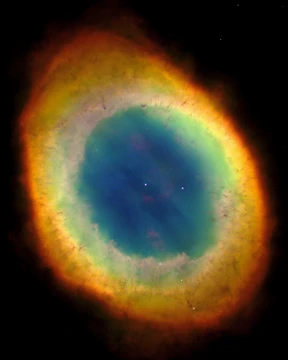
Sh 2-264
A star-forming ring nebula in Orion, ionized by blue giant λ Orionis.
Last updated
Sh 2-264, also known as the Lambda Orionis Ring or the Angelfish Nebula, is a molecular cloud and H II region located in the northern part of the Orion molecular cloud complex (OMCC). It is notable as a star-forming zone, with its main feature being the molecular cloud that becomes visible in long-exposure photographs of over one minute in clear, dry skies. The nebula is named after its central star, λ Orionis (Meissa or Heka), a blue giant that ionizes the surrounding material.
Quick Facts
- Designations
- Sh 2-264
- Lambda Orionis Ring
- Angelfish Nebula
- Type
- Molecular cloud and H II region
- Constellation
- Orion
- Central star
- λ Orionis (Meissa or Heka)
- Associated open cluster
- Collinder 69
Facts from the source article.
Lore & Background
The Lambda Orionis Ring is part of the Orion molecular cloud complex, one of the best-known star formation regions and the closest part of the Milky Way to the Solar System where high-mass stars are born. The nebula spans a few hundred light-years and is centered on the open cluster Collinder 69, composed of young hot stars of fourth and fifth magnitude, visible to the naked eye and resolvable with binoculars. The star λ Orionis, representing the head of Orion in mythology, lies at the cluster's center and ionizes the surrounding gas.
The broad nebula is not visible to the unaided eye, with binoculars, or through small amateur telescopes; it becomes clear only in long-exposure photographs. The orange giant φ2 Orionis appears to be surrounded by the Ring but is a foreground object at about 116 light-years from Earth. HD 34989, a blue-white main sequence star visible only with magnification, lies just outside the Ring and has a small nebulous cloud more prominent in the near-infrared than other parts of the neighboring ionized regions.
Reader's Guide
Sh 2-264 holds significance as a prominent star-forming region within the Orion molecular cloud complex, the closest sector of the Milky Way where high-mass stars are born. Its central star, λ Orionis, a blue giant, drives the ionization of the surrounding material, creating the H II region visible in long-exposure photographs. The nebula's alternative name, the Angelfish Nebula, derives from the pink-to-peach lighter areas that resemble an angelfish in visible light, while its ionized boundaries appear in infrared.
The associated open cluster Collinder 69, containing young hot stars, is visible to the naked eye and resolvable with binoculars, making the region accessible to observers despite the nebula itself being photographically elusive. The foreground star φ2 Orionis and the nearby HD 34989 add context to the structure, with the latter exhibiting a near-infrared cloud distinct from the Ring's ionized zones. The nebula's location near the bright stars Betelgeuse and Bellatrix, which mark Orion's shoulders in myth, further ties it to one of the most recognizable constellations in the night sky.
More in Emission, Dark and Reflection Nebulae
Sources
Compiled from Wikipedia and the sources listed below. Text from Wikipedia is available under CC BY-SA 4.0; this entry is adapted from it.
- Wikipedia: Sh 2-264 (CC BY-SA 4.0).
- Word definitions: the Codexery glossary, each quoted from its Wikipedia article.
Spotted an error? Know more?
Reader corrections go straight into our review queue. Suggest an edit · How this site is sourced