V1974 Cygni
First nova observed across the full electromagnetic spectrum.
Last updated
V1974 Cygni, designated Nova Cygni 1992, was a naked-eye nova in the constellation Cygnus. Amateur astronomer Peter Collins of Boulder, Colorado, discovered it on February 19, 1992, using 10×50 binoculars. At first sighting, its apparent magnitude was 7.2; nine hours later, it had brightened by one full magnitude.
Collins received the AAVSO Nova Award in 1993 for this discovery. The nova peaked at magnitude 4.4 at 22:00 UT on February 22, 1992. Pre-nova images from the Palomar Sky Survey showed a possible precursor with photographic magnitudes of 18 (blue) and 17 (red), though this identification is uncertain.
It declined three magnitudes from peak in 43 days, classifying it as a "fast" nova. Its light curve is type P (Plateau), and it may be a recurrent nova. In 1995, it was observed with the Very Large Array at five radio frequencies (1.49, 4.9, 8.4, 14.9, and 22.5 GHz).
The Hubble Space Telescope’s High Speed Photometer recorded brief ultraviolet photometry, and Voyager 2 observed it in the far-ultraviolet. It was sought but not detected by the Compton Gamma Ray Observatory. V1974 Cygni was the first nova observed across the entire electromagnetic spectrum, from radio to gamma rays.
Like all novae, it is a binary system: a donor star orbits a white dwarf, transferring matter to it. The orbital period is 1 hour, 57 minutes. The white dwarf is oxygen-neon-magnesium, making it a neon nova. Its mass is estimated between 0.98 and 1.12 solar masses, and it is accreting material from the donor star.
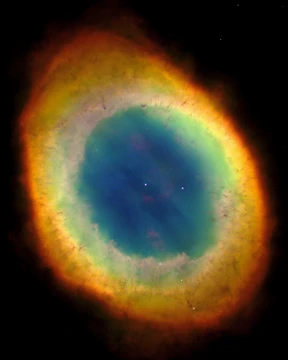
The nova remnant shell, nearly circular, has been observed multiple times with the Hubble Space Telescope and the Infrared Space Observatory. As of February 10, 1998, its radius was 0.983 arc seconds, expanding at about 0.26 milliarcseconds per day. The shell was also imaged at 6 cm radio wavelengths by the MERLIN interferometer.
Quick Facts
- Discovery date
- February 19, 1992
- Discoverer
- Peter Collins
- Discovery location
- Boulder, Colorado
- Peak magnitude
- 4.4
- Peak magnitude date
- 22 February 1992
- Nova type
- fast nova
- Light curve classification
- type P (Plateau)
Facts from the source article.
Lore & Background
V1974 Cygni was discovered visually with 10×50 binoculars on February 19, 1992, by amateur astronomer Peter Collins in Boulder, Colorado. At first sighting it had an apparent magnitude of 7.2; nine hours later it had brightened by a full magnitude.
The nova reached magnitude 4.4 at 22:00 UT on 22 February 1992. It declined from peak brightness by three magnitudes in 43 days, classifying it as a fast nova, and its light curve is type P (Plateau). It may be a recurrent nova.
The nova is a binary system with an orbital period of 1 hour, 57 minutes, consisting of a donor star transferring matter to an oxygen-neon-magnesium white dwarf primary, making it a neon nova. Estimates of the white dwarf mass range from 0.98 to 1.12 solar masses. A possible precursor was identified on Palomar Sky Survey images with photographic magnitudes of 18 (blue) and 17 (red), but the identification is not firm.
V1974 Cygni has a nearly circular nova remnant shell. As of 10 February 1998, its radius was 0.983 arc seconds, expanding at about 0.26 milli arc seconds per day. The shell has been observed with the Hubble Space Telescope, the Infrared Space Observatory, and in 6 cm radio waves with the MERLIN interferometer.
Reader's Guide
V1974 Cygni holds a unique place in nova studies as the first nova observed throughout the electromagnetic spectrum, from radio waves to gamma rays. It was observed with the Very Large Array at multiple frequencies (1.49, 4.9, 8.4, 14.9, and 22.5 GHz) in 1995, and studied with the Hubble Space Telescope's High Speed Photometer, which recorded ultraviolet photometry. The far-ultraviolet was observed by Voyager 2. It was also observed, but not detected, with the Compton Gamma Ray Observatory.
This comprehensive coverage made it a benchmark for multi-wavelength nova research. The nova's light curve, classified as type P (Plateau), and its possible status as a recurrent nova add to its significance. The remnant shell, expanding at a measured rate and imaged by multiple observatories, provides ongoing data on nova ejecta dynamics. The discovery earned Peter Collins the AAVSO Nova Award in 1993.
More in Emission, Dark and Reflection Nebulae
Sources
Compiled from Wikipedia and the sources listed below. Text from Wikipedia is available under CC BY-SA 4.0; this entry is adapted from it.
- Wikipedia: V1974 Cygni (CC BY-SA 4.0).
- Word definitions: the Codexery glossary, each quoted from its Wikipedia article.
Spotted an error? Know more?
Reader corrections go straight into our review queue. Suggest an edit · How this site is sourced