Post-AGB star
Luminous low-mass supergiants in a late phase of stellar evolution.
Last updated
A post-AGB star (post-asymptotic giant branch) is a luminous low-mass supergiant star of intermediate mass in a very late phase of stellar evolution. It occurs after the asymptotic giant branch has ended, when the dying star, initially very cool and large, shrinks and heats up. The duration of this stage varies based on the star's initial mass, ranging from 100,000 years for a solar-mass star to just over 1,000 years for more massive stars, and gets slightly shorter with lower metallicity.
Quick Facts
- Stage duration range
- 100,000 years (solar-mass) to just over 1,000 years (more massive)
- Luminosity behavior
- usually constant throughout the stage
- slightly dependent on core mass
- slightly brighter with lower metallicity
- Brightest visible example
- 89 Herculis
- Other examples
- RV Tauri
- R Scuti
- U Monocerotis
Facts from the source article.
Lore & Background
Post-AGB stars span a large range of temperatures as they heat up from very cool values up to about 30,000 K. Technically, the post-AGB stage only ends when the star reaches its maximum temperature of 100,000–200,000 K, but beyond 30,000 K the star ionises the surrounding gas and is more often considered a central star of a planetary nebula. The luminosity of post-AGB stars is usually constant throughout the stage, slightly dependent on the star's core mass, and getting slightly brighter with lower metallicity.
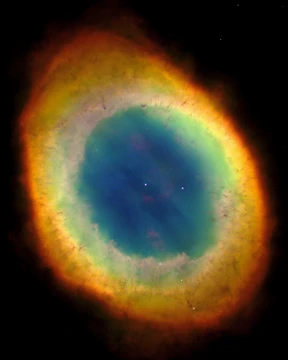
Towards the end of this stage, post-AGB stars tend to produce protoplanetary nebulae as they shed their outer layers, creating a large infrared excess and obscuring the stars in visible light. After reaching an effective temperature of about 30,000 K, the star is able to ionise its surrounding nebula, producing a true planetary nebula. Due to the dust usually obscuring them, many post-AGB stars are visually relatively dim, though some are visible to the naked eye, the brightest being 89 Herculis.
Reader's Guide
Post-AGB stars represent a critical transitional phase in the life cycle of intermediate-mass stars, bridging the asymptotic giant branch and the planetary nebula stage. Their significance lies in the dramatic physical changes they undergo: shrinking from a very cool, large supergiant to a hot, compact object while shedding outer layers to form protoplanetary nebulae. The dust produced during this shedding creates a large infrared excess and obscures the stars in visible light, making them challenging to observe directly. Despite this, several examples are visible to the naked eye, including 89 Herculis, RV Tauri, R Scuti, and U Monocerotis.
The stage's duration varies widely—from 100,000 years for a solar-mass star to just over 1,000 years for more massive stars—and is slightly shorter with lower metallicity. The constant luminosity throughout the stage, slightly dependent on core mass and brighter with lower metallicity, provides a stable reference for studying stellar evolution. Ultimately, when the star reaches about 30,000 K, it ionises its surrounding nebula, marking the transition to a true planetary nebula and the end of the post-AGB phase.
More in Emission, Dark and Reflection Nebulae
Sources
Compiled from Wikipedia and the sources listed below. Text from Wikipedia is available under CC BY-SA 4.0; this entry is adapted from it.
- Wikipedia: Post-AGB star (CC BY-SA 4.0).
- Word definitions: the Codexery glossary, each quoted from its Wikipedia article.
Spotted an error? Know more?
Reader corrections go straight into our review queue. Suggest an edit · How this site is sourced