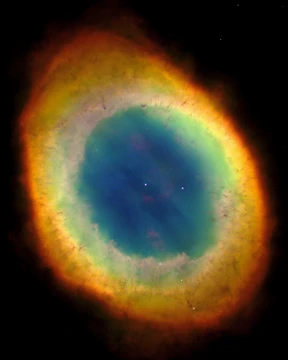
Red Square Nebula
A nearly perfectly symmetrical square nebula around star MWC 922.
Last updated
The Red Square Nebula lies in the constellation Serpens, centered on the star MWC 922. Its distinctive square shape, first captured in images from California’s Palomar Observatory Hale Telescope and released in April 2007, is described by University of Sydney astrophysicist Peter Tuthill as one of the most nearly perfectly symmetrical celestial objects ever photographed. Tuthill and Cornell University’s James Lloyd propose that the square form results from two cones placed tip to tip, viewed from the side—an arrangement that also accounts for the double-ring structure observed in supernova SN 1987A. Faint spokes radiate from the nebula’s center, possibly shadows cast by periodic ripples or waves on the surface of an inner disk close to the star.
However, the origin of the nebula’s crisp structure remains unclear. Many low-mass stars, like the Sun, shed their outer layers to form planetary nebulae late in life, but MWC 922 is relatively massive, suggesting a different process is at work. “How did all this beautiful, crisp structure form?” Tuthill asks. “This is the million dollar question.”
Lore & Background
The first images of the Red Square Nebula were taken using the Palomar Observatory Hale Telescope in California and released in April 2007. The nebula's square shape is explained by a proposed model in which two cone shapes are placed tip-to-tip, as seen from the side. This same geometry also explains the double-ring structure seen in SN 1987A.
A series of faint spokes radiate from the center of the structure. One possible explanation is that these spokes are shadows cast by periodic ripples or waves on the surface of an inner disk close to the central star. There is no clear explanation of how the central star could produce the nebula's shape.
Towards the end of their lives, many low-mass stars, like the Sun, slough off their outer layers to produce striking planetary nebulae. But the hot star at the heart of the Red Square nebula, called MWC 922, appears to be relatively massive, suggesting another process formed its signature shape. Peter Tuthill has described this as the 'million dollar question.'
Reader's Guide
The Red Square Nebula holds significance as one of the most nearly discrete-symmetrical celestial objects ever imaged, a distinction noted by astrophysicist Peter Tuthill. Its crisp, square structure challenges conventional understanding of nebular formation, particularly because the central star MWC 922 appears to be relatively massive, unlike the low-mass stars that typically produce planetary nebulae.
The proposed cone-tip-to-cone-tip model not only accounts for the square shape but also provides a unifying explanation for the double-ring structure observed in SN 1987A. The faint spokes radiating from the center, possibly shadows from ripples on an inner disk, add further complexity. The lack of a clear explanation for how the central star produces this shape leaves the nebula as an ongoing puzzle, with Tuthill calling it the 'million dollar question.' Its legacy lies in pushing the boundaries of known stellar and nebular physics, inviting further study into the processes that can create such highly ordered structures in space.
More in Emission, Dark and Reflection Nebulae
Sources
Compiled from Wikipedia and the sources listed below. Text from Wikipedia is available under CC BY-SA 4.0; this entry is adapted from it.
- Wikipedia: Red Square Nebula (CC BY-SA 4.0).
Spotted an error? Know more?
Reader corrections go straight into our review queue. Suggest an edit · How this site is sourced