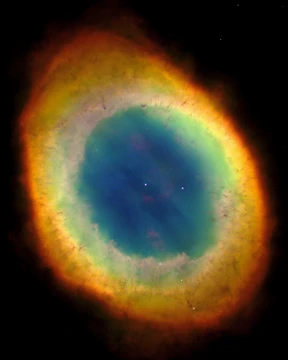
Protoplanetary nebula
A short-lived infrared reflection nebula between AGB and planetary nebula phases.
Last updated
A protoplanetary nebula (PPN, plural PPNe) is a short-lived astronomical object that appears during the rapid evolution of an intermediate-mass star (1–8 solar masses) between the late asymptotic giant branch (LAGB) phase and the subsequent planetary nebula (PN) phase. It emits strongly in infrared radiation and is classified as a kind of reflection nebula. The PPN represents the second-from-last high-luminosity phase in the life cycle of such stars.
Quick Facts
- Phase duration
- less than about 10,000 years
- Transition temperature for ionization
- 30,000 K
Facts from the source article.
Lore & Background
The name 'protoplanetary nebula' is an unfortunate choice because it can be confused with the unrelated concept of protoplanetary disks. The term derives from the older 'planetary nebula', which was coined by early astronomers who saw a resemblance to gas giants like Neptune and Uranus. To avoid confusion, the alternative term 'preplanetary nebula' has been suggested, as it does not overlap with other astronomical disciplines. These objects are also often called post-AGB stars, though that category includes stars that will never ionize their ejected matter.
During the PPN phase, the central star's effective temperature rises due to mass loss from hydrogen shell burning. The star remains too cool to ionize the slow-moving circumstellar shell ejected during the AGB phase, but it drives high-velocity, collimated winds that shape and shock the shell, entraining slow AGB ejecta to produce a fast molecular wind. Observations from 1998 to 2001 showed that this rapidly evolving phase ultimately determines the morphology of the subsequent planetary nebula. The envelope shape changes from roughly spherically symmetric to axially symmetric, producing bipolar structures, knotty jets, and Herbig–Haro-like bow shocks, even in relatively young PPNe.
The PPN phase ends when the central star reaches about 30,000 K and becomes hot enough to ionize the circumstellar nebula, turning it into an emission nebula called a planetary nebula. This transition must occur within less than about 10,000 years; otherwise, the density of the circumstellar envelope falls below about 100 per cm³, and no planetary nebula forms—a case sometimes called a 'lazy planetary nebula'.
Reader's Guide
The protoplanetary nebula phase is significant as the critical transitional stage that shapes the morphology of the eventual planetary nebula. Observations and high-resolution imaging from 1998 to 2001 demonstrated that the rapidly evolving PPN phase ultimately determines the structure of the subsequent PN, with shapes such as bipolar outflows, knotty jets, and bow shocks appearing even in relatively young PPNe. The phase is also notable for the theoretical challenges it presents: the 'interacting stellar winds' model of radiatively-driven winds was found insufficient to account for CO observations of PPN fast winds, which imply high momentum and energy.
Alternative models have investigated accretion disk scenarios, similar to those used to explain jets from active galactic nuclei and young stars, to account for the point symmetry and high collimation seen in many PPN jets. In these models, the accretion disk forms through binary interactions, and magneto-centrifugal launching from the disk surface converts gravitational energy into kinetic energy of a fast wind. If the accretion-disk jet paradigm is correct, magneto-hydrodynamic processes mediate the energetics and collimation of PPN outflows and determine the physics of the associated shocks, which can be confirmed with high-resolution pictures of the emission regions.
More in Emission, Dark and Reflection Nebulae
Sources
Compiled from Wikipedia and the sources listed below. Text from Wikipedia is available under CC BY-SA 4.0; this entry is adapted from it.
- Wikipedia: Protoplanetary nebula (CC BY-SA 4.0).
- Word definitions: the Codexery glossary, each quoted from its Wikipedia article.
Spotted an error? Know more?
Reader corrections go straight into our review queue. Suggest an edit · How this site is sourced