RR Pictoris
A slow nova discovered in 1925 by an amateur astronomer.
Last updated
RR Pictoris—also cataloged as Nova Pictoris 1925—is a cataclysmic variable star system that erupted as a nova in the constellation Pictor during 1925. The outburst was first spotted by Robert Watson, an amateur astronomer and telegraph operator living in Beaufort West, South Africa.
At 05:50 AM on 25 May 1925, while walking to work, he noticed an unfamiliar star aligned with α Crucis and β Carinae. Checking his copy of Norton's Star Atlas, he recognized it as a nova. Because he worked as a telegraph operator, he quickly sent a telegram to the Royal Observatory at Cape Town, enabling southern observatories to capture spectra of the nova before it reached peak brightness.
At discovery, RR Pictoris shone at apparent magnitude 2.3. It continued brightening, hitting magnitude 1.2 on 9 June 1925, then dimmed to magnitude 4 by 4 July, only to brighten again to 1.9 on 9 August. Six months after its peak, the star faded below naked-eye visibility, and by 1975 it had dropped to magnitude 12.5. Classified as a slow nova, its light curve shows positive superhumps—superhumps whose period is about 8.6% longer than the system’s orbital period.
Gaia spacecraft measurements place the system roughly 510 parsecs (about 1670 light-years) from Earth. Novae are close binary systems: a white dwarf and a secondary star so near that the secondary fills its Roche lobe, spilling material onto the white dwarf’s accretion disk.
When that material reaches a critical mass, it ignites, causing the dramatic brightening. The two stars in RR Pictoris orbit each other every 3.48 hours. Calculations of the secondary’s speed indicate it is not dense enough for its size to still be on the main sequence; it has likely begun expanding and cooling as its core exhausted its hydrogen fuel.
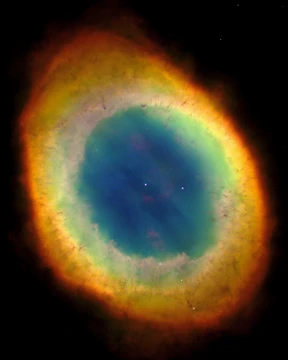
Small variations in the observed orbital period hint at a possible third star—a low-mass object (about 0.25 solar masses) orbiting the close binary pair with a period of roughly 70 years. A small filamentary nebula, less than 30 arc seconds across, surrounds the nova. Comparing images taken years apart has allowed astronomers to measure its expansion rate.
Quick Facts
- Discovery date
- 25 May 1925
- Discoverer
- Robert Watson
- Discovery location
- Beaufort West, South Africa
- Peak magnitude
- 1.2
- Distance
- 510 parsecs (1670 light-years)
- Orbital period
- 3.48 hours
- Classification
- slow nova
Facts from the source article.
Lore & Background
RR Pictoris was discovered by South African amateur astronomer Robert Watson, who lived in Beaufort West. At 05:50 AM on 25 May 1925, while walking to work, he noticed a star he did not recognize in line with α Crucis and β Carinae. Consulting his copy of Norton's Star Atlas, he realized it was a nova.
Employed as a telegraph operator, Watson promptly sent a telegram describing his discovery to the Royal Observatory at Cape Town, allowing southern observatories to obtain spectra before maximum brightness. At discovery, its apparent magnitude was 2.3. It brightened to magnitude 1.2 on 9 June 1925, dimmed to magnitude 4 by 4 July, then brightened again to 1.9 on 9 August. Six months after peak, it faded below unaided-eye visibility, reaching magnitude 12.5 by 1975.
The system consists of a white dwarf and a secondary star that fills its Roche lobe, transferring material onto an accretion disc. The secondary star is not dense enough for its size to still be on the main sequence, indicating it has begun expanding and cooling as its core exhausted hydrogen. Small variations in the observed orbital period suggest a possible low-mass (0.25 M☉) third star orbiting the close binary pair with a period of about 70 years.
Reader's Guide
RR Pictoris is significant as a well-observed slow nova whose early detection by an amateur astronomer enabled critical pre-maximum spectroscopy. Its light curve, showing three brightness peaks shortly after discovery and positive superhumps 8.6% longer than the orbital period, provides insight into the behavior of cataclysmic variables. The system's measured distance of 510 parsecs from Gaia helps calibrate nova distances.
The surrounding filamentary nebula, expanding measurably over years, offers a rare opportunity to study the ejected material from a nova event. The possible third star in a 70-year orbit adds complexity to understanding the system's evolution and mass transfer dynamics. The secondary star's post-main-sequence state indicates the binary is in an advanced evolutionary stage, informing models of nova progenitor systems.
More in Emission, Dark and Reflection Nebulae
Sources
Compiled from Wikipedia and the sources listed below. Text from Wikipedia is available under CC BY-SA 4.0; this entry is adapted from it.
- Wikipedia: RR Pictoris (CC BY-SA 4.0).
- Word definitions: the Codexery glossary, each quoted from its Wikipedia article.
Spotted an error? Know more?
Reader corrections go straight into our review queue. Suggest an edit · How this site is sourced