IRAS 19475+3119
A protoplanetary nebula with a quadrupolar structure and pulsating central star.
Last updated
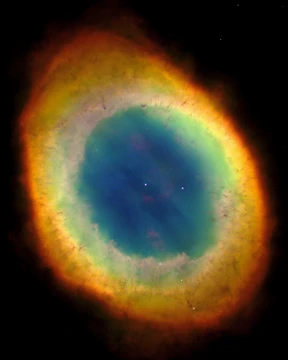
IRAS 19475+3119 is a protoplanetary nebula located in the constellation Cygnus, about 15,000 light-years from Earth. The central star, known as V2513 Cygni, is an F-type post-AGB star. The brightest part of the nebula has a quadrupolar shape, featuring elongated bipolar lobes, all enclosed within a faint halo.
The distance to this object is not well established. Estimates rely on assumptions about the star's luminosity.
Using an assumed kinematical distance, the luminosity and radius are calculated, and the star is thought to have originally been at least a certain mass, now reduced. If a different luminosity is assumed, the distance changes accordingly. Measurements based on oxygen spectral line strengths suggest much higher luminosities, with an absolute magnitude of at least −8.
In 2006, Vera P. Arkhipova and colleagues reported that IRAS 19475+3119 is a variable star, and it received the designation V2513 Cygni in 2013. The star's brightness varies between roughly magnitude 9.33 and 9.50. A primary period of 41 days has been identified, but a slightly shorter secondary period creates long beats, causing changes in the amplitude and apparent period from year to year. These variations result from stellar pulsations, with the star brightest when it is hottest; its temperature varies by up to a certain amount.
Quick Facts
- Constellation
- Cygnus
- Central star
- V2513 Cygni
- Spectral type
- F-type post-AGB
- Apparent magnitude range
- 9.33 to 9.50
- Variability period
- 41 days (primary); secondary period leads to long beats
Facts from the source article.
Lore & Background
The nebula IRAS 19475+3119 was identified as a protoplanetary nebula, a short-lived transitional phase between a red giant and a planetary nebula. Its central star, V2513 Cygni, is an F-type post-AGB star. The brightest portion of the nebula displays a quadrupolar morphology, featuring elongated bipolar lobes embedded within a faint halo. The distance to the object is uncertain; assumptions about the star's luminosity have been used to derive distance and other stellar parameters.
At an assumed kinematical distance, the luminosity and radius are given, and the star was originally at least a certain mass and is now a different mass. Assuming a different luminosity yields a different distance. Estimates based on oxygen spectral line strengths suggest much higher luminosities, with an absolute magnitude of at least −8.
In 2006, Vera P. Arkhipova et al. announced that the star is variable, and it received the variable star designation V2513 Cygni in 2013. The star varies in brightness from about magnitude 9.33 to 9.50. A primary period of 41 days has been determined, but a slightly shorter secondary period produces long beats, causing variations in amplitude and apparent period from year to year. These variations arise from stellar pulsations; the star is brightest when it is hottest, and its temperature varies by up to a certain amount.
Reader's Guide
IRAS 19475+3119 is significant as a protoplanetary nebula that offers insight into the late evolutionary stages of intermediate-mass stars. Its quadrupolar structure, with elongated bipolar lobes and a surrounding halo, is a relatively rare morphology that provides clues about the shaping mechanisms at work during the post-AGB phase. The central star, V2513 Cygni, is an F-type post-AGB star whose pulsations cause brightness variations with a primary period of 41 days and a secondary period that creates long beats. This pulsational behavior, with the star brightest when hottest, helps constrain stellar interior models.
The distance to the object remains uncertain, with estimates ranging from an assumed kinematical distance to values derived from different luminosity assumptions or oxygen spectral line strengths, which imply an absolute magnitude of at least −8. This uncertainty underscores the challenges in characterizing such objects. The nebula's legacy lies in its contribution to understanding the transition from asymptotic giant branch stars to planetary nebulae, the development of complex nebular shapes, and the pulsational properties of post-AGB stars.
More in Emission, Dark and Reflection Nebulae
Sources
Compiled from Wikipedia and the sources listed below. Text from Wikipedia is available under CC BY-SA 4.0; this entry is adapted from it.
- Wikipedia: IRAS 19475+3119 (CC BY-SA 4.0).
- Word definitions: the Codexery glossary, each quoted from its Wikipedia article.
Spotted an error? Know more?
Reader corrections go straight into our review queue. Suggest an edit · How this site is sourced