Egg Nebula
A bipolar protoplanetary nebula with bright arcs and polarized light.
Last updated
The Egg Nebula (also cataloged as RAFGL 2688 and CRL 2688) is a bipolar protoplanetary nebula located roughly 3,000 light-years from Earth. Its unusual characteristics were first documented in 1975, based on data from an 11 μm survey conducted between 1971 and 1974 using a sounding rocket by the Air Force Geophysical Laboratory. Before that, Fritz Zwicky had listed the object as a pair of galaxies.
The nebula is best known for the bright arcs and rings that surround its central star. A thick shell of gas and dust hides the star from direct view, but light escapes through thinner parts of this dusty cocoon, illuminating the outer gas layers and creating the visible arcs. The central star, V1610 Cygni, has a spectral type of F5, meaning its surface is about 900 K hotter than the Sun’s, but still too cool to ionize the surrounding nebula. This places the Egg Nebula at an earlier evolutionary stage than the Westbrook Nebula, whose B0 central star has just begun ionizing its surroundings.
The dusty shroud is likely a disk. The bipolar outflows seen in images suggest the system has angular momentum, probably generated by an accretion disk. Such a disk would explain why the cocoon varies in thickness, letting light escape along the disk’s axis while blocking it from view along the edge. Although dusty disks have been confirmed around several post-AGB objects, a disk around the Egg Nebula has not yet been confirmed.
The nebula emits strong microwave radiation from rotational transitions of carbon monoxide and hydrogen cyanide. The strong HCN signal indicates that the progenitor AGB star was a carbon star. Millimeter-wave spectral lines from 38 molecular species have been detected in the outflow. The CO and HCN spectra show a strong blue-shifted P Cygni absorption feature, revealing a high-velocity wind of about 100 km/s inside the slower remnant AGB wind, which expands at 18 km/s.
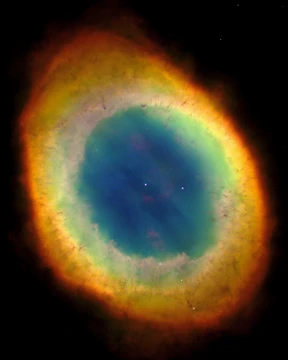
The Egg Nebula was imaged by the Wide Field and Planetary Camera 2 on the Hubble Space Telescope. It emits polarized light, which can be detected visually with a medium-sized telescope.
Lore & Background
The Egg Nebula's peculiar properties were first described in 1975 using data from an 11 μm survey obtained with a sounding rocket by the Air Force Geophysical Laboratory between 1971 and 1974. Previously, the object had been catalogued by Fritz Zwicky as a pair of galaxies. The central star, V1610 Cygni, has a spectral type of F5, with a photosphere about 900 K hotter than the Sun, but not hot enough to have begun ionizing the nebula. This places the Egg Nebula at a slightly earlier evolutionary stage than the Westbrook Nebula, whose B0 central star has recently begun ionization.
The dusty enclosure around the central star is very likely a disc, which would account for the varying thickness that allows light to escape along the disc's axis and illuminate the outer gas layers while blocking direct view along the disc edge. Although dusty discs have been confirmed around several post-AGB objects, a disc around the Egg Nebula is yet to be confirmed. The nebula shows strong microwave emission from rotational transitions of carbon monoxide and hydrogen cyanide, with the strong HCN emission indicating that the progenitor AGB star was a carbon star. Millimeter wave spectral lines from 38 molecular species have been detected in the outflow, and the CO and HCN spectra show a blue-shifted P Cygni absorption feature, revealing a high-velocity wind of about 100 km/sec inside the remnant AGB wind expanding at 18 km/sec.
Reader's Guide
The Egg Nebula was photographed by the Wide Field and Planetary Camera 2 of the NASA/ESA Hubble Space Telescope, and its image reveals searchlight beams and multiple arcs around a dying star. The nebula's bipolar outflows indicate that the system has angular momentum, very likely generated by an accretion disc. Its polarized light makes it accessible to amateur astronomers with medium-sized telescopes, offering a visual link to the late stages of stellar evolution.
The detection of 38 molecular species in its outflow provides a rich chemical laboratory for studying the transition from asymptotic giant branch star to planetary nebula. The presence of strong HCN emission confirms the carbon-rich nature of the progenitor star, while the dual wind speeds—a fast inner wind and a slower outer wind—illustrate the dynamic processes at work during this brief evolutionary phase. The nebula's arcs and circles, illuminated by scattered light from the hidden central star, serve as a key example of how dust and gas are shaped by angular momentum and outflow in protoplanetary nebulae.
More in Emission, Dark and Reflection Nebulae
Sources
Compiled from Wikipedia and the sources listed below. Text from Wikipedia is available under CC BY-SA 4.0; this entry is adapted from it.
- Wikipedia: Egg Nebula (CC BY-SA 4.0).
- Word definitions: the Codexery glossary, each quoted from its Wikipedia article.
Spotted an error? Know more?
Reader corrections go straight into our review queue. Suggest an edit · How this site is sourced