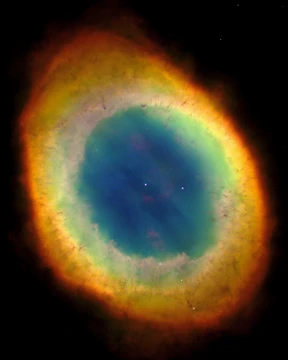
M1-92
Bipolar protoplanetary nebula in Cygnus, also called the Footprint Nebula.
Last updated
M1-92, also called Minkowski’s Footprint or the Footprint Nebula, is a bipolar protoplanetary nebula located in the constellation Cygnus. It is a reflection nebula, meaning it is only visible because its central star’s light bounces off surrounding dust and gas. That star is not yet a white dwarf, but it is rapidly evolving toward that stage; within a few thousand years, it will become hot enough to release intense ultraviolet radiation, ionizing the surrounding nebula and turning it into a full planetary nebula.
Rudolph Minkowski discovered M1-92 in 1946. The Very Large Array captured images of it in 1983, and the Hubble Space Telescope followed in 1996. The nebula lies about 8,000 light-years from Earth, moving toward us at a radial velocity of -7.086 kilometers per second (roughly -4.4 miles per second).
Its axis is tilted 35 degrees relative to our line of sight. Angularly, it spans 11 by 6 arcseconds, which corresponds to a diameter of 0.42 light-years. Its total brightness equals about 10,000 times that of the Sun.
The most striking feature of M1-92 is its two onion-shaped lobes, one on each side of the central star. Stellar winds carve these lobes into their distinctive shape. Dust partially hides the southeastern lobe, making it appear much fainter than the other.
Material is breaking through the ends of the lobes, forming two polar tips. These tips have a temperature of roughly 450 K, while the lobes themselves are extremely cold at 17 K. Inside the lobes, bright knots—ionized by shock waves—race through the nebula at 55 kilometers per second (34 miles per second). A narrow jet is also present, and its axis is slightly misaligned with the lobes, suggesting the central star is precessing.
Surrounding the star is an expanding circumstellar dust disk. The progenitor star’s temperature is estimated at about 27,000 K, far cooler than the 50,000 to 250,000 K typical of white dwarfs. There is a promising hypothesis that the central star is actually a binary system.
The spectrum of M1-92 is complex. It includes the highly polarized light of the central star, along with various emission lines from ionized gas. Some of these emission lines are intermediately polarized, while others show no polarization at all. The intermediately polarized lines are also reflected, but the unpolarized lines come from shock emission produced inside the bipolar lobes.
Quick Facts
- Discovered by
- Rudolph Minkowski
- Discovery year
- 1946
- Distance
- 8,000 light-years
- Radial velocity
- -7.086 km/s
- Angular size
- 11 by 6 arcseconds
- Diameter
- 0.42 light-years
- Luminosity
- 10,000 solar luminosities
Facts from the source article.
Lore & Background
M1-92 was discovered by Rudolph Minkowski in 1946. It was imaged by the Very Large Array in 1983 and by the Hubble Space Telescope in 1996. The object is 8,000 light-years away from Earth, with a radial velocity of -7.086 kilometers per second. Its axis is tilted 35 degrees from our line of sight.
The most obvious feature is two onion-shaped lobes on either side of the central star, sculpted by stellar winds. Dust partially obscures the southeastern lobe, making it appear much dimmer than the other. Material bursts through the ends of the lobes, creating two polar tips with a temperature of roughly 450 K, while the lobes themselves are at 17 K. Inside the lobes are bright knots, ionized from shock, dashing through the nebula at 55 km/s.
A narrow jet is also present; its axis slightly differs from that of the lobes, indicating that the central star is precessing. The central star is surrounded by an expanding circumstellar dust disk. The temperature of the progenitor star is estimated to be around 27,000 K, much cooler than white dwarf temperatures. The hypothesis that the central star is actually a binary system is promising for this object.
Reader's Guide
M1-92 is significant as a protoplanetary nebula in a transitional stage, where the central star is rapidly evolving toward becoming a white dwarf. Its complex spectrum consists of the highly polarized spectrum of the central star and various emission lines from ionized gas; some lines are intermediately polarized (reflected), while unpolarized lines are shock emission generated inside the bipolar lobes. The dust grains in the bipolar lobes are submicron-sized, whereas those in the circumstellar disk could be up to 1 mm; the largest disk grains must be at least 0.1 mm to explain the amount of carbon monoxide present.
Hydroxide (OH) was discovered in the object in 1974 and is located in the dust disk but not in the lobes. M1-92 has been proposed to be similar to MWC 560, a symbiotic star, with striking spectral similarities, a thick equatorial dust disk, and a collimated jet; MWC 560 is thought to be in an earlier evolutionary stage by 900–1,200 years, not having ejected a nebula yet. The object's legacy lies in its detailed structure—bipolar lobes, polar tips, bright knots, a precessing jet, and a dusty disk—offering a snapshot of the brief protoplanetary phase before the star ionizes its surroundings into a planetary nebula.
More in Emission, Dark and Reflection Nebulae
Sources
Compiled from Wikipedia and the sources listed below. Text from Wikipedia is available under CC BY-SA 4.0; this entry is adapted from it.
- Wikipedia: M1-92 (CC BY-SA 4.0).
- Word definitions: the Codexery glossary, each quoted from its Wikipedia article.
Spotted an error? Know more?
Reader corrections go straight into our review queue. Suggest an edit · How this site is sourced