V476 Cygni
A fast nova with a dust dip and an expanding shell.
Last updated
V476 Cygni, also known as Nova Cygni 1920, is a nova that erupted in the constellation Cygnus in 1920. It is notable for its unusual light curve, which includes a rapid decline, a brief 'dust dip' attributed to dust formation in the ejected material, and a long, slow fading. The system is a close binary consisting of a white dwarf and a donor star, and it has transitioned into a recurrent dwarf nova earlier than expected.
Quick Facts
- Discovery date
- 20 August 1920
- Discoverer
- William Frederick Denning
- Discovery magnitude
- 3.7
- Peak magnitude
- 1.7
- Peak date
- 23 August 1920
- Quiescent magnitude
- 17.09
- White dwarf mass
- 1.18 M☉
Facts from the source article.
Lore & Background
V476 Cygni was discovered by English amateur astronomer William Frederick Denning at 09:30 GMT on 20 August 1920, when it shone at magnitude 3.7. It reached a peak brightness of magnitude 1.7 on 23 August 1920. Its light curve is unusual: a rapid decline from maximum, followed by a slow, nearly linear fading. A 'dust dip' appears as a fast decline to a local minimum, then a small increase, and finally a long, slow decline.
This dip is believed to coincide with the formation of dust in the material ejected from the nova as it moves away and cools. The nova is classified as very fast, with a very long tail. The system is a close binary with a white dwarf of 1.18 solar masses receiving material from a donor star. It has transitioned into a recurrent dwarf nova, doing so much earlier than expected.
Reader's Guide
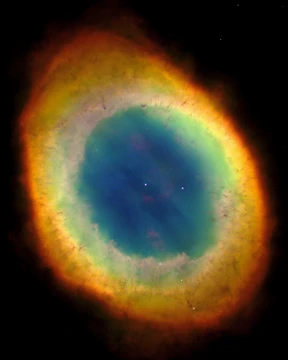
V476 Cygni holds significance as a well-observed nova whose light curve provides insight into dust formation in nova ejecta. The 'dust dip' is a key feature, marking the point where ejected material cools enough for dust grains to condense, temporarily dimming the system. The expanding emission nebula, or shell, around the star resembles a planetary nebula and has been tracked over decades: images from 1944, 1993, and 2018 show it is clearly expanding.
As of 2018, the shell measures 14.6 by 13.4 arc seconds, expanding at rates of 0.073 by 0.067 arc seconds per year, corresponding to physical expansion speeds of 230 by 200 km/s. A 1997 attempt to image the shell with the Hubble Space Telescope was unsuccessful. The system's early transition to a recurrent dwarf nova challenges expectations about the evolution of nova systems, making it a subject of continued interest for binary evolution and accretion physics.
More in Emission, Dark and Reflection Nebulae
Sources
Compiled from Wikipedia and the sources listed below. Text from Wikipedia is available under CC BY-SA 4.0; this entry is adapted from it.
- Wikipedia: V476 Cygni (CC BY-SA 4.0).
- Word definitions: the Codexery glossary, each quoted from its Wikipedia article.
Spotted an error? Know more?
Reader corrections go straight into our review queue. Suggest an edit · How this site is sourced