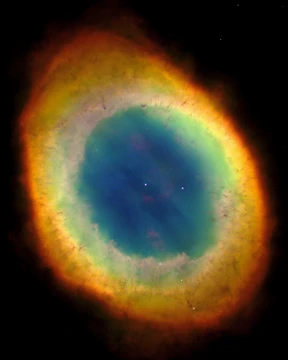
Cotton Candy Nebula
A faint bipolar protoplanetary nebula in Scorpius.
Last updated
The Cotton Candy Nebula, cataloged as IRAS 17150-3224, is a bipolar nebula located in the constellation Scorpius. It belongs to a rare class of objects called protoplanetary nebulae, also known as post-AGB stars. These form when a star leaves the asymptotic giant branch and moves toward the planetary nebula stage, shedding its outer atmosphere while its core contracts into a white dwarf.
This nebula is a classic example of a DUPLEX-type protoplanetary nebula, an acronym for DUst-Prominent Longitudinally-EXtended. The spherical rings encircling the nebula were produced during the asymptotic giant branch phase, the second-to-last stage of a star’s life. Like many protoplanetary nebulae, it was first detected by the IRAS satellite, which launched in January 1983 and mapped roughly 96 percent of the sky.
The Cotton Candy Nebula is challenging to observe because it spans only 16 arcseconds and emits very little light. Astronomy senior editor Michael E. Bakich, who has studied the object, confirmed it is visible through a telescope with a 16-inch aperture. By using the object’s designation, IRAS 17150-3224, and taking advantage of its position where starlight is blocked, astronomers have been able to examine the ring-like structures that, as astronomer Sun Kwok described, "cocoon" the nebula.
Lore & Background
The Cotton Candy Nebula was originally discovered by the IRAS satellite, which launched in January 1983 and surveyed about 96 percent of the sky. The nebula is difficult to spot because it is only 16 arcseconds long and hardly shines. Astronomer Sun Kwok described the ring-like structures that 'cocoon' the nebula.
These spherical ring structures were created throughout the asymptotic giant branch stage, the penultimate stage in stellar evolution. The nebula's position is such that starlight is blocked, allowing examination of these ring structures. Michael E. Bakich, an Astronomy senior editor, has studied the Cotton Candy Nebula and confirmed that it can be seen through a telescope with an aperture of 16 inches.
Reader's Guide
The Cotton Candy Nebula holds significance as a representative example of a DUPLEX-type protoplanetary nebula, a rare and transitional phase in stellar evolution. Its bipolar morphology and the spherical ring structures that cocoon it provide insight into the mass-loss processes occurring during the asymptotic giant branch stage, the penultimate phase before a star becomes a planetary nebula.
The nebula's faintness and small angular size (16 arcseconds) make it a challenging target for amateur astronomers, requiring at least a 16-inch aperture telescope to observe. Its discovery by the IRAS satellite highlights the role of infrared surveys in uncovering objects obscured by dust. The blocking of starlight in its perfect position has allowed astronomers to study the ring-like structures in detail, contributing to the understanding of how stars shed their outer layers as they evolve toward white dwarfs.
More in Emission, Dark and Reflection Nebulae
Sources
Compiled from Wikipedia and the sources listed below. Text from Wikipedia is available under CC BY-SA 4.0; this entry is adapted from it.
- Wikipedia: Cotton Candy Nebula (CC BY-SA 4.0).
- Word definitions: the Codexery glossary, each quoted from its Wikipedia article.
Spotted an error? Know more?
Reader corrections go straight into our review queue. Suggest an edit · How this site is sourced