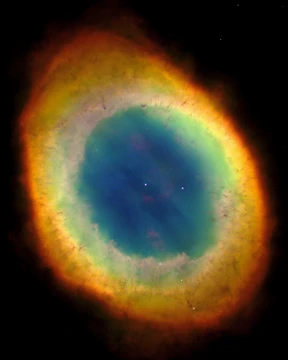
Frosty Leo Nebula
First bipolar protoplanetary nebula with point reflection symmetry.
Last updated
The Frosty Leo Nebula is a protoplanetary nebula about 3,000 light-years away in the constellation Leo. Its central star, also called Frosty Leo, is a K7II spectral type. The nebula is unusual for its location more than 900 parsecs above the galactic plane and for a very deep absorption feature at 3.1 micrometers. It is the only known protoplanetary nebula where crystalline ice dominates the long-wavelength emission, and the only one with point-reflection-symmetric deviations from axial symmetry.
The object was originally designated IRAS 09371+1212 and got its nickname from its extremely unusual far-infrared spectrum, which suggested water was largely depleted from gas by condensing into icy grains, combined with its position in Leo. This interpretation was confirmed by three independent studies in 1988. Observations between 35 and 65 micrometers showed that very cold silicate dust grains, heavily coated with crystalline ice, cause the excess emission at 60 micrometers. The central star's name "Frosty Leo" was officially approved by the IAU Working Group on Star Names on 13 June 2026.
Characteristics
The nebula has two lobes separated by 2 arcseconds, with a nearly edge-on dust ring between them. Two fainter, compact nebular features called ansae lie about 23 arcseconds apart along the polar axis. The overall shape is hourglass-like, with an inclination of 15 degrees relative to the plane of the sky. Its molecular envelope expands at roughly 25 kilometers per second.
Point symmetry
The nebula was first observed in 1983 by the Infrared Astronomical Satellite, which noted its exceptionally cold infrared colors and a uniquely sharp peak at 60 micrometers. It is the first bipolar protoplanetary nebula known to have point reflection symmetry; all others are axially symmetric. Point symmetry is common in planetary nebulae, seen in objects such as NGC 2022, NGC 2371-2, NGC 6309, the Cat's Eye Nebula, NGC 6563, the Dumbbell Nebula, the Saturn Nebula, A24, and Hb5. One hypothesis is that point symmetry arises from a bipolar outflow directed by a precessing disk or a precessing common-envelope binary.
Lore & Background
The Frosty Leo Nebula was first observed in 1983 by the Infrared Astronomical Satellite (IRAS), which noted its exceptionally cold IRAS color temperatures and a uniquely sharp maximum at 60 μm. It was dubbed 'Frosty Leo' because its extremely unusual far infrared spectrum suggested water is largely depleted in its gaseous state by ice condensation into grains, and for its location in Leo. This interpretation was verified in 1988 by three independent papers. Further observations in the band between 35 and 65 μm showed that very cold (<50 K) silicate dust grains, abundantly coated with crystalline ice, are responsible for the 60-μm excess.
The nebula has two lobes separated by 2 arcseconds, between which lies an almost edge-on dust ring. It also has two relatively faint but prominent compact nebulosities (ansae) separated by ~23 arcseconds along the polar axis. The overall shape is hourglass-like, with an inclination angle of 15° relative to the plane of the sky.
Its molecular envelope expands at about 25 km/s. The central star, itself called Frosty Leo, is of optical spectral type K7II and is unusually located more than 900 parsecs above the plane of the galaxy. It has an extremely deep absorption feature at 3.1 μm.
Reader's Guide
The Frosty Leo Nebula holds a unique place in the study of protoplanetary nebulae. It is the first bipolar PPN known to have point reflection symmetry, a trait more common among planetary nebulae such as NGC 2022, NGC 2371-2, NGC 6309, the Cat's Eye Nebula, NGC 6563, the Dumbbell Nebula, the Saturn Nebula, A24, and Hb5. This point symmetry is hypothesized to result either from a bipolar outflow directed by a precessing disc or a precessing common envelope binary.
Additionally, as of 1990, it remains the only known PPN with a circumstellar outflow where crystalline ice dominates the long-wavelength emission spectrum, and the only known PPN with point-reflection-symmetric deviations from axial symmetry. Its central star, officially named Frosty Leo by the IAU Working Group on Star Names on 13 June 2026, is itself remarkable for its high galactic latitude and deep 3.1 μm absorption feature. The nebula's discovery via IRAS and subsequent verification of ice-coated grains have made it a key object for understanding ice chemistry and asymmetric outflows in late stellar evolution.
More in Emission, Dark and Reflection Nebulae
Sources
Compiled from Wikipedia and the sources listed below. Text from Wikipedia is available under CC BY-SA 4.0; this entry is adapted from it.
- Wikipedia: Frosty Leo Nebula (CC BY-SA 4.0).
- Word definitions: the Codexery glossary, each quoted from its Wikipedia article.
Spotted an error? Know more?
Reader corrections go straight into our review queue. Suggest an edit · How this site is sourced