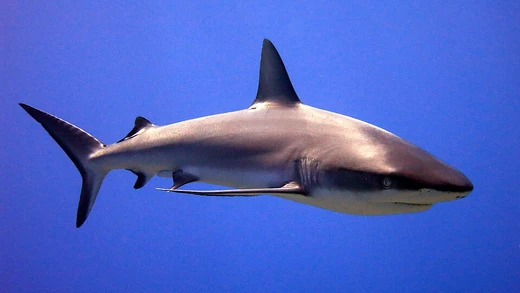
Lemon shark
A social, nocturnal shark with a distinctive yellow hue.
Last updated

USFWS Headquarters · Public domain
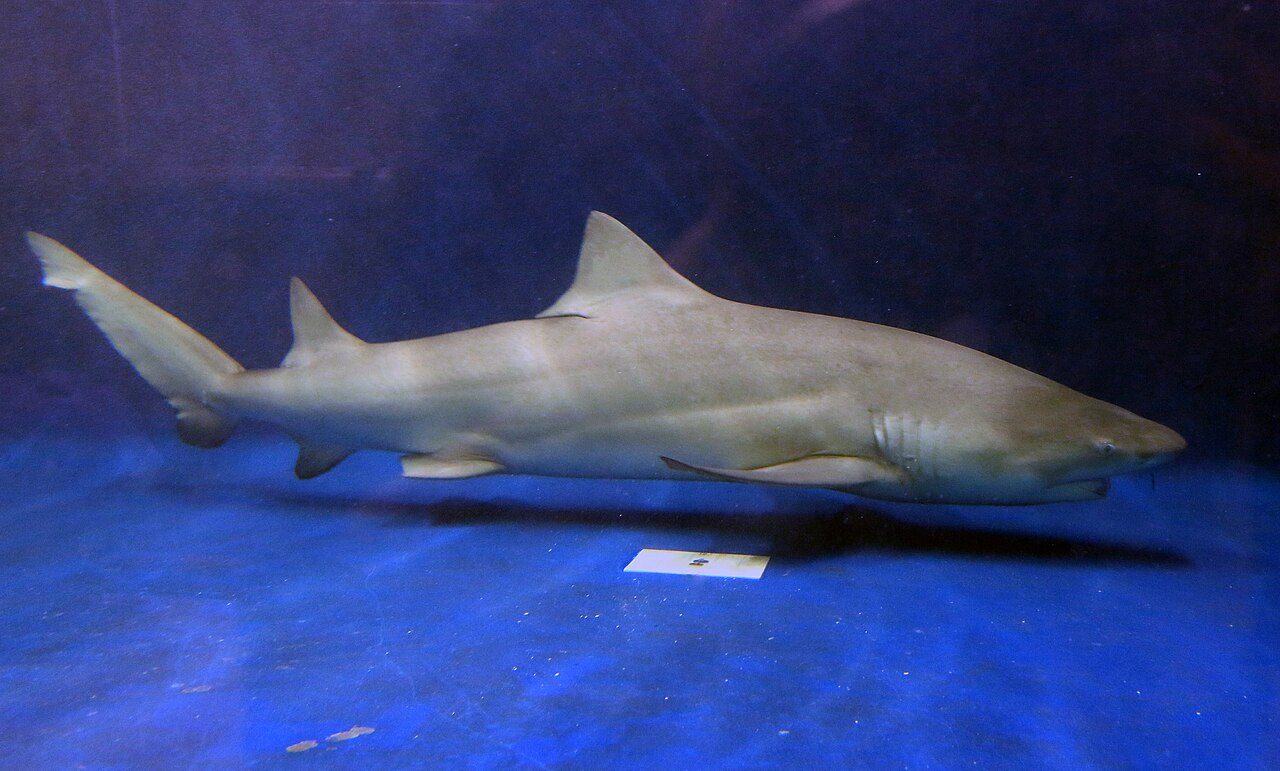
The lemon shark gets its common name from its yellowish skin, and it's part of the requiem shark family.[1] The International Union for the Conservation of Nature says this shark is vulnerable.[2]
Scientific classification
- KingdomAnimalia
- PhylumChordata
- ClassChondrichthyes
- SubclassElasmobranchii
- DivisionSelachii
- OrderCarcharhiniformes
- FamilyCarcharhinidae
- GenusNegaprion
- SpeciesNegaprion brevirostris
Named by (Poey, 1868)
Sources: Wikipedia taxobox: Lemon shark (CC BY-SA 4.0) · order, family and genus agree with WoRMS AphiaID 105800 (CC BY 4.0)
Conservation status
Vulnerable (VU)
- LC
- NT
- VU▲ this species
- EN
- CR
- EW
- EX
Source: IUCN Red List assessment · GBIF copy of the Red List category
How big is it?
Largest length in the source, 3.43 m, next to a 1.8 m person.
Diagram: drawn by Codexery, schematic shapes to scale (not a likeness). Length: Wikipedia: Lemon shark
Where the lemon shark has been recorded
Each dot is a place where the species has been observed and reported (23,292 records, half-degree grid) — not a modelled range. 39 inland records left out (institution coordinates). 2 isolated far-off records not drawn.
Map: drawn by Codexery. Data: GBIF occurrence search (records CC0 / CC BY) · Natural Earth basemap (public domain)
Description
Lemon sharks commonly reach 2.4 to 3.1 m in length as adults, with a maximum recorded length of 3.43 m.[3] Adults weigh up to 90 kg, though the maximum recorded weight is 183.7 kg.[3] Their yellow coloring helps them blend in when swimming over sandy seafloors.[4] Their heads contain special electroreceptors, called ampullae of Lorenzini, that pick up electrical pulses from prey.[5]
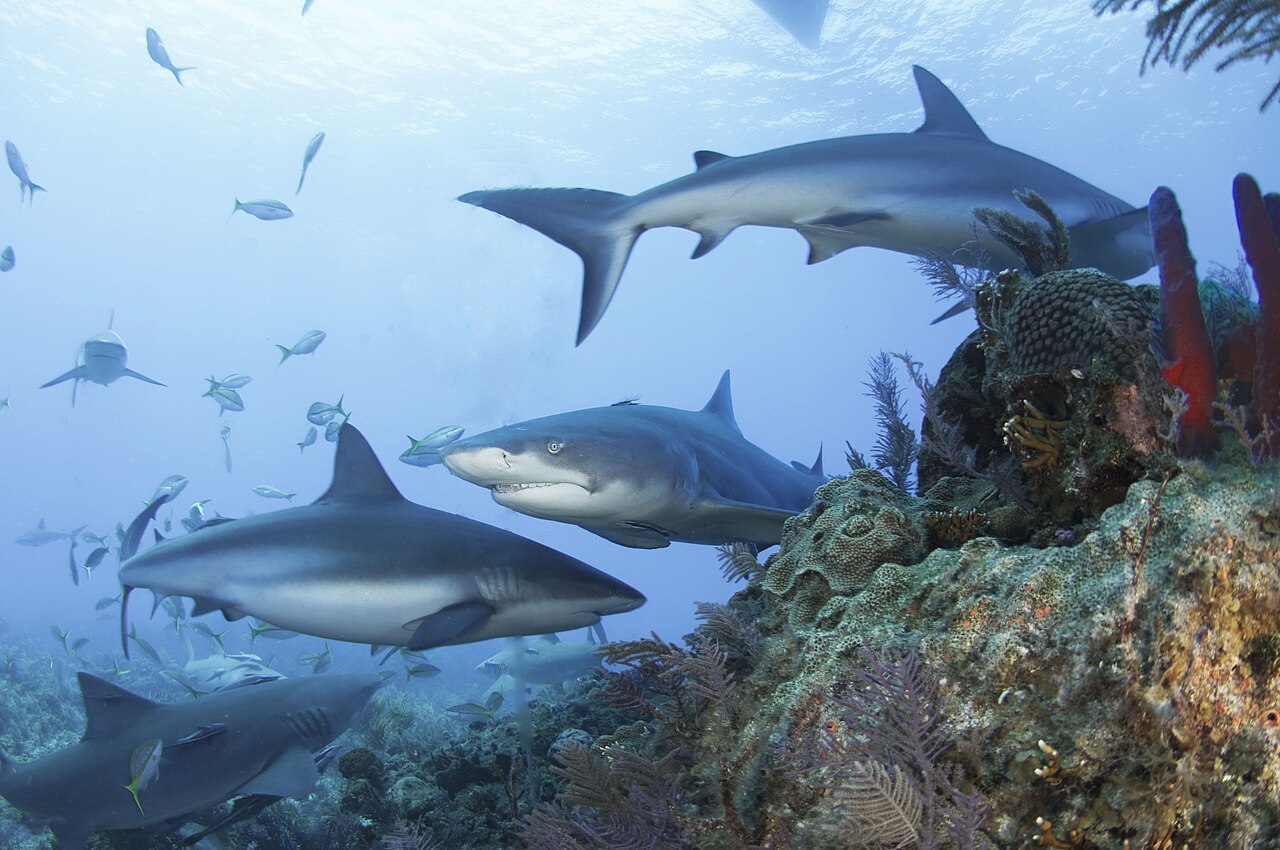
Lemon sharks look a lot like bull sharks, but you can tell them apart because their two dorsal fins are about the same size.[6]
Biology and ecology
Larger lemon sharks sometimes prey on smaller ones.[7] A lemon shark approaches its prey quickly, brakes with its pectoral fins, and then jabs forward to grasp it.[8] Groups of sharks may form a feeding frenzy when they sense blood or hear struggling prey.[9] Relative to their body size, their brain is about as big as a mammal's or a bird's.[10]
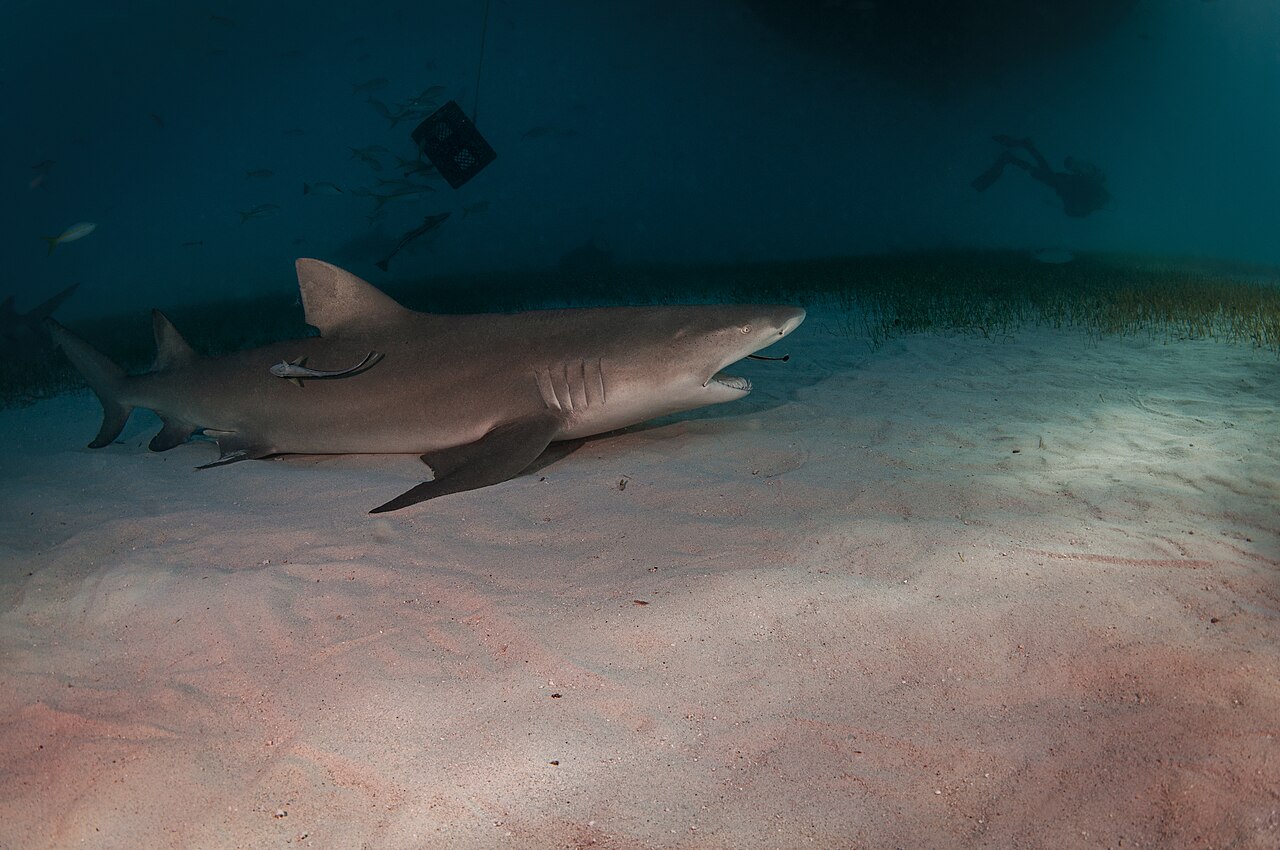
Females give birth to live pups after internal fertilization.[11] The typical lifespan is 25 to 30 years.[12] Fish make up the bulk of their diet, but they'll also snack on crustaceans and other bottom-dwelling creatures.[7] Lemon sharks do most of their hunting after dark, using special electroreceptors to track down fish.[12][5]
When food is plentiful, these sharks get picky and show a clear preference for certain types and sizes of prey.[13] Lemon sharks are social animals that hang out in groups or loose gatherings.[14] These groups form based on similar size, though sharks under one year old don't show any size preference.[15] Living in a group gives them perks like better communication, easier courtship, and extra protection.[16]
But there are downsides too, like a higher chance of catching diseases and having to compete for food.[16] Female lemon sharks mate with multiple males and can hold onto sperm for several months.[17] Females follow a two-year breeding cycle: one year for pregnancy and another for making eggs.[18] It takes lemon sharks about 12 to 16 years to reach sexual maturity.[18]
The biggest litter ever recorded for a lemon shark had 18 pups.[18]
Distribution and habitat
You can find them near Sal Island in Cape Verde.[19] They live in shallow subtropical waters around coral reefs, mangroves, enclosed bays, and river mouths.[20] They've also been spotted in the open ocean, as deep as 92 meters.[20] They stick to continental and island shelves for most of their lives, only heading into open water during migrations.[21]
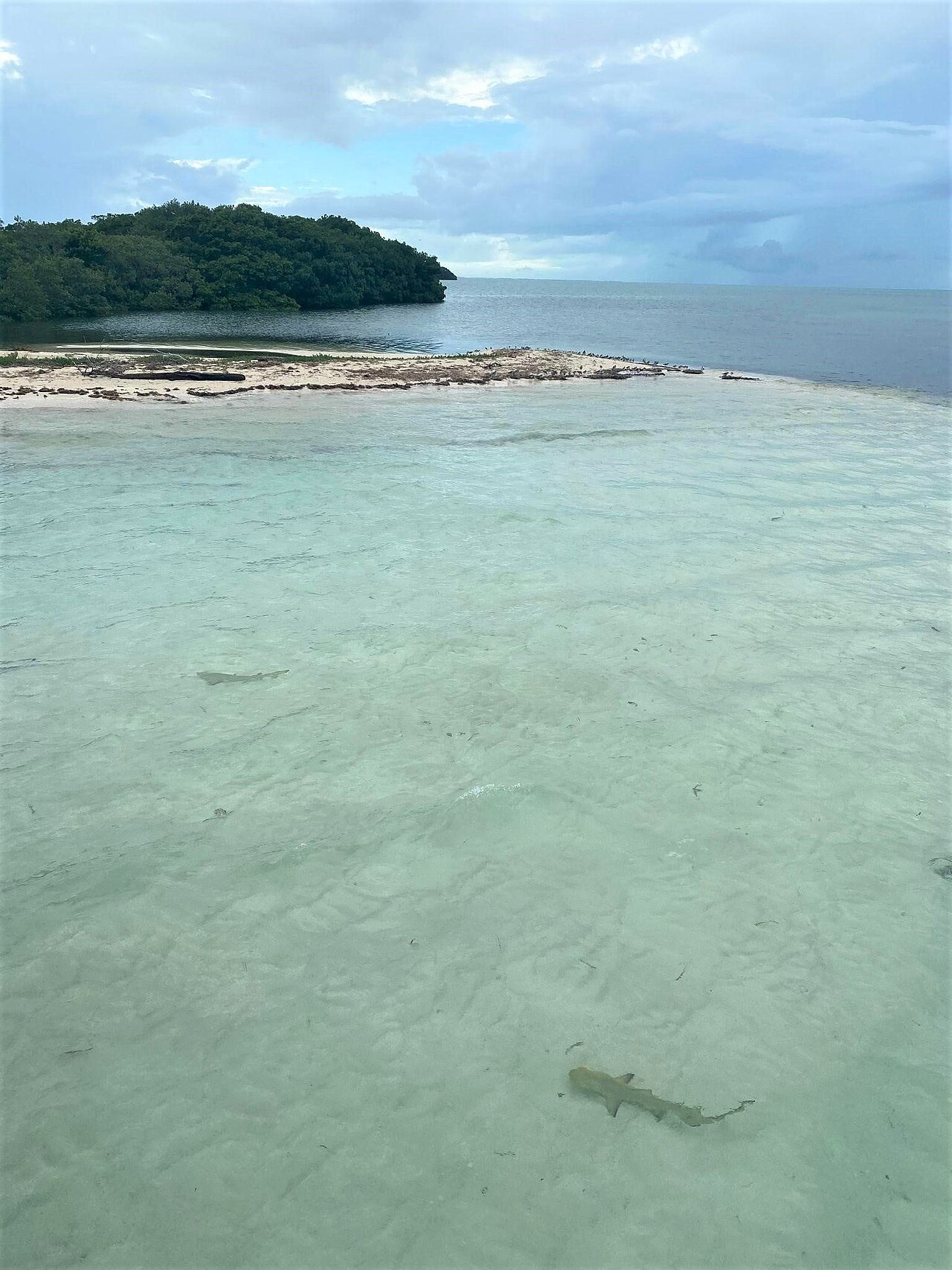
Mangrove areas act as nurseries, and that's where you'll usually find young lemon sharks.[22][23] These mangroves likely offer plenty of food and shelter from bigger sharks.[22] As lemon sharks grow, they shift to deeper waters.[24] Warm water helps keep their metabolism running smoothly.[24]
Human interactions
Commercial and recreational fishers both target lemon sharks for their meat, fins, and skin.[25] Their biggest threat is overfishing, which has cut their numbers by 50% to 79% over the last fifty years.[25]
Taxonomy and phylogeny
Felipe Poey first named and described the lemon shark in 1868, calling it Hypoprion brevirostris.[26] He later moved it to the genus Negaprion, giving it the scientific name Negaprion brevirostris, which is still its name today.[26] The oldest known lemon shark fossils date back to the Early Miocene and have turned up in Odisha, India, as well as in Peru and Cuba.[27] From the Middle Miocene onward, their fossils become more common across the Americas and western Africa.[27]
References
- Wikipedia, "Lemon shark" (CC BY-SA 4.0), which cites: Jessop, "Lemon Shark (Negaprion brevirostris)", ANGARI Foundation, 2024-03-01 (original not read by us) en.wikipedia.org
- Wikipedia, "Lemon shark" (CC BY-SA 4.0), which cites: Nam, "Mercury and selenium levels in lemon sharks (Negaprion brevirostris) in relation to a harmful red tide event", Environmental Monitoring and Assessment, 2011, p. 549–559 (original not read by us) en.wikipedia.org
- Wikipedia, "Lemon shark" (CC BY-SA 4.0), which cites: "FLMNH Ichthyology Department: Lemon Shark", flmnh.ufl.edu; "Negaprion brevirostris, Lemon shark", FishBase (original not read by us) en.wikipedia.org
- Wikipedia, "Lemon shark" (CC BY-SA 4.0), which cites: Carwardine, "The Shark Watcher's Handbook", BBC Worldwide Ltd., 2002 (original not read by us) en.wikipedia.org
- Wikipedia, "Lemon shark" (CC BY-SA 4.0), which cites: "Evaluation of a Three-Dimensional Magnetic Barrier on Juvenile Negaprion brevirostris"; "Evaluation of a Three-Dimensional Magnetic Barrier on Juvenile Negaprion brevirostris" (original not read by us) en.wikipedia.org
- Wikipedia, "Lemon shark" (CC BY-SA 4.0), which cites: "Lemon Shark", Florida Fish And Wildlife Conservation Commission (original not read by us) en.wikipedia.org
- Wikipedia, "Lemon shark" (CC BY-SA 4.0), which cites: Bright, "The private life of sharks: the truth behind the myth", Stackpole Books, 2000; Guttridge, "Deep danger: intra-specific predation risk influences habitat use and aggregation formation of juvenile lemon sharks Negaprion brevirostris", Marine Ecology Progress Series, 2012-01-20, p. 279–291 (we also read that source) en.wikipedia.org
- Wikipedia, "Lemon shark" (CC BY-SA 4.0), which cites: Bright, "The private life of sharks: the truth behind the myth", Stackpole Books, 2000 (we also read that source) en.wikipedia.org
- Wikipedia, "Lemon shark" (CC BY-SA 4.0), which cites: Bright, "The private life of sharks: the truth behind the myth", Stackpole Books, 2000; Banner, "Use of Sound in Predation by Young Lemon Sharks, Negaprion brevirostris (Poey)", Bulletin of Marine Science, February 2020 (we also read that source) en.wikipedia.org
- Wikipedia, "Lemon shark" (CC BY-SA 4.0), which cites: Jacoby, "Social behaviour in sharks and rays: analysis, patterns and implications for conservation", Fish and Fisheries, 2012-12-01, p. 399–417; Guttridge, "Social preferences of juvenile lemon sharks, Negaprion brevirostris", Animal Behaviour, August 2009, p. 543–548 (we also read that source) en.wikipedia.org
- Wikipedia, "Lemon shark" (CC BY-SA 4.0), which cites: "BBC Nature"; Feldheim, "The breeding biology of lemon sharks at a tropical nursery lagoon", Proceedings of the Royal Society B: Biological Sciences, 2002-08-22, p. 1655–1661; Feldheim, "The breeding biology of lemon sharks at a tropical nursery lagoon", Proceedings of the Royal Society B: Biological Sciences, 2002-08-22, p. 1655–1661 (we also read that source) en.wikipedia.org
- Wikipedia, "Lemon shark" (CC BY-SA 4.0), which cites: "Lemon Shark", gwinnett.k12.ga.us (we also read that source) en.wikipedia.org
- Wikipedia, "Lemon shark" (CC BY-SA 4.0), which cites: Newman, "Diet and prey preference of juvenile lemon sharks Negaprion brevirostris", Marine Ecology Progress Series, 2010-01-05, p. 221–234 (original not read by us) en.wikipedia.org
- Wikipedia, "Lemon shark" (CC BY-SA 4.0), which cites: Guttridge, "Social preferences of juvenile lemon sharks, Negaprion brevirostris", Animal Behaviour, August 2009, p. 543–548 (we also read that source) en.wikipedia.org
- Wikipedia, "Lemon shark" (CC BY-SA 4.0), which cites: Jacoby, "Social behaviour in sharks and rays: analysis, patterns and implications for conservation", Fish and Fisheries, 2012-12-01, p. 399–417; Guttridge, "Social preferences of juvenile lemon sharks, Negaprion brevirostris", Animal Behaviour, August 2009, p. 543–548; Guttridge, "Social preferences of juvenile lemon sharks, Negaprion brevirostris", Animal Behaviour, August 2009, p. 543–548; Jacoby, "Social behaviour in sharks and rays: analysis, patterns and implications for conservation", Fish and Fisheries, 2012-12-01, p. 399–417 (we als en.wikipedia.org
- Wikipedia, "Lemon shark" (CC BY-SA 4.0), which cites: Guttridge, "Social preferences of juvenile lemon sharks, Negaprion brevirostris", Animal Behaviour, August 2009, p. 543–548; "Lemon Shark", Oceana; Alexander, "The Evolution of Social Behavior", Annual Review of Ecology and Systematics, November 1974, p. 325–383 (we also read that source) en.wikipedia.org
- Wikipedia, "Lemon shark" (CC BY-SA 4.0), which cites: Feldheim, "The breeding biology of lemon sharks at a tropical nursery lagoon", Proceedings of the Royal Society B: Biological Sciences, 2002-08-22, p. 1655–1661; Dibattista, "Are indirect genetic benefits associated with polyandry? Testing predictions in a natural population of lemon sharks", Molecular Ecology, 2008-01-09, p. 783–795; Dibattista, "Are indirect genetic benefits associated with polyandry? Testing predictions in a natural population of lemon sharks", Molecular Ecology, 2008-01-09, p. 783–795 (we also read that source) en.wikipedia.org
- Wikipedia, "Lemon shark" (CC BY-SA 4.0), which cites: "Lemon Shark Negaprion brevirostris Shark Database", www.sharkwater.com, 2018-07-31; Feldheim, "The breeding biology of lemon sharks at a tropical nursery lagoon", Proceedings of the Royal Society B: Biological Sciences, 2002-08-22, p. 1655–1661 (we also read that source) en.wikipedia.org
- Wikipedia, "Lemon shark" (CC BY-SA 4.0), which cites: "Lemon shark", arkive.org; "Lemon shark", arkive.org (we also read that source) en.wikipedia.org
- Wikipedia, "Lemon shark" (CC BY-SA 4.0), which cites: "Lemon Sharks, Negaprion brevirostris", Marinebio (original not read by us) en.wikipedia.org
- Wikipedia, "Lemon shark" (CC BY-SA 4.0), which cites: Carlson, J., "Negaprion brevirostris", 2021 (we also read that source) en.wikipedia.org
- Wikipedia, "Lemon shark" (CC BY-SA 4.0), which cites: Ruiz-Abierno, "Distribution and length composition of lemon sharks (Negaprion brevirostris) in a nursery ground in southern Cuba", Environmental Biology of Fishes, 2020-12-01, p. 1583–1594; Wetherbee, "Movement patterns of juvenile lemon sharks Negaprion brevirostris within Atol das Rocas, Brazil: a nursery characterized by tidal extremes", Marine Ecology Progress Series, 2007-08-07, p. 283–293 (original not read by us) en.wikipedia.org
- Wikipedia, "Lemon shark" (CC BY-SA 4.0), which cites: Franks, "The Spatial Ecology and Resource Selection of Juvenile Lemon Sharks (Negaprion brevirostris) in their Primary Nursery Areas", Drexel University, October 2007 (original not read by us) en.wikipedia.org
- Wikipedia, "Lemon shark" (CC BY-SA 4.0), which cites: Guttridge, "Deep danger: intra-specific predation risk influences habitat use and aggregation formation of juvenile lemon sharks Negaprion brevirostris", Marine Ecology Progress Series, 2012-01-20, p. 279–291 (we also read that source) en.wikipedia.org
- Wikipedia, "Lemon shark" (CC BY-SA 4.0), which cites: Carlson, J., "Negaprion brevirostris", 2021; "Florida Museum of Natural History"; Carwardine, "The Shark Watcher's Handbook", BBC Worldwide Ltd., 2002; "Lemon shark", Save Our Seas Foundation (we also read that source) en.wikipedia.org
- Wikipedia, "Lemon shark" (CC BY-SA 4.0), which cites: "Florida Museum of Natural History"; "Florida Museum of Natural History" (we also read that source) en.wikipedia.org
- Wikipedia, "Lemon shark" (CC BY-SA 4.0), which cites: Höltke, "A Review of the Paleobiology of Some Neogene Sharks and the Fossil Records of Extant Shark Species", Diversity, 2024-02-26, p. 147 (original not read by us) en.wikipedia.org
Each numbered sentence above was checked against the source it cites before publication. Sentences citing Wikipedia adapt text from the English Wikipedia article Lemon shark (contributors), used under CC BY-SA 4.0; this entry is available under the same licence. Other sources were used for facts only; no text or images are copied from them.
More in Reef sharks
Elsewhere in Sharks
Test yourself
Three questions drawn from this entry’s sources. Pick an answer to check it.
Answers checked against the source article
Sources
Compiled from Wikipedia and the sources listed below. Text from Wikipedia is available under CC BY-SA 4.0; this entry is adapted from it.
- Wikipedia: Lemon shark (CC BY-SA 4.0).
- Classification: the source article's taxobox; order, family and genus checked against WoRMS, the World Register of Marine Species (CC BY 4.0).
- Conservation status: IUCN Red List assessment.
- Occurrence records: GBIF (CC0 / CC BY). Basemap: Natural Earth (public domain).
- Word definitions: the Codexery glossary, each quoted from its Wikipedia article.
Spotted an error? Know more?
Reader corrections go straight into our review queue. Suggest an edit · How this site is sourced