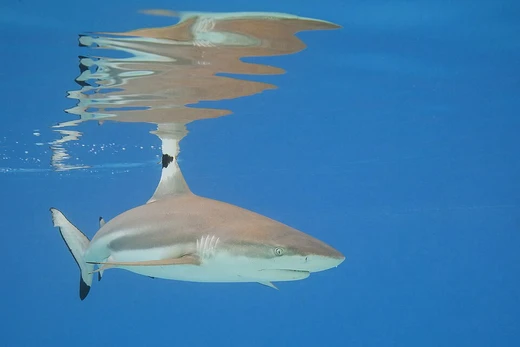
Whitecheek shark
A slender requiem shark with a black-tipped second dorsal fin.

The whitecheek shark (Carcharhinus dussumieri), also known as the widemouth blackspot shark, is a requiem shark of the family Carcharhinidae found in the Indo-West Pacific Ocean. It is notable for its slender body, distinctive black patch on the second dorsal fin, and its near-threatened conservation status due to fishing pressure.
Quick Facts
- Genus
- Carcharhinus
- Species
- dussumieri
Facts from the source article.
Lore & Background
The whitecheek shark grows to a length around 100 cm (39 in) and has a slender body with a long head and rounded snout. Its eyes are oval, and both jaws contain multiple rows of backward-pointing, serrated teeth. The pectoral fins are long, narrow, and curved with pointed tips, while the first dorsal fin is triangular and moderately sized; the second dorsal fin is much smaller and bears a large black patch at its apex. Its dorsal surface is grey or brownish-grey, and its ventral surface is pale.
It is native to the Indo-Pacific Ocean, found on continental shelves and inshore slopes around islands down to about 170 m (560 ft), ranging from the Arabian Sea and Persian Gulf to Java, Indonesia, Japan, and Australia. The species is common but not well known, and it is sometimes confused with the blackspot shark (Carcharhinus sealei). Both males and females mature at about 70 cm (28 in) long. Females are viviparous, breeding throughout the year, and normally carry one to four pups (usually two) that feed from a yolk sac; pups are about 38 cm (15 in) at birth.
The specific name honours the French explorer and trader Jean-Jacques Dussumier (1792–1883).
Reader's Guide
The whitecheek shark is listed as near threatened on the IUCN Red List because it is often caught in shallow-water fisheries by rod and line, gillnetting, and trawling. Its population trend appears to be decreasing, and it faces local extinction in some parts of its range. It is usually taken as bycatch rather than as a target species; in Australian waters, it makes up around 2–3% of the total biomass caught. The shark is not harmful to humans, and its flesh is marketed for human consumption. The species feeds mainly on fish, but also eats octopus, squid, and various crustaceans including crabs, and sometimes picks off molluscs and worms from the seabed. Despite being common, it remains poorly understood and is frequently misidentified with the similar blackspot shark.
Did You Know?
- The whitecheek shark can reach a length of 1 m (39 in).
- It is viviparous, with females giving birth to up to four live young.
- The second dorsal fin bears a large black patch at its apex.
Freshwater Mastery and Osmoregulatory Evolution
The bull shark stands apart among requiem sharks for its remarkable ability to osmoregulate in both saline and freshwater environments, a trait its closest relatives—such as the sandbar shark within the same genus—simply lack. This euryhaline capacity allows the species to venture extraordinarily far from the ocean: documented records place individuals as far as Alton, Illinois, roughly 1,100 kilometres upstream along the Mississippi, and an astonishing 4,000 kilometres up the Amazon to Iquitos. Populations also persist in Lake Nicaragua, the Ganges and Brahmaputra systems of eastern India, and even the Tigris River near Baghdad. Despite this freshwater presence, the bull shark is not a true freshwater species in the way the river sharks of genus Glyphis are. Genetic and taxonomic analysis places the two lineages in entirely different branches of the Carcharhinidae family, indicating that their similar freshwater physiologies arose through convergent evolution rather than shared ancestry. Remarkably, despite this extensive freshwater range, very few incidents of human interaction have been recorded in riverine or lacustrine settings.
Built for Power — Anatomy and Bite Force
Bull sharks are unmistakably robust, wider and heavier than any other requiem shark of comparable length. Sexual dimorphism is pronounced: adult females average 2.4 metres and 130 kilograms, while males come in slightly smaller at roughly 2.25 metres and 95 kilograms. Although a maximum length of 3.5 metres is commonly cited, a single verified female specimen measured exactly 4.0 metres, and a pregnant individual of 3.25 metres was recorded at 450 kilograms. Extrapolating from that data, a full-size 4-metre gravid female could exceed 600 kilograms, placing the species among the heaviest requiem sharks known. At birth, pups can already reach 81 centimetres. The body plan is distinctive—broad and flat-snouted, grey dorsally and white ventrally, with a second dorsal fin noticeably smaller than the first, a caudal fin that is longer and lower than those of larger sharks, and no interdorsal ridge. Perhaps most striking is the bite: up to 5,914 newtons, the highest force-to-weight ratio measured across all cartilaginous fishes studied to date.
A Truly Cosmopolitan Predator
The bull shark's range spans virtually every warm coastal ocean on Earth. Along the Atlantic it stretches from Massachusetts down to southern Brazil and from Morocco to Angola; in the Pacific, its footprint runs from Baja California to Ecuador. The species tolerates depths to 150 metres but rarely ventures past 30 metres, favouring shallow, warm, brackish, and freshwater systems including estuaries and the lower reaches of rivers. In Australia, more than 500 individuals are thought to inhabit the Brisbane River, with even greater numbers in Gold Coast canals, and the sharks are regular visitors to Sydney Harbour during warmer months. During the 2010–11 Queensland floods, several were sighted swimming through the flooded streets of Goodna. After Hurricane Katrina, large numbers appeared in Lake Pontchartrain, and by 2023 fishermen on the Atchafalaya River reported rising sightings. In South Africa, the species thrives in the high-salinity St. Lucia Estuary, and unconfirmed reports suggest it may also inhabit Cahora Bassa lake upstream of the Zambezi. A clear preference for warm currents ties these scattered populations together.
Vulnerability, Aggression, and the Human Cost
The bull shark's well-documented aggressive and unpredictable temperament has made it a persistent concern for coastal communities. Larger individuals are implicated in a significant share of nearshore shark attacks, and because the species is so widespread, many incidents involving an unidentified shark may in fact involve a bull shark. This reputation has driven ongoing culling programmes near popular beaches, an effort that—combined with other pressures—is cited as one of the key drivers behind the species' continued population decline. The IUCN Red List currently classifies the bull shark as vulnerable. Yet the human footprint extends beyond direct conflict: the species has become a cultural icon, appearing on the image of Costa Rica's 2000-colón banknote. Notable captures in recent years underscore the animal's sheer size—a 3-metre, 347.8-kilogram pregnant female was hauled from the Arabian Sea off Fujairah in 2019, and a comparable specimen followed in 2020. Unconfirmed reports even suggest the very largest specimens might approach 900 kilograms, though no verified record supports that figure.
Frequently Asked Questions
Who is Whitecheek shark?
The whitecheek shark (Carcharhinus dussumieri), sometimes called the widemouth blackspot shark, is a small requiem shark native to the Indo-West Pacific. You'll spot it by its slim, streamlined body and a distinctive dark blotch sitting on the second dorsal fin.
What are Whitecheek shark's powers/role?
It's a nimble mid-water predator that chases down fish, cephalopods, and crustaceans, operating at depths of up to roughly 170 meters. As a viviparous shark, it carries its young internally and delivers up to four live pups, each about 38 cm long at birth.
Why is Whitecheek shark important?
As a mid-level predator in coastal and reef-adjacent waters, it helps keep populations of smaller fish and invertebrates in check. Its slender build lets it exploit a foraging niche that larger, bulkier requiem sharks simply can't match.
How big does Whitecheek shark get?
Adults max out at around one meter (about 39 inches) in total length, making it one of the smaller carcharhinids. Females hit sexual maturity at roughly 70 cm, so they're still quite modest when they first reproduce.
More in Reef Sharks and Rays, Part 2 1-24
Spotted an error? Know more?
Reader corrections go straight into our review queue. Suggest an edit · How this site is sourced