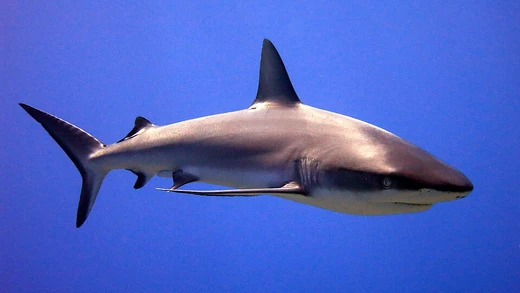
Milk shark
A requiem shark named for a belief in lactation benefits.
Last updated

Karunakar Rayker from India · via Wikipedia: Milk shark · CC BY 2.0
This shark is one of the most abundant near-shore sharks in its range, and it gets its common name from a belief in India that eating its meat helps with milk production.[1][2] German naturalist Eduard Rüppell first described the milk shark scientifically, calling it Carcharias acutus, in his 1837 book Fische des Rothen Meeres.[3]
Scientific classification
- KingdomAnimalia
- PhylumChordata
- ClassChondrichthyes
- SubclassElasmobranchii
- DivisionSelachii
- OrderCarcharhiniformes
- FamilyCarcharhinidae
- GenusRhizoprionodon
- SpeciesRhizoprionodon acutus
Named by (Rüppell, 1837)
Close relatives
Other species of Rhizoprionodon with a Codexery entry.
- Atlantic sharpnose shark Rhizoprionodon terraenovae
- Brazilian sharpnose shark Rhizoprionodon lalandii
- Pacific sharpnose shark Rhizoprionodon longurio
Sources: Wikipedia taxobox: Milk shark (CC BY-SA 4.0) · order, family and genus agree with WoRMS AphiaID 105802 (CC BY 4.0)
Conservation status
Vulnerable (VU)
- LC
- NT
- VU▲ this species
- EN
- CR
- EW
- EX
Source: IUCN Red List assessment · GBIF copy of the Red List category
How big is it?
Largest length in the source, 1.78 m, next to a 1.8 m person.
Diagram: drawn by Codexery, schematic shapes to scale (not a likeness). Length: Wikipedia: Milk shark
Where the milk shark has been recorded
Each dot is a place where the species has been observed and reported (3,646 records, half-degree grid) — not a modelled range. 60 inland records left out (institution coordinates).
Map: drawn by Codexery. Data: GBIF occurrence search (records CC0 / CC BY) · Natural Earth basemap (public domain) · place coordinates: Wikipedia (CC BY-SA 4.0)
Description
Behind the corner of the jaw on each side of the head, you'll usually find between seven and fifteen larger-than-normal pores.[4] Its nostrils are tiny, and the triangular flaps of skin next to them are also tiny.[4] The teeth on top are finely jagged and lean strongly to the side, while the bottom teeth look similar but have smaller jagged edges and tips that curve gently upward. Young sharks have teeth with smooth edges.[4] There's no ridge running between the two dorsal fins.[5]
Biology and ecology
The milk shark feeds mainly on small fish that live near the seafloor, plus other bony fishes.[1] Like other requiem sharks, the milk shark is viviparous, meaning the young develop inside the mother.[6] Pregnant females use inshore nursery areas to give birth, taking advantage of warmer waters and abundant food.[7] In Shark Bay, its main meals are silversides, herring, smelt-whitings, and wrasses, and it's the only shark species there that hunts the Waigeo seaperch.[1]
Lots of predators hunt the milk shark, including bigger sharks like the blacktip shark and the Australian blacktip shark, and possibly also marine mammals.[8] Females usually have just one working ovary on the left side and two working uteruses that are divided into separate compartments for each baby.[6] In waters off Oman, litters have more than twice as many females as males on average, and it's not unusual to find litters with only females.[9] Females carry their young for about a year, and the pregnancy happens in three stages.[9]
Known nursery areas where pregnant females give birth include the Banc d'Arguin National Park off Mauritania, and Cleveland Bay and Herald Bight off Australia.[7] When they grow up, the sharks leave these coastal bays.[10] Males and females reach maturity at different sizes depending on where they live: off West Africa, males mature at 84 to 95 cm and females at 89 to 100 cm; off southern Africa, males at 68 to 72 cm and females at 70 to 80 cm; and off Oman, males at 63 to 71 cm and females at 62 to 74 cm.[11]
Human interactions
Because there are so many of them, they're an important part of small-scale and commercial fisheries all across their range.[12] This shark's reproductive habits suggest it can handle a fair amount of fishing pressure, though not as much as the grey sharpnose shark or the Australian sharpnose shark.[13]
Taxonomy and phylogeny
The specific epithet acutus means "sharp" in Latin.[3] Scientists have placed it in several different genera over time, including Carcharhinus and Scoliodon, before finally putting it in the genus Rhizoprionodon by merging it with the species that defines that genus, R. crenidens.[3]
References
- Wikipedia, "Milk shark" (CC BY-SA 4.0), which cites: Compagno, L.J.V., "Sharks of the World: An Annotated and Illustrated Catalogue of Shark Species Known to Date", Food and Agricultural Organization, 1984, p. 525–526 (we also read that source) en.wikipedia.org
- Wikipedia, "Milk shark" (CC BY-SA 4.0), which cites: Van der Elst, R., "A Guide to the Common Sea Fishes of Southern Africa", Struik, 1993, p. 46; ; Naylor, G.J.P., "The phylogenetic relationships among requiem and hammerhead sharks: inferring phylogeny when thousands of equally most parsimonious trees result", Cladistics, 1992, p. 295–318; Carrier, J.C., "Biology of Sharks and Their Relatives", CRC Press, 2004, p. 52–53 (we also read that source) en.wikipedia.org
- Wikipedia, "Milk shark" (CC BY-SA 4.0), which cites: Compagno, L.J.V., "Sharks of the World: An Annotated and Illustrated Catalogue of Shark Species Known to Date", Food and Agricultural Organization, 1984, p. 525–526; Van der Elst, R., "A Guide to the Common Sea Fishes of Southern Africa", Struik, 1993, p. 46; Compagno, L.J.V., "Sharks of the World: An Annotated and Illustrated Catalogue of Shark Species Known to Date", Food and Agricultural Organization, 1984, p. 525–526 (we also read that source) en.wikipedia.org
- Wikipedia, "Milk shark" (CC BY-SA 4.0), which cites: Compagno, L.J.V., "Sharks of the World: An Annotated and Illustrated Catalogue of Shark Species Known to Date", Food and Agricultural Organization, 1984, p. 525–526; "Coastal Fishes of Oman", University of Hawaii Press, 1995, p. 36; Bester, C. Biological Profiles: Milk Shark. Florida Museum of Natural History Ichthyology Department. Retrieved on September 10, 2009. (we also read that source) en.wikipedia.org
- Wikipedia, "Milk shark" (CC BY-SA 4.0), which cites: Compagno, L.J.V., "Sharks of the World: An Annotated and Illustrated Catalogue of Shark Species Known to Date", Food and Agricultural Organization, 1984, p. 525–526; "Coastal Fishes of Oman", University of Hawaii Press, 1995, p. 36 (we also read that source) en.wikipedia.org
- Wikipedia, "Milk shark" (CC BY-SA 4.0), which cites: Capape, C., "Reproduction in the milk shark, Rhizoprionodon acutus (Ruppell, 1837) (Chondrichthyes: Carcharhinidae), from the coast of Senegal (eastern tropical Atlantic)", Acta Adriatica, 2006, p. 111–126 (original not read by us) en.wikipedia.org
- Wikipedia, "Milk shark" (CC BY-SA 4.0), which cites: Capape, C., "Reproduction in the milk shark, Rhizoprionodon acutus (Ruppell, 1837) (Chondrichthyes: Carcharhinidae), from the coast of Senegal (eastern tropical Atlantic)", Acta Adriatica, 2006, p. 111–126; Setna, S.B., "Breeding habits on Bombay elasmobranchs", Records of the Indian Museum, 1949, p. 107–124; Valadou, B., "Biological and ecological data of five elasmobranch species from the waters of the Banc d'Arguin National Park (Mauritania)", Cybium, December 31, 2006, p. 313–322; "Utilisation of a tropical bay as a nur en.wikipedia.org
- Wikipedia, "Milk shark" (CC BY-SA 4.0), which cites: Bester, C. Biological Profiles: Milk Shark. Florida Museum of Natural History Ichthyology Department. Retrieved on September 10, 2009.; "Coastal Fishes of Southern Africa", NISC and SAIAB, 2004, p. 62; "Pseudopandarus australis, a new species of pandarid copepod from Australian sharks", Proceedings of the Biological Society of Washington, 1988, p. 340–345; Capape, C., "Reproduction in the milk shark, Rhizoprionodon acutus (Ruppell, 1837) (Chondrichthyes: Carcharhinidae), from the coast of Senegal (eastern tropical Atlantic)", Acta Adri en.wikipedia.org
- Wikipedia, "Milk shark" (CC BY-SA 4.0), which cites: Compagno, L.J.V., "Sharks of the World: An Annotated and Illustrated Catalogue of Shark Species Known to Date", Food and Agricultural Organization, 1984, p. 525–526; Valadou, B., "Biological and ecological data of five elasmobranch species from the waters of the Banc d'Arguin National Park (Mauritania)", Cybium, December 31, 2006, p. 313–322; Henderson, A.C., "Reproductive biology of the milk shark Rhizoprionodon acutus and the bigeye houndshark Iago omanensis in the coastal waters of Oman", Journal of Fish Biology, June 2006, p. en.wikipedia.org
- Wikipedia, "Milk shark" (CC BY-SA 4.0), which cites: "Habitat partitioning among four elasmobranch species in nearshore, shallow waters of a subtropical embayment in Western Australia", Marine Biology, October 2004, p. 1023–1032 (we also read that source) en.wikipedia.org
- Wikipedia, "Milk shark" (CC BY-SA 4.0), which cites: Capape, C., "Reproduction in the milk shark, Rhizoprionodon acutus (Ruppell, 1837) (Chondrichthyes: Carcharhinidae), from the coast of Senegal (eastern tropical Atlantic)", Acta Adriatica, 2006, p. 111–126; Bass, A.J., "Sharks of the east coast of southern Africa. III. The families Carcharhinidae (excluding Mustelus and Carcharhinus) and Sphyrnidae", Investigative Report of the Oceanographic Research Institute of South Afri (original not read by us) en.wikipedia.org
- Wikipedia, "Milk shark" (CC BY-SA 4.0), which cites: Bester, C. Biological Profiles: Milk Shark. Florida Museum of Natural History Ichthyology Department. Retrieved on September 10, 2009.; Rigby, C.L., "Rhizoprionodon acutus", 2020; Bester, C. Biological Profiles: Milk Shark. Florida Museum of Natural History Ichthyology Department. Retrieved on September 10, 2009. (we also read that source) en.wikipedia.org
- Wikipedia, "Milk shark" (CC BY-SA 4.0), which cites: Rigby, C.L., "Rhizoprionodon acutus", 2020 (we also read that source) en.wikipedia.org
Each numbered sentence above was checked against the source it cites before publication. Sentences citing Wikipedia adapt text from the English Wikipedia article Milk shark (contributors), used under CC BY-SA 4.0; this entry is available under the same licence. Other sources were used for facts only; no text or images are copied from them.
More in Reef sharks
Elsewhere in Sharks
Test yourself
Three questions drawn from this entry’s sources. Pick an answer to check it.
Answers checked against the source article
Sources
Compiled from Wikipedia and the sources listed below. Text from Wikipedia is available under CC BY-SA 4.0; this entry is adapted from it.
- Wikipedia: Milk shark (CC BY-SA 4.0).
- Classification: the source article's taxobox; order, family and genus checked against WoRMS, the World Register of Marine Species (CC BY 4.0).
- Conservation status: IUCN Red List assessment.
- Occurrence records: GBIF (CC0 / CC BY). Basemap: Natural Earth (public domain).
- Word definitions: the Codexery glossary, each quoted from its Wikipedia article.
Spotted an error? Know more?
Reader corrections go straight into our review queue. Suggest an edit · How this site is sourced