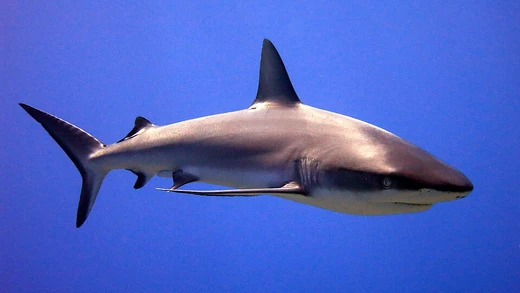
Sicklefin lemon shark
A large, slow-moving Indo-Pacific shark with sickle-shaped fins.
Last updated

Patrick Quinn-Graham from Vancouver, Canada · via Wikipedia: Sicklefin lemon shark · CC BY 2.0
The sicklefin lemon shark is a big, heavy-bodied shark. It hangs out in warm, shallow coastal waters from South Africa and the Red Sea, across the Indian subcontinent and Southeast Asia, up to Taiwan and the Philippines, and down to New Guinea and northern Australia.[1] This shark lives a slow, bottom-hugging lifestyle. It reproduces slowly and doesn't move around much, so overfishing hits it hard.[2][1]
Scientific classification
- KingdomAnimalia
- PhylumChordata
- ClassChondrichthyes
- SubclassElasmobranchii
- DivisionSelachii
- OrderCarcharhiniformes
- FamilyCarcharhinidae
- GenusNegaprion
- SpeciesNegaprion acutidens
Named by (Rüppell, 1837)
Close relatives
Other species of Negaprion with a Codexery entry.
- Lemon shark Negaprion brevirostris
Sources: Wikipedia taxobox: Sicklefin lemon shark (CC BY-SA 4.0) · order, family and genus agree with WoRMS AphiaID 217356 (CC BY 4.0)
Conservation status
Endangered (EN)
- LC
- NT
- VU
- EN▲ this species
- CR
- EW
- EX
Source: IUCN Red List assessment · GBIF copy of the Red List category
How big is it?
Largest length in the source, 3.8 m, next to a 1.8 m person.
Diagram: drawn by Codexery, schematic shapes to scale (not a likeness). Length: Wikipedia: Sicklefin lemon shark
Where the sicklefin lemon shark has been recorded
Each dot is a place where the species has been observed and reported (48,016 records, half-degree grid) — not a modelled range. 26 inland records left out (institution coordinates).
Map: drawn by Codexery. Data: GBIF occurrence search (records CC0 / CC BY) · Natural Earth basemap (public domain) · place coordinates: Wikipedia (CC BY-SA 4.0)
Description
These teeth become more angled toward the corners of the mouth.[3] The pectoral fins are long and broad.[4] At the corners of the mouth, you'll find short furrows.[5] The lower teeth are skinnier and stand up straighter.[3]
Once a shark grows past 1.4 meters long, its teeth get finely serrated edges.[3] Compared to the American lemon shark, this species has fins that are more curved like a sickle, especially the dorsal, pectoral, and pelvic fins.[4] The second dorsal fin is almost as big as the first one.[4] The anal fin has a deep notch along its back edge.[4]
Right in front of the tail fin, there's a pit that runs lengthwise along the body.[4] The biggest known sicklefin lemon shark measured 3.8 meters long, though most don't get bigger than 3.1 meters.[4]
Biology and ecology
The sicklefin lemon shark is sluggish. It usually cruises just above the sea bottom or lies still on it.[2] Unlike most requiem sharks, it can actively pump water over its gills.[2] Over 90% of its diet is bottom- and shore-dwelling bony fish, like herring, mullets, and mackerel.[6] It may also eat cephalopods and crustaceans.[6]
Older sharks eat stingrays and guitarfish.[6] Larger sharks may prey on this species.[6] Several tapeworm species live on this shark as parasites.[6] Sicklefin lemon sharks have been seen resting on the bottom and letting bluestreak cleaner wrasses clean them.[6]
During cleaning, they may open their mouths and stop breathing for up to 150 seconds.[6] Like other members of its family, this shark gives birth to live young. The young develop inside the mother.[7] The gestation period lasts 10 to 11 months.[7] The growing embryos get their nutrients from a placental connection that forms from their used-up yolk sacs.[7]
Newborn pups are 45 to 80 centimeters long.[8]
Distribution and habitat
Significant genetic differences between sharks in Australia and French Polynesia suggest little intermingling between regional groups.[9] Sometimes an individual may venture into open water.[10] This shark also lives around lots of Pacific islands, like New Caledonia, Palau, and Fiji.[1] This shark lives on coastal shelves near continents and islands, from the tide pools down to 92 meters deep.[11]
At Moorea, some sharks stayed around the island all year, while others just dropped by now and then.[2] In Herald Bight off Western Australia, a known nursery, young sharks use open areas and mangroves in water less than 3 meters deep.[10]
Human interactions
Its size and teeth make it potentially dangerous.[12] It defends itself quickly and vigorously if touched or provoked.[12] Normally, though, this shark is shy and won't come near divers, even if you offer it bait.[12] Once agitated, it can be a persistent adversary.[12]
People catch them with gillnets, beach nets, and longlines.[1] Habitat degradation, including pollution and blast fishing, also threatens them.[13] This shark has already disappeared from parts of India and Thailand.[13] The IUCN says the sicklefin lemon shark is Endangered worldwide.[1][14]
Taxonomy and phylogeny
This shark may also be called the broadfin shark, Indian lemon shark, or Indo-Pacific lemon shark.[15] This split likely happened when the closure of the Tethys Sea separated lemon sharks in the Indian Ocean from those in the Atlantic.[16] Studies of its body and genes place this shark in the middle of the requiem shark family tree.[16] German naturalist Eduard Rüppell first described the sicklefin lemon shark in 1837, calling it Carcharias acutidens.[5]
References
- Wikipedia, "Sicklefin lemon shark" (CC BY-SA 4.0), which cites: Pillans, R., "Negaprion acutidens", 2003; Compagno, L.J.V., "Sharks of the World: An Annotated and Illustrated Catalogue of Shark Species Known to Date", Food and Agricultural Organization, 1984, p. 517–518 (we also read that source) en.wikipedia.org
- Wikipedia, "Sicklefin lemon shark" (CC BY-SA 4.0), which cites: Compagno, L.J.V., "Sharks of the World: An Annotated and Illustrated Catalogue of Shark Species Known to Date", Food and Agricultural Organization, 1984, p. 517–518; Schultz, J.K., "Global phylogeography and seascape genetics of the lemon sharks (genus Negaprion)", Molecular Ecology, 2008, p. 5336–5348; Stevens, J.D., "Life-History and Ecology of Sharks at Aldabra Atoll, Indian Ocean", Proceedings of the Royal Society B, July 23, 1984, p. 79–106; Buray, N., J. Mourier, E. Clua and S. Planes. (2009). "Population s en.wikipedia.org
- Wikipedia, "Sicklefin lemon shark" (CC BY-SA 4.0), which cites: "Coastal Fishes of Oman", University of Hawaii Press, 1995, p. 35; Compagno, L.J.V., "Sharks of the World: An Annotated and Illustrated Catalogue of Shark Species Known to Date", Food and Agricultural Organization, 1984, p. 517–518 (we also read that source) en.wikipedia.org
- Wikipedia, "Sicklefin lemon shark" (CC BY-SA 4.0), which cites: Compagno, L.J.V., "Sharks of the World: An Annotated and Illustrated Catalogue of Shark Species Known to Date", Food and Agricultural Organization, 1984, p. 517–518; Bester, C. Biological Profiles: Sicklefin Lemon Shark . Florida Museum of Natural History Ichthyology Department. Retrieved on August 24, 2009.; Randall, J.E., "Fishes of the Great Barrier Reef and Coral Sea", University of Hawaii Press, 1997, p. 22; ; "Coastal Fishes of Oman", University of Hawaii Press, 1995, p. 35 (we also read that source) en.wikipedia.org
- Wikipedia, "Sicklefin lemon shark" (CC BY-SA 4.0), which cites: Compagno, L.J.V., "Sharks of the World: An Annotated and Illustrated Catalogue of Shark Species Known to Date", Food and Agricultural Organization, 1984, p. 517–518 (we also read that source) en.wikipedia.org
- Wikipedia, "Sicklefin lemon shark" (CC BY-SA 4.0), which cites: Compagno, L.J.V., "Sharks of the World: An Annotated and Illustrated Catalogue of Shark Species Known to Date", Food and Agricultural Organization, 1984, p. 517–518; Stevens, J.D., "Life-History and Ecology of Sharks at Aldabra Atoll, Indian Ocean", Proceedings of the Royal Society B, July 23, 1984, p. 79–106; White, W.T., "Comparisons between the diets of four abundant species of elasmobranchs in a subtropical embayment: implications for resource partitioning", Marine Biology, 2004, p. 439–448; Salini, J.P., "Di en.wikipedia.org
- Wikipedia, "Sicklefin lemon shark" (CC BY-SA 4.0), which cites: Compagno, L.J.V., "Sharks of the World: An Annotated and Illustrated Catalogue of Shark Species Known to Date", Food and Agricultural Organization, 1984, p. 517–518; Stevens, J.D., "Life-History and Ecology of Sharks at Aldabra Atoll, Indian Ocean", Proceedings of the Royal Society B, July 23, 1984, p. 79–106; Schultz, J.K., "Global phylogeography and seascape genetics of the lemon sharks (genus Negaprion)", Molecular Ecology, 2008, p. 5336–5348 (we also read that source) en.wikipedia.org
- Wikipedia, "Sicklefin lemon shark" (CC BY-SA 4.0), which cites: Compagno, L.J.V., "Sharks of the World: An Annotated and Illustrated Catalogue of Shark Species Known to Date", Food and Agricultural Organization, 1984, p. 517–518; Stevens, J.D., "Life-History and Ecology of Sharks at Aldabra Atoll, Indian Ocean", Proceedings of the Royal Society B, July 23, 1984, p. 79–106 (we also read that source) en.wikipedia.org
- Wikipedia, "Sicklefin lemon shark" (CC BY-SA 4.0), which cites: Schultz, J.K., "Global phylogeography and seascape genetics of the lemon sharks (genus Negaprion)", Molecular Ecology, 2008, p. 5336–5348 (we also read that source) en.wikipedia.org
- Wikipedia, "Sicklefin lemon shark" (CC BY-SA 4.0), which cites: Compagno, L.J.V., "Sharks of the World: An Annotated and Illustrated Catalogue of Shark Species Known to Date", Food and Agricultural Organization, 1984, p. 517–518; "Coastal Fishes of Oman", University of Hawaii Press, 1995, p. 35; "Habitat partitioning among four elasmobranch species in nearshore, shallow waters of a subtropical embayment in Western Australia", Marine Biology, 2004, p. 1023–1032 (we also read that source) en.wikipedia.org
- Wikipedia, "Sicklefin lemon shark" (CC BY-SA 4.0), which cites: Bester, C. Biological Profiles: Sicklefin Lemon Shark . Florida Museum of Natural History Ichthyology Department. Retrieved on August 24, 2009. (original not read by us) en.wikipedia.org
- Wikipedia, "Sicklefin lemon shark" (CC BY-SA 4.0), which cites: Compagno, L.J.V., "Sharks of the World: An Annotated and Illustrated Catalogue of Shark Species Known to Date", Food and Agricultural Organization, 1984, p. 517–518; Buray, N., J. Mourier, E. Clua and S. Planes. (2009). "Population size, residence patterns and reproduction of a sicklefin lemon shark population (Negaprion acu; Compagno, L.J.V., "Sharks of the World: An Annotated and Illustrated Catalogue of Shark Species Known to Date", Food and Agricultural Organization, 1984, p. 517–518 (we also read that source) en.wikipedia.org
- Wikipedia, "Sicklefin lemon shark" (CC BY-SA 4.0), which cites: Pillans, R., "Negaprion acutidens", 2003 (we also read that source) en.wikipedia.org
- IUCN Red List assessment (category and year as redistributed in GBIF's IUCN Red List checklist). IUCN Red List terms: fact (category, year) cited, no text reused. iucnredlist.org
- Wikipedia, "Sicklefin lemon shark" (CC BY-SA 4.0) en.wikipedia.org
- Wikipedia, "Sicklefin lemon shark" (CC BY-SA 4.0), which cites: Schultz, J.K., "Global phylogeography and seascape genetics of the lemon sharks (genus Negaprion)", Molecular Ecology, 2008, p. 5336–5348; Schultz, J.K., "Global phylogeography and seascape genetics of the lemon sharks (genus Negaprion)", Molecular Ecology, 2008, p. 5336–5348; Carrier, J.C., "Biology of Sharks and Their Relatives", CRC Press, 2004, p. 52, 502 (we also read that source) en.wikipedia.org
Each numbered sentence above was checked against the source it cites before publication. Sentences citing Wikipedia adapt text from the English Wikipedia article Sicklefin lemon shark (contributors), used under CC BY-SA 4.0; this entry is available under the same licence. Other sources were used for facts only; no text or images are copied from them.
More in Reef sharks
Elsewhere in Sharks
Test yourself
Three questions drawn from this entry’s sources. Pick an answer to check it.
Answers checked against the source article
Sources
Compiled from Wikipedia and the sources listed below. Text from Wikipedia is available under CC BY-SA 4.0; this entry is adapted from it.
- Wikipedia: Sicklefin lemon shark (CC BY-SA 4.0).
- Classification: the source article's taxobox; order, family and genus checked against WoRMS, the World Register of Marine Species (CC BY 4.0).
- Conservation status: IUCN Red List assessment.
- Occurrence records: GBIF (CC0 / CC BY). Basemap: Natural Earth (public domain).
- Word definitions: the Codexery glossary, each quoted from its Wikipedia article.
Spotted an error? Know more?
Reader corrections go straight into our review queue. Suggest an edit · How this site is sourced