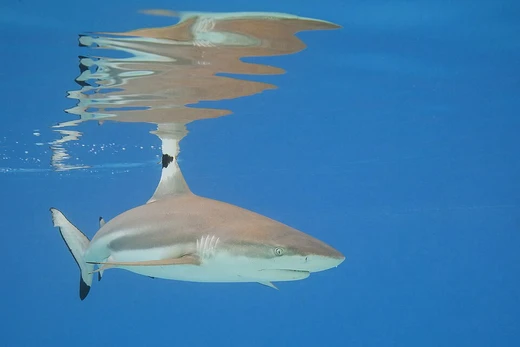
Smalltail shark
A slim, critically endangered requiem shark of the western Atlantic.

The smalltail shark (Carcharhinus porosus) is a species of requiem shark in the family Carcharhinidae, found in the western Atlantic Ocean from the northern Gulf of Mexico to southern Brazil. It is notable for forming large aggregations segregated by sex and for its significant population decline since the 1980s, leading to its classification as critically endangered by the International Union for Conservation of Nature.
Quick Facts
- Genus
- Carcharhinus
- Species
- porosus
Facts from the source article.
Lore & Background
Italian naturalist Camillo Ranzani first described the smalltail shark in 1839, naming it Carcharias porosus from the Greek porus ('pore'), referring to prominent pores behind its eyes. The type specimen, a 1.2 m male from Brazil, has since been lost. Its evolutionary relationships are uncertain; morphological studies placed it with the whitecheek and blackspot sharks, while a 2011 genetic study found close ties to the daggernose, blacknose, and finetooth sharks. The Pacific smalltail shark (C. cerdale) was once mistakenly synonymized with C. porosus until 2011.
The smalltail shark is a slender species with a long, pointed snout, broad triangular first dorsal fin, and plain gray coloration without prominent fin markings. It inhabits shallow inshore waters no deeper than 36 m, favoring muddy bottoms around estuaries. Off northern Brazil, it experiences tides up to 7 m and salinity fluctuations from 14 to 34 ppt. It feeds mainly on bony fishes such as croakers, but also consumes crustaceans, cephalopods, and smaller sharks and rays. It is viviparous with a placental connection, and females bear litters of two to nine young on a biennial cycle after a 12-month gestation.
Reader's Guide
The smalltail shark is often caught as bycatch in gillnet and longline fisheries throughout its range. Its meat is sold fresh, frozen, or dried and salted; its dried fins are exported for shark fin soup, and its liver oil, cartilage, and carcass are used medicinally or processed into fishmeal. In Trinidad, it is the most economically important shark. Off northern Brazil, substantial numbers are caught by gillnet fisheries targeting Serra Spanish mackerel. In the 1980s, this species constituted roughly 43% of the shark and ray catch, but has since declined to around 17%. This decline is attributed to increasing fishing effort, the large proportion of juveniles captured, and the shark's low reproductive rate. The International Union for Conservation of Nature has listed it as critically endangered. Although it was given protection by inclusion on the 2004 Official List of Endangered Animals in Brazil, fishing remains effectively unmanaged. The species is harmless to humans.
Did You Know?
- The smalltail shark's scientific name Carcharhinus porosus comes from the Greek porus ('pore'), referring to prominent pores behind its eyes.
- Females grow larger than males, reaching a maximum known length of 1.5 m (4.9 ft).
- Off northern Brazil, the smalltail shark is the most common shark and was once 43% of the shark and ray catch.
- The Pacific smalltail shark (Carcharhinus cerdale) was mistakenly synonymized with C. porosus until 2011.
Freshwater Mastery and Osmoregulation
The bull shark possesses a remarkable physiological trait called euryhalinity, allowing it to regulate its internal salt balance and thrive in both marine and freshwater environments. This capability sets it apart from many of its closest relatives within the genus Carcharhinus, such as the sandbar shark, which lacks any osmoregulatory ability whatsoever. Despite sharing a similar freshwater tolerance with the river sharks of the genus Glyphis, taxonomic evidence reveals that these two lineages occupy entirely different positions within the family Carcharhinidae. The bull shark is nested firmly within Carcharhinus, while river sharks sit as sister to the genus Lamiopsis, strongly suggesting that their parallel freshwater adaptations evolved independently through convergent evolution. In practice, this means the bull shark is not a true freshwater species in the way Glyphis sharks are. Nevertheless, individuals have been documented traveling extraordinary distances inland, including up the Mississippi River to Alton, Illinois, roughly 1,100 kilometres from the nearest ocean. Despite this remarkable range, direct encounters between humans and bull sharks in freshwater settings remain comparatively rare.
Massive Build and Record-Breaking Bite
Bull sharks are notably stocky and broad-bodied, wider and heavier than any other requiem shark of equivalent length. Females consistently outsize males, with adult females averaging 2.4 metres and 130 kilograms, while males average 2.25 metres and 95 kilograms. At birth, pups can already measure up to 81 centimetres. The commonly cited maximum length is 3.5 metres, yet a single verified female specimen reached exactly 4.0 metres. A pregnant individual measuring 3.25 metres was recorded at 450 kilograms, and the maximum estimated weight for a full-sized 4.0-metre pregnant female exceeds 600 kilograms, placing the species among the heaviest requiem sharks known. Their colouration is a straightforward grey dorsal surface fading to white ventrally, with a small broad snout, a second dorsal fin noticeably smaller than the first, and a caudal fin that is longer and lower than those of larger shark species. Perhaps most striking is their bite force, measured at up to 5,914 newtons, which represents the highest weight-for-weight bite among all cartilaginous fishes studied to date.
A Truly Global Ranging Species
The bull shark's distribution spans virtually every warm coastal ocean on Earth. In the Atlantic, its range stretches from Massachusetts down to southern Brazil and from Morocco to Angola, while in the Pacific it extends from Baja California to Ecuador. It tolerates depths up to 150 metres, though it rarely ventures past 30 metres. Beyond open coastlines, this species has established populations in major river systems worldwide. Over 500 individuals are estimated to inhabit the Brisbane River in Australia, and during the devastating 2010–11 Queensland floods, sharks were spotted swimming through flooded residential streets in Brisbane and Goodna. In the warmer months, they frequent Sydney Harbour and the canals of the Gold Coast. In South America, a bull shark traveled an astonishing 4,000 kilometres up the Amazon to Iquitos in Peru and into northern Bolivia. The species also inhabits Lake Nicaragua, the Ganges and Brahmaputra rivers in eastern India and Bangladesh, and has been recorded in the Tigris River as far upstream as Baghdad since at least 1924. After Hurricane Katrina, large numbers appeared in Lake Pontchartrain, and by July 2023, fishermen on the Atchafalaya River reported increasing sightings.
Aggression, Human Conflict, and a Fragile Status
The bull shark's reputation for aggressive, unpredictable behaviour is so well established that it directly inspired its common name, alongside its stocky frame and broad, flat snout. This temperament has made larger individuals a significant contributor to nearshore shark-attack statistics, and they are suspected to be the species behind many incidents where the attacking shark was never positively identified. In response, coastal communities have implemented ongoing culling programmes near popular beaches to reduce the risk to swimmers and surfers. These removals are cited as one of the key drivers behind the continued decline of bull shark populations worldwide. The IUCN Red List currently classifies the species as vulnerable, reflecting the pressure it faces across its vast range. Despite the fear they inspire, genuine freshwater encounters with humans remain uncommon. The shark carries dozens of local names across its range—Zambezi shark, zambi, Ganges River shark, Swan River whaler, shovelnose shark, among others—and its image even appears on Costa Rica's 2000-colones banknote, a testament to its cultural footprint in regions where it is a familiar presence.
Frequently Asked Questions
Who is Smalltail shark?
Smalltail shark is a slender requiem shark in the Carcharhinidae family, native to the western Atlantic from the northern Gulf of Mexico down to southern Brazil. It's a modest-sized predator, typically measuring around 3 to 3.6 feet in length.
What are Smalltail shark's powers/role?
Rather than superpowers, this species is known for gathering into massive groups where males and females remain in separate clusters. It fills a mid-level predator niche in western Atlantic coastal and offshore waters.
Why is Smalltail shark important?
As a critically endangered mid-level predator, its decline signals broader damage to western Atlantic marine ecosystems. Its sex-segregated aggregation behavior also makes it a valuable subject for studying social structure in requiem sharks.
What's Smalltail shark's family/origin?
Smalltail shark reproduces roughly every two years, carrying a litter of 2 to 9 pups for about 12 months before giving birth. Both males and females reach sexual maturity at around 6 years of age.
More in Reef Sharks and Rays, Part 2 1-24
Spotted an error? Know more?
Reader corrections go straight into our review queue. Suggest an edit · How this site is sourced