Pristipomoides macrophthalmus
A western Atlantic snapper with large eyes and a poorly known biology.
Last updated
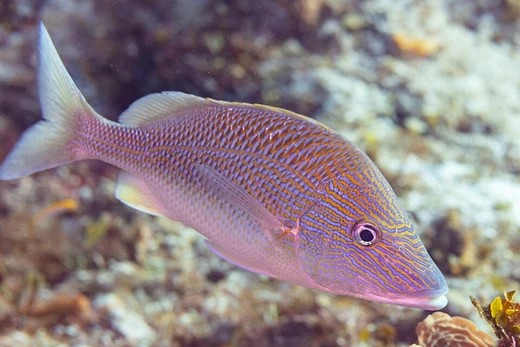
The cardinal snapper, also called the bigeye snapper, is a ray-finned fish in the family Lutjanidae. It lives in the western Atlantic Ocean. Its most obvious feature is its large eyes, which are bigger than the space between them.
Description
The body is moderately deep and oblong, typically more than a third of its standard length, and shaped like a torpedo. The mouth is large with a slightly protruding upper jaw, the snout is short and blunt, and the area between the eyes is flat. The dorsal fin has 10 spines and 11 soft rays, while the anal fin has 3 spines and 8 soft rays; the last soft ray on each of these fins extends into a short filament. The long pectoral fins reach the anus and have 15 or 16 rays, and the tail fin is forked.
The back and upper sides are pink with a silvery sheen, fading to silver on the lower sides and belly. The fins range from see-through to pink. This species can reach a total length of 50 cm (20 in), though 30 cm (12 in) is more common.
Taxonomy
The species was first formally described in 1848 as Centropristis macrophthalmus by German zoologists Johannes Peter Müller and Franz Herman Troschel, based on a specimen from Barbados. The name macrophthalmus means "large eyed." In 1862, Theodore N. Gill used Mesoprion vorax (a junior synonym) as the type species for the genus Platyinius, which is now considered a subgenus of Pristipomoides.
Distribution and habitat
This snapper is found from Bermuda, southeastern Florida, and Louisiana south through the Gulf of Mexico to Campeche and Cuba. In the Caribbean, it ranges from Cuba to St. Lucia and along the Central and South American coast from Nicaragua to La Guajira, Colombia. It lives near the bottom at depths between 110 and 550 m (360 to 1,800 ft), over soft or semi-hard seafloors.
Biology
Little is known about its biology. Like other snappers, it is a predator that eats smaller fish and large zooplankton. Off Puerto Rico, it breeds year-round, with peaks in March and December. Off Florida, it reaches sexual maturity at a fork length of 18 cm (7.1 in).
This species is not a primary target for fisheries. It is usually caught as bycatch, or targeted only when stocks of other snappers are low. In Puerto Rico, it became a target after the population of Lutjanus vivanus dropped sharply. It is caught with handlines and bottom trawls, and the catch is typically sold fresh.
Scientific classification
- KingdomAnimalia
- PhylumChordata
- ClassActinopterygii
- DivisionTeleostei
- OrderAcanthuriformes
- FamilyLutjanidae
- GenusPristipomoides
- SpeciesPristipomoides macrophthalmus
Named by (J. P. Müller & Troschel, 1848)
Close relatives
Other species of Pristipomoides with a Codexery entry.
- Pristipomoides auricilla Pristipomoides auricilla
- Pristipomoides filamentosus Pristipomoides filamentosus
- Pristipomoides flavipinnis Pristipomoides flavipinnis
- Pristipomoides multidens Pristipomoides multidens
- Pristipomoides sieboldii Pristipomoides sieboldii
- Pristipomoides typus Pristipomoides typus
Sources: Wikipedia taxobox: Pristipomoides macrophthalmus (CC BY-SA 4.0) · differs from this box at order: WoRMS AphiaID 276555 (CC BY 4.0)
Conservation status
Least Concern (LC)
- LC▲ this species
- NT
- VU
- EN
- CR
- EW
- EX
Source: IUCN Red List assessment · GBIF copy of the Red List category
How big is it?
Largest length in the source, 0.5 m, next to a 1.8 m person.
Diagram: drawn by Codexery, schematic shapes to scale (not a likeness). Length: Wikipedia: Pristipomoides macrophthalmus
Where the pristipomoides macrophthalmus has been recorded
Each dot is a place where the species has been observed and reported (168 records, half-degree grid) — not a modelled range. 1 inland record left out (institution coordinates).
Map: drawn by Codexery. Data: GBIF occurrence search (records CC0 / CC BY) · Natural Earth basemap (public domain) · place coordinates: Wikipedia (CC BY-SA 4.0)
Ranked in
More in Snappers
Elsewhere in Snappers and Grunts
Test yourself
Three questions drawn from this entry’s sources. Pick an answer to check it.
Answers checked against the source article
Sources
Compiled from Wikipedia and the sources listed below. Text from Wikipedia is available under CC BY-SA 4.0; this entry is adapted from it.
- Wikipedia: Pristipomoides macrophthalmus (CC BY-SA 4.0).
- Classification: the source article's taxobox; compare WoRMS, the World Register of Marine Species (CC BY 4.0).
- Conservation status: IUCN Red List assessment.
- Occurrence records: GBIF (CC0 / CC BY). Basemap: Natural Earth (public domain).
- Word definitions: the , each quoted from its Wikipedia article.
Spotted an error? Know more?
Reader corrections go straight into our review queue. Suggest an edit · How this site is sourced