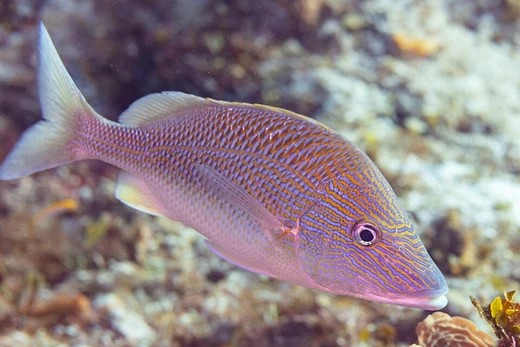
Pristipomoides multidens
A deepwater snapper with golden stripes and excellent flesh.
Last updated
The goldbanded jobfish, also known as the goldbanded snapper, is a ray-finned fish in the family Lutjanidae. It is a deepwater, demersal species that lives over hard, rocky, and bumpy substrates at depths between 40 and 245 meters. Its body is elongated and robust, with a depth about one-third of its standard length. The space between its eyes is flat, and its lower jaw protrudes slightly.
Description
The fish has an outer row of conical and canine-like teeth in both jaws, with the front two to three pairs of canines enlarged, plus an inner band of bristle-like teeth. The vomerine teeth form a triangular patch, and the tongue has no teeth. The dorsal fin has 10 spines and 11 soft rays, while the anal fin has 3 spines and 8 soft rays; both fins lack scales at their bases, and their last soft ray extends into a short filament. The long pectoral fins reach the anus and have 15 or 16 rays, and the caudal fin is forked.
Coloration ranges from yellowish to pale pink, marked with six interrupted golden stripes on the flanks. The snout side and cheek have two blue-edged golden stripes, and the crown shows a series of yellow chevrons pointing toward the snout. The dorsal fin has yellowish stripes or lines of spots. This species reaches a maximum total length of 90 cm, though 70 cm is more typical.
Taxonomy
The goldbanded jobfish was first formally described in 1871 as Mesoprion multidens by English zoologist Francis Day, with the type locality given as the Andaman Islands. Its specific name combines multi (many) and dens (teeth), referring to the six canine teeth in the lower jaw and the two larger ones in the upper jaw. An older name, Diacope sparus, was coined by Temminck and Schlegel in 1842 and has been considered a synonym, but it is uncertain which taxon the supposed type specimen of D. sparus represents.
Distribution and habitat
This snapper has a wide Indo-Pacific distribution, occurring along the eastern African coast in Tanzania, Mozambique, and South Africa, in the Red Sea, and across the Indian Ocean (excluding the Arabian Sea) into the Pacific, where its range extends east to Samoa, north to Japan, and south to Australia. It is a sociable species that forms schools over hard, rocky, and uneven seabeds near steep drop-offs. Like other snappers, it is predatory, feeding on fishes, crustaceans, squids, gastropods, and urochordates.
Scientific classification
- KingdomAnimalia
- PhylumChordata
- ClassActinopterygii
- DivisionTeleostei
- OrderAcanthuriformes
- FamilyLutjanidae
- GenusPristipomoides
- SpeciesPristipomoides multidens
Named by (Day, 1871)
Close relatives
Other species of Pristipomoides with a Codexery entry.
- Pristipomoides auricilla Pristipomoides auricilla
- Pristipomoides filamentosus Pristipomoides filamentosus
- Pristipomoides flavipinnis Pristipomoides flavipinnis
- Pristipomoides macrophthalmus Pristipomoides macrophthalmus
- Pristipomoides sieboldii Pristipomoides sieboldii
- Pristipomoides typus Pristipomoides typus
Sources: Wikipedia taxobox: Pristipomoides multidens (CC BY-SA 4.0) · differs from this box at order: WoRMS AphiaID 218513 (CC BY 4.0)
Conservation status
Least Concern (LC)
- LC▲ this species
- NT
- VU
- EN
- CR
- EW
- EX
Source: IUCN Red List assessment · GBIF copy of the Red List category
How big is it?
Largest length in the source, 0.9 m, next to a 1.8 m person.
Diagram: drawn by Codexery, schematic shapes to scale (not a likeness). Length: Wikipedia: Pristipomoides multidens
Where the pristipomoides multidens has been recorded
Each dot is a place where the species has been observed and reported (11,007 records, half-degree grid) — not a modelled range. 4 inland records left out (institution coordinates).
Map: drawn by Codexery. Data: GBIF occurrence search (records CC0 / CC BY) · Natural Earth basemap (public domain) · place coordinates: Wikipedia (CC BY-SA 4.0)
Frequently Asked Questions
Where does Pristipomoides multidens live?
It is a demersal, deepwater species that patrols hard, rocky, and bumpy substrates well below the surface, typically found between 40 and 245 meters (about 131 to 804 feet). It is not a shallow-water reef dweller but a true deep-sea snapper.
How big does Pristipomoides multidens grow?
A typical adult reaches around 70 cm (28 in) in total length, though the species can grow to a maximum of 90 cm (35 in). At that size it is a substantial deepwater predator with excellent flesh, making it a prized catch where it is harvested.
Ranked in
More in Snappers
Elsewhere in Snappers and Grunts
Test yourself
Three questions drawn from this entry’s sources. Pick an answer to check it.
Answers checked against the source article
Sources
Compiled from Wikipedia and the sources listed below. Text from Wikipedia is available under CC BY-SA 4.0; this entry is adapted from it.
- Wikipedia: Pristipomoides multidens (CC BY-SA 4.0).
- Classification: the source article's taxobox; compare WoRMS, the World Register of Marine Species (CC BY 4.0).
- Conservation status: IUCN Red List assessment.
- Occurrence records: GBIF (CC0 / CC BY). Basemap: Natural Earth (public domain).
- Word definitions: the , each quoted from its Wikipedia article.
Spotted an error? Know more?
Reader corrections go straight into our review queue. Suggest an edit · How this site is sourced