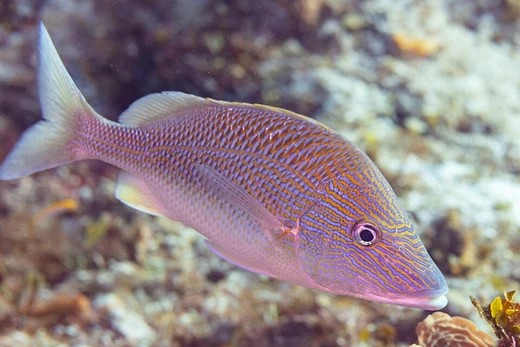
Pristipomoides typus
A snapper species found in the Indian and Pacific Oceans.
Last updated
Pristipomoides typus, commonly called the sharptooth jobfish, white snapper, white jobfish, goldband snapper, or threadfin snapper, is a ray-finned fish belonging to the snapper family Lutjanidae. Its range covers the Indian and Pacific Oceans.
Taxonomy
The Dutch scientist Pieter Bleeker first described this species in 1852, basing it on a specimen from Sibogha, Sumatra. Its scientific name, typus, marks it as the type species for the genus Pristipomoides.
Description
This fish has a long, sturdy body, with a depth measuring just under one-third of its standard length. The area between its eyes is flat, and its upper and lower jaws are nearly equal in length. Each jaw has an outer row of conical, canine-like teeth and an inner row of bristle-like teeth.
A triangular patch of teeth sits on the vomer, but the tongue is toothless. The dorsal fin consists of 10 spines and 11 to 12 soft rays, while the anal fin has 3 spines and 8 soft rays. Neither fin has scales at its base, and the last soft ray of each fin extends into a short filament.
The long pectoral fins reach as far as the anus and contain 16 rays. The tail fin is forked. Overall, the fish is pinkish red, with the top of the head marked by horizontal wavy lines and spots that are brownish yellow; the dorsal fin shows sinuous yellow lines. The largest recorded total length is 70 cm (28 in), and the heaviest published weight is 2.2 kg (4.9 lb).
Distribution and habitat
This species lives in the eastern Indian Ocean and western Pacific Ocean, from the Andaman Sea east to Papua New Guinea, north to Japan’s Ryukyu Islands, and south to Australia. It is a demersal fish, found at depths of 40 to 180 m (130 to 590 ft) over hard, rocky, or bumpy seafloors.
Biology
A social fish, Pristipomoides typus forms schools. Its diet consists mainly of bottom-dwelling invertebrates and other fish. It spawns in series, with a single female producing between 760,000 and 2,100,000 eggs. The fish reaches sexual maturity at about 2.7 years old and can live up to 11.3 years.
Fishermen catch this species mostly with handlines. It is considered good to eat and occasionally appears in markets, usually sold fresh. In Southeast Asia, it is the primary fish used in fish head curry and claypot fish head.
Scientific classification
- KingdomAnimalia
- PhylumChordata
- ClassActinopterygii
- DivisionTeleostei
- OrderAcanthuriformes
- FamilyLutjanidae
- GenusPristipomoides
- SpeciesPristipomoides typus
Named by Bleeker, 1852
Close relatives
Other species of Pristipomoides with a Codexery entry.
- Pristipomoides auricilla Pristipomoides auricilla
- Pristipomoides filamentosus Pristipomoides filamentosus
- Pristipomoides flavipinnis Pristipomoides flavipinnis
- Pristipomoides macrophthalmus Pristipomoides macrophthalmus
- Pristipomoides multidens Pristipomoides multidens
- Pristipomoides sieboldii Pristipomoides sieboldii
Sources: Wikipedia taxobox: Pristipomoides typus (CC BY-SA 4.0) · differs from this box at order: WoRMS AphiaID 218507 (CC BY 4.0)
Conservation status
Least Concern (LC)
- LC▲ this species
- NT
- VU
- EN
- CR
- EW
- EX
Source: IUCN Red List assessment · GBIF copy of the Red List category
How big is it?
Largest length in the source, 0.7 m, next to a 1.8 m person.
Diagram: drawn by Codexery, schematic shapes to scale (not a likeness). Length: Wikipedia: Pristipomoides typus
Where the pristipomoides typus has been recorded
Each dot is a place where the species has been observed and reported (1,049 records, half-degree grid) — not a modelled range. 15 inland records left out (institution coordinates). 1 isolated far-off record not drawn.
Map: drawn by Codexery. Data: GBIF occurrence search (records CC0 / CC BY) · Natural Earth basemap (public domain) · place coordinates: Wikipedia (CC BY-SA 4.0)
Ranked in
More in Snappers
Elsewhere in Snappers and Grunts
Test yourself
Three questions drawn from this entry’s sources. Pick an answer to check it.
Answers checked against the source article
Sources
Compiled from Wikipedia and the sources listed below. Text from Wikipedia is available under CC BY-SA 4.0; this entry is adapted from it.
- Wikipedia: Pristipomoides typus (CC BY-SA 4.0).
- Classification: the source article's taxobox; compare WoRMS, the World Register of Marine Species (CC BY 4.0).
- Conservation status: IUCN Red List assessment.
- Occurrence records: GBIF (CC0 / CC BY). Basemap: Natural Earth (public domain).
- Word definitions: the , each quoted from its Wikipedia article.
Spotted an error? Know more?
Reader corrections go straight into our review queue. Suggest an edit · How this site is sourced