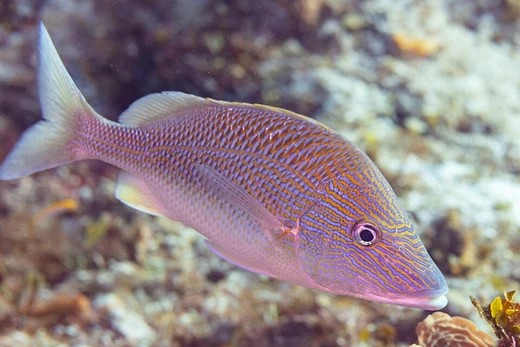
Pristipomoides sieboldii
A snapper with a lavender tint, found across the Indian and Pacific Oceans.
Last updated
The lavender jobfish, also called the lavender snapper or von Siebold's snapper, is a ray-finned fish in the snapper family Lutjanidae. It lives across a broad area of the Indian and Pacific Oceans.
Taxonomy
This species was first scientifically described in 1871 by the Dutch scientist Pieter Bleeker, who named it Chaetopterus sieboldii based on a specimen from Nagasaki. The name likely honors German physician and traveler Philipp Franz von Siebold, who collected many fish specimens later described in the Fauna Japonica series.
Description
The fish has an elongated, sturdy body, with a depth roughly 30–40% of its standard length. Its eyes are set apart by a flat space, and its lower jaw sticks out slightly. Both jaws have an outer row of conical and canine-like teeth, plus an inner band of bristle-like teeth. A diamond-shaped patch of teeth sits on the vomer, and teeth also appear on the tongue.
The dorsal fin has 10 spines and 11 soft rays; the anal fin has 3 spines and 8 soft rays. Neither fin has scales at its base, and the last soft ray of each extends into a short filament. The long pectoral fins reach the anus and contain 16 rays.
The caudal fin is forked. Overall, the fish is silvery with a lavender tint, and the top of the head has dark spots that are more noticeable in younger individuals. The dorsal fin has an orange margin, while the caudal fin is purplish with pale edges on the fork. It can reach a maximum total length of 79 cm (31 in), though 40 cm (16 in) is more typical, and a maximum published weight of 8.6 kg (19 lb).
Distribution, habitat and biology
A benthopelagic predator, it lives over rocky substrates at depths from 140 to 500 m (460 to 1,640 ft). Its diet consists mainly of fishes, crustaceans, polychaetes, cephalopods, and urochordates. The fish reaches sexual maturity at three years old and has a lifespan of no more than eight years.
Fisheries
In Japan, the lavender jobfish is a common food fish. It is also important to fisheries in Hawaii—where it is managed as part of the Deep 7 bottomfish hook and line fishery—and in the Great Barrier Reef/Torres Strait fishery in Australia. It is caught with bottom longlines and deep handlines, and the catch is sold fresh.
Scientific classification
- KingdomAnimalia
- PhylumChordata
- ClassActinopterygii
- DivisionTeleostei
- OrderAcanthuriformes
- FamilyLutjanidae
- GenusPristipomoides
- SpeciesPristipomoides sieboldii
Named by (Bleeker, 1855)
Close relatives
Other species of Pristipomoides with a Codexery entry.
- Pristipomoides auricilla Pristipomoides auricilla
- Pristipomoides filamentosus Pristipomoides filamentosus
- Pristipomoides flavipinnis Pristipomoides flavipinnis
- Pristipomoides macrophthalmus Pristipomoides macrophthalmus
- Pristipomoides multidens Pristipomoides multidens
- Pristipomoides typus Pristipomoides typus
Sources: Wikipedia taxobox: Pristipomoides sieboldii (CC BY-SA 4.0) · differs from this box at order: WoRMS AphiaID 218509 (CC BY 4.0)
Conservation status
Least Concern (LC)
- LC▲ this species
- NT
- VU
- EN
- CR
- EW
- EX
Source: IUCN Red List assessment · GBIF copy of the Red List category
How big is it?
Largest length in the source, 0.79 m, next to a 1.8 m person.
Diagram: drawn by Codexery, schematic shapes to scale (not a likeness). Length: Wikipedia: Pristipomoides sieboldii
Where the pristipomoides sieboldii has been recorded
Each dot is a place where the species has been observed and reported (384 records, half-degree grid) — not a modelled range. 14 inland records left out (institution coordinates).
Map: drawn by Codexery. Data: GBIF occurrence search (records CC0 / CC BY) · Natural Earth basemap (public domain) · place coordinates: Wikipedia (CC BY-SA 4.0)
Ranked in
More in Snappers
Elsewhere in Snappers and Grunts
Sources
Compiled from Wikipedia and the sources listed below. Text from Wikipedia is available under CC BY-SA 4.0; this entry is adapted from it.
- Wikipedia: Pristipomoides sieboldii (CC BY-SA 4.0).
- Classification: the source article's taxobox; compare WoRMS, the World Register of Marine Species (CC BY 4.0).
- Conservation status: IUCN Red List assessment.
- Occurrence records: GBIF (CC0 / CC BY). Basemap: Natural Earth (public domain).
- Word definitions: the , each quoted from its Wikipedia article.
Spotted an error? Know more?
Reader corrections go straight into our review queue. Suggest an edit · How this site is sourced