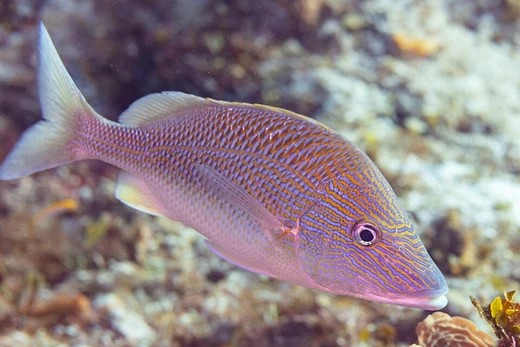
Borriqueta porgy
A grunt native to the southwestern Atlantic Ocean.
Last updated
The Borriqueta porgy (Boridia grossidens) is a marine ray-finned fish and a type of grunt in the Haemulidae family. It lives along the Atlantic coast of South America and is the sole species in its genus, Boridia.
Description
This fish has a rectangular body and a shallow, blunt head, with eyes set toward the front and a small mouth. The soft-rayed parts of its dorsal and anal fins lack scales, and the dorsal fin has a clear notch between its spiny and soft-rayed sections. The dorsal fin consists of 12 spines and 13 soft rays, while the anal fin has 3 spines and 10 to 11 soft rays.
The first two dorsal spines are low, and the second anal spine is robust. Its pectoral fins are short. The body is light gray, darker on the back, with dark scale margins that create a latticed pattern.
The spiny part of the dorsal fin is gray with darker membranes between the spines, and the soft-rayed parts of the dorsal and anal fins are gray with a darker blotch. The rear parts of the caudal and pelvic fins are dark. It reaches a maximum total length of 32 cm (13 in).
Distribution
The Borriqueta porgy is found in the southwestern Atlantic Ocean, off southern Brazil, Uruguay, and northern Argentina. There is evidence its range is shifting southward due to warming waters, possibly from climate change.
Habitat and biology
It inhabits continental shelf waters and estuaries over soft substrates. It forms distinct pairs for mating. The trematode Diplomonorchis leiostomi is an endoparasite of this species.
Systematics
French anatomist Georges Cuvier first formally described the Borriqueta porgy in 1830, with the type locality given as Brazil. The genus name Boridia comes from a word used by Xenocrates for an unidentified fish, while the species name grossidens combines grossus (large) and dens (teeth), referring to its large front teeth on both jaws.
Scientific classification
- KingdomAnimalia
- PhylumChordata
- ClassActinopterygii
- DivisionTeleostei
- OrderAcanthuriformes
- FamilyHaemulidae
- GenusBoridia
- SpeciesBoridia grossidens
Named by G. Cuvier, 1830
Sources: Wikipedia taxobox: Borriqueta porgy (CC BY-SA 4.0) · differs from this box at order: WoRMS AphiaID 279940 (CC BY 4.0)
Conservation status
Least Concern (LC)
- LC▲ this species
- NT
- VU
- EN
- CR
- EW
- EX
Source: IUCN Red List assessment · GBIF copy of the Red List category
How big is it?
Largest length in the source, 0.32 m, next to a 1.8 m person.
Diagram: drawn by Codexery, schematic shapes to scale (not a likeness). Length: Wikipedia: Borriqueta porgy
Where the borriqueta porgy has been recorded
Each dot is a place where the species has been observed and reported (44 records, half-degree grid) — not a modelled range. 10 inland records left out (institution coordinates).
Map: drawn by Codexery. Data: GBIF occurrence search (records CC0 / CC BY) · Natural Earth basemap (public domain) · place coordinates: Wikipedia (CC BY-SA 4.0)
More in Grunts
Elsewhere in Snappers and Grunts
Test yourself
Three questions drawn from this entry’s sources. Pick an answer to check it.
Answers checked against the source article
Sources
Compiled from Wikipedia and the sources listed below. Text from Wikipedia is available under CC BY-SA 4.0; this entry is adapted from it.
- Wikipedia: Borriqueta porgy (CC BY-SA 4.0).
- Classification: the source article's taxobox; compare WoRMS, the World Register of Marine Species (CC BY 4.0).
- Conservation status: IUCN Red List assessment.
- Occurrence records: GBIF (CC0 / CC BY). Basemap: Natural Earth (public domain).
- Word definitions: the , each quoted from its Wikipedia article.
Spotted an error? Know more?
Reader corrections go straight into our review queue. Suggest an edit · How this site is sourced