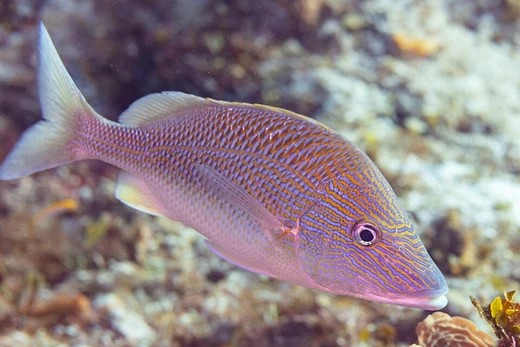
Plectorhinchus chatodonoides
A spotted Indo-Pacific sweetlips with juvenile mimicry of flatworms.
Last updated
The harlequin sweetlips, also called the clown, spotted, or many-spotted sweetlips, is a marine fish in the grunt family. It lives in the Indo-Pacific. Local fisheries catch it in small numbers, and it also appears in the aquarium trade.
Description
This fish has thick lips that swell more as it gets older. Its chin has six pores but no central pit. The dorsal fin usually has 12 spines (rarely 11) and 18 to 20 soft rays, with the soft part about as tall as its base. Young fish are brown with large, separate creamy white blotches that later develop brown spots.
Adults turn grayish with big dark brown spots, each spot wider than the eye. They can reach 72 cm (28 in) long, though 60 cm (24 in) is more common, and weigh up to 7 kg (15 lb). Juveniles may mimic poisonous flatworms (Batesian mimicry). Their tail fin is deeply forked with wide, rounded lobes that are mostly white with a large brown spot; in adults, the tail is less forked.
Distribution
The species ranges from the Maldives and Mauritius east to Tonga, north to the Ryukyu Islands, and south to the Great Barrier Reef. One was seen off St. Martin in the West Indies in 2007, likely released from an aquarium.
Habitat and biology
Adults live alone near ledges or caves in clear lagoons and seaward reefs, hiding during the day. Juveniles shelter in corals. They hunt at night, eating bottom-dwelling invertebrates like crustaceans and molluscs, as well as fish. Young fish often swim head-down with wiggling fins, possibly mimicking toxic flatworms or nudibranchs to avoid predators.
Systematics
French naturalist Bernard Germain de Lacépède first described the species in 1801, without giving a type locality (likely somewhere in modern Indonesia). The name chaetodonoides means "having the form of Chaetodon," which at the time included both butterflyfish and marine angelfish, referring to the serrated gill cover and the then-assumed close relationship with that genus.
People catch these fish with handlines and spears. They are sold fresh or salted. Larger ones have coarse, dry meat. Colorful juveniles are collected for aquariums, and overexploitation may occur in some areas.
Scientific classification
- KingdomAnimalia
- PhylumChordata
- ClassActinopterygii
- DivisionTeleostei
- OrderAcanthuriformes
- FamilyHaemulidae
- GenusPlectorhinchus
- SpeciesPlectorhinchus chaetodonoides
Named by Lacépède, 1801
Close relatives
Other species of Plectorhinchus with a Codexery entry.
- Plectorhinchus gaterinus
- Plectorhinchus caeruleonothus
- Plectorhinchus gibbosus
- Plectorhinchus vittatus
- Plectorhinchus macrospilus
- Plectorhinchus mediterraneus
- Plectorhinchus centurio
- Plectorhinchus ceylonensis
Sources: Wikipedia taxobox: Plectorhinchus chaetodonoides (CC BY-SA 4.0) · differs from this box at order: WoRMS AphiaID 273483 (CC BY 4.0)
Conservation status
Least Concern (LC)
- LC▲ this species
- NT
- VU
- EN
- CR
- EW
- EX
Source: IUCN Red List assessment · GBIF copy of the Red List category
How big is it?
Largest length in the source, 0.72 m, next to a 1.8 m person.
Diagram: drawn by Codexery, schematic shapes to scale (not a likeness). Length: Wikipedia: Plectorhinchus chaetodonoides
Where the plectorhinchus chatodonoides has been recorded
Each dot is a place where the species has been observed and reported (2,794 records, half-degree grid) — not a modelled range. 26 inland records left out (institution coordinates). 2 isolated far-off records not drawn.
Map: drawn by Codexery. Data: GBIF occurrence search (records CC0 / CC BY) · Natural Earth basemap (public domain) · place coordinates: Wikipedia (CC BY-SA 4.0)
More in Grunts
Elsewhere in Snappers and Grunts
Sources
Compiled from Wikipedia and the sources listed below. Text from Wikipedia is available under CC BY-SA 4.0; this entry is adapted from it.
- Wikipedia: Plectorhinchus chaetodonoides (CC BY-SA 4.0).
- Classification: the source article's taxobox; compare WoRMS, the World Register of Marine Species (CC BY 4.0).
- Conservation status: IUCN Red List assessment.
- Occurrence records: GBIF (CC0 / CC BY). Basemap: Natural Earth (public domain).
- Word definitions: the , each quoted from its Wikipedia article.
Spotted an error? Know more?
Reader corrections go straight into our review queue. Suggest an edit · How this site is sourced