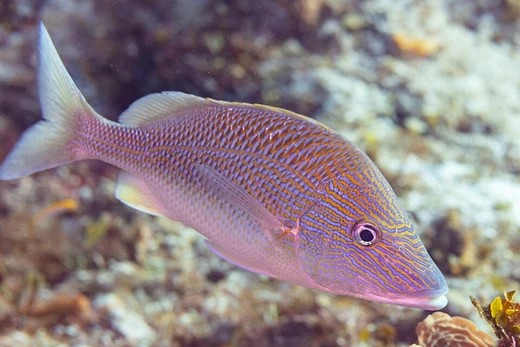
Mexican barred snapper
Monotypic snapper endemic to the eastern Pacific Ocean.
Last updated
The Mexican barred snapper (Hoplopagrus guentherii), also called the barred pargo, is a marine fish in the snapper family Lutjanidae. It lives in the eastern Pacific Ocean and is the sole member of its genus.
Taxonomy
This species was first scientifically described in 1862 by American ichthyologist Theodore Nicholas Gill, who gave the type location as Baja California. The genus name likely combines hoplo ("armed," referring to the serrated preoperculum) and pagrus ("porgy"), as Gill thought the fish was intermediate between snappers and porgies.
The specific name honors German-born British ichthyologist Albert Günther. An extinct snapper called Hypsocephalus, known from the Late Eocene of Florida, is thought to be the closest relative of Hoplopagrus based on skull similarities. Its presence in the Atlantic suggests that Hoplopagrus relatives once ranged across both tropical Pacific and Atlantic coasts of the Americas, later shrinking to the Pacific due to cooling and falling sea levels.
Description
The Mexican barred snapper has a deep, moderately compressed body—the deepest among snappers, with a depth 44–46% of its length. Its preoperculum is strongly notched with a distinct knob. It has a long, downward-pointing tubular front nostril and a rear nostril set in a deep groove before the eye.
The jaws hold bands of robust molar-like teeth, with similar teeth on the vomer but none on the tongue. The dorsal fin has 10 spines and 14 soft rays; the anal fin has 3 spines and 9 soft rays; both fins have scales at their bases. Long pectoral fins, with 16–17 rays, extend past the anus.
Overall color is reddish-brown, browner on the head, with a white chin and six alternating broad and narrow vertical white bars on the sides. Juveniles have closely paired bars and a black spot at the base of the dorsal fin rays. Maximum total length is 92 cm (36 in), though 50 cm (20 in) is more typical, and the heaviest recorded weight is 9.6 kg (21 lb).
Distribution and habitat
The species is endemic to the eastern Pacific, from southern Baja California and the northern Gulf of California south to Ecuador, including the Galapagos, Malpelo, and Cocos Islands. It lives at depths of 3 to 50 m (9.8 to 164 ft). Adults inhabit rocky areas near coral reefs and caves; juveniles are found in rocky tidal pools.
Scientific classification
- KingdomAnimalia
- PhylumChordata
- ClassActinopterygii
- DivisionTeleostei
- OrderAcanthuriformes
- FamilyLutjanidae
- GenusHoplopagrus
- SpeciesHoplopagrus guentherii
Named by T. N. Gill, 1862
Sources: Wikipedia taxobox: Mexican barred snapper (CC BY-SA 4.0) · differs from this box at order: WoRMS AphiaID 281087 (CC BY 4.0)
Conservation status
Least Concern (LC)
- LC▲ this species
- NT
- VU
- EN
- CR
- EW
- EX
Source: IUCN Red List assessment · GBIF copy of the Red List category
How big is it?
Largest length in the source, 0.92 m, next to a 1.8 m person.
Diagram: drawn by Codexery, schematic shapes to scale (not a likeness). Length: Wikipedia: Mexican barred snapper
Where the mexican barred snapper has been recorded
Each dot is a place where the species has been observed and reported (903 records, half-degree grid) — not a modelled range. 52 inland records left out (institution coordinates).
Map: drawn by Codexery. Data: GBIF occurrence search (records CC0 / CC BY) · Natural Earth basemap (public domain) · place coordinates: Wikipedia (CC BY-SA 4.0)
Ranked in
More in Snappers
Elsewhere in Snappers and Grunts
Test yourself
Three questions drawn from this entry’s sources. Pick an answer to check it.
Answers checked against the source article
Sources
Compiled from Wikipedia and the sources listed below. Text from Wikipedia is available under CC BY-SA 4.0; this entry is adapted from it.
- Wikipedia: Mexican barred snapper (CC BY-SA 4.0).
- Classification: the source article's taxobox; compare WoRMS, the World Register of Marine Species (CC BY 4.0).
- Conservation status: IUCN Red List assessment.
- Occurrence records: GBIF (CC0 / CC BY). Basemap: Natural Earth (public domain).
- Word definitions: the , each quoted from its Wikipedia article.
Spotted an error? Know more?
Reader corrections go straight into our review queue. Suggest an edit · How this site is sourced