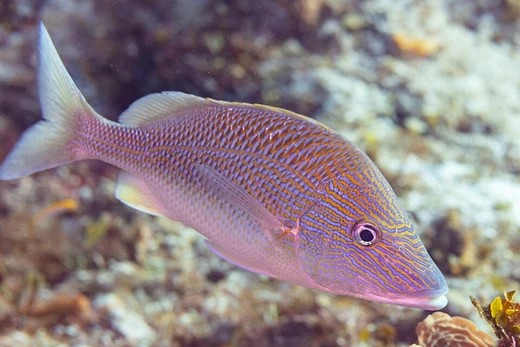
Tang's snapper
A deepwater snapper with fleshy lips, sole member of its genus.
Last updated
Tang's snapper (Lipocheilus carnolabrum) is a marine ray-finned fish in the snapper family Lutjanidae. Found in the Indian Ocean and western Pacific, it is the only species in its genus and is commercially fished for food.
Description
The fish’s body depth is about 40% of its standard length. It has a large mouth, with the upper jaw jutting forward when closed; adults also have a thick, fleshy knob on the front of the upper lip. The area between the eyes may be flat or slightly curved.
It has teeth on the palate and vomer, the vomerine teeth forming a V-shaped patch. The tail fin is moderately forked. The dorsal fin has 10 spines and 10 soft rays, and the anal fin has 3 spines and 8 soft rays—neither fin has scales. The rearmost soft rays of the dorsal and anal fins are not elongated.
The long pectoral fins extend past the anus. The upper head and body are brown, with yellowish or pinkish sides and a silvery underside. Adults reach up to 60 cm (24 in) in total length.
Distribution
This species has a broad Indo-West Pacific range, but it has been recorded only in scattered locations: the Ryukyu Islands, the South China Sea, the Andaman Sea, the northwestern Arabian Sea, the Lakshadweep Islands, Sri Lanka, Vanuatu, northern Australia, Papua New Guinea, and the Solomon Islands.
Habitat and biology
Tang’s snapper is a demersal fish that lives over rocky bottoms and reefs on the continental shelf, at depths between 90 and 340 m (300–1,120 ft). It likely preys on fish and larger invertebrates. It is a typical part of the fish community found at depths greater than 200 m (660 ft) in offshore waters.
Systematics and etymology
The species was first formally described in 1970 as Tangia carnolabrum by Chan William Lai-Yee, based on a specimen taken about 145 km (90 mi) southeast of Hong Kong at 110–130 m (360–430 ft) depth. The genus name Tangia was already used for a leafhopper, so in 1977 William D. Anderson Jr., Purnesh Kumar Talwar, and G. David Johnson created the new genus Lipocheilus—from lipos (fat) and cheilos (lip), referring to the fleshy lip knob. The specific name carnolabrum means “fleshy lips” for the same reason. It remains the sole member of its genus.
Tang’s snapper is targeted by long-line fisheries, especially off southern China. In Papua New Guinea, it is commercially important even when not directly targeted.
Scientific classification
- KingdomAnimalia
- PhylumChordata
- ClassActinopterygii
- DivisionTeleostei
- OrderAcanthuriformes
- FamilyLutjanidae
- GenusLipocheilus
- SpeciesLipocheilus carnolabrum
Named by (W. L. Y. Chan, 1970)
Sources: Wikipedia taxobox: Tang's snapper (CC BY-SA 4.0) · differs from this box at order: WoRMS AphiaID 218471 (CC BY 4.0)
Conservation status
Least Concern (LC)
- LC▲ this species
- NT
- VU
- EN
- CR
- EW
- EX
Source: IUCN Red List assessment · GBIF copy of the Red List category
How big is it?
Largest length in the source, 0.6 m, next to a 1.8 m person.
Diagram: drawn by Codexery, schematic shapes to scale (not a likeness). Length: Wikipedia: Tang's snapper
Where the tang's snapper has been recorded
Each dot is a place where the species has been observed and reported (83 records, half-degree grid) — not a modelled range. 8 inland records left out (institution coordinates).
Map: drawn by Codexery. Data: GBIF occurrence search (records CC0 / CC BY) · Natural Earth basemap (public domain) · place coordinates: Wikipedia (CC BY-SA 4.0)
Frequently Asked Questions
What is Tang's snapper?
Tang's snapper (Lipocheilus carnolabrum) is a deepwater marine ray-finned fish in the snapper family Lutjanidae. It stands alone as the only species within its genus, which makes it taxonomically distinctive among snappers.
Where does Tang's snapper live?
This species ranges across the Indian Ocean and the western Pacific, occupying depths from roughly 90 to 340 meters. Its type locality sits in the South China Sea, about 145 km southeast of Hong Kong at 110–130 m depth.
What does Tang's snapper look like?
It has a large mouth with the upper jaw projecting past the lower when closed, and adults grow a thick fleshy knob on the front of the upper lip. The body depth is about 40 % of standard length, the caudal fin is moderately forked, and the vomerine teeth form a characteristic V-shaped patch.
Ranked in
More in Snappers
Elsewhere in Snappers and Grunts
Test yourself
Three questions drawn from this entry’s sources. Pick an answer to check it.
Answers checked against the source article
Sources
Compiled from Wikipedia and the sources listed below. Text from Wikipedia is available under CC BY-SA 4.0; this entry is adapted from it.
- Wikipedia: Tang's snapper (CC BY-SA 4.0).
- Classification: the source article's taxobox; compare WoRMS, the World Register of Marine Species (CC BY 4.0).
- Conservation status: IUCN Red List assessment.
- Occurrence records: GBIF (CC0 / CC BY). Basemap: Natural Earth (public domain).
- Word definitions: the , each quoted from its Wikipedia article.
Spotted an error? Know more?
Reader corrections go straight into our review queue. Suggest an edit · How this site is sourced