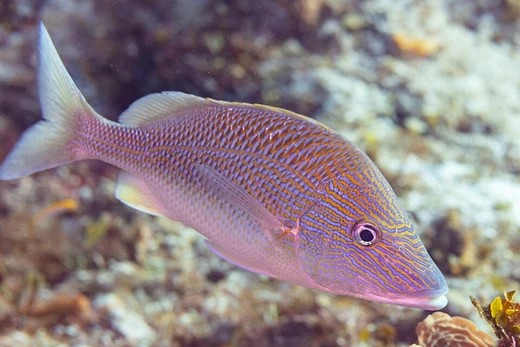
Genyatremus luteus
A silvery-yellow grunt of South American Atlantic estuaries.
Last updated
Genyatremus luteus, commonly known as the Torroto grunt, is a species of marine ray-finned fish belonging to the subfamily Plectorhinchinae of the family Haemulidae. It is native to the Atlantic coast of South America, ranging from Colombia to Brazil, and also occurs north into the southern part of the Lesser Antilles. This species is notable for its distinctive coloration and its preference for brackish estuarine habitats.
Scientific classification
- KingdomAnimalia
- PhylumChordata
- ClassActinopterygii
- DivisionTeleostei
- OrderAcanthuriformes
- FamilyHaemulidae
- GenusGenyatremus
- SpeciesGenyatremus luteus
Named by (Bloch, 1790)
Sources: Wikipedia taxobox: Genyatremus luteus (CC BY-SA 4.0) · differs from this box at order: WoRMS AphiaID 280829 (CC BY 4.0)
Conservation status
Data Deficient (DD)
Data Deficient: there is not enough information to place this species on the risk scale.
Source: IUCN Red List assessment · GBIF copy of the Red List category
How big is it?
Largest length in the source, 0.37 m, next to a 1.8 m person.
Diagram: drawn by Codexery, schematic shapes to scale (not a likeness). Length: Wikipedia: Genyatremus luteus
Where the genyatremus luteus has been recorded
Each dot is a place where the species has been observed and reported (480 records, half-degree grid) — not a modelled range. 47 inland records left out (institution coordinates). 1 isolated far-off record not drawn.
Map: drawn by Codexery. Data: GBIF occurrence search (records CC0 / CC BY) · Natural Earth basemap (public domain) · place coordinates: Wikipedia (CC BY-SA 4.0)
Background
Genyatremus luteus was first formally described in 1790 as Lutjanus luteus by the German naturalist and physician Marcus Elieser Bloch, with the type locality given as the Antilles, thought to be Martinique. The specific name luteus means “yellow”, a reference to the yellow or yellowish fins of this species. Some authorities have argued that Genyatremus luteus is not a valid name and that this taxon is synonymous with Cuvier's Diagramma cavifrons, while others contend that Cuvier's D. cavifrons is not a haemulid but belongs to another family, and that Bloch's L. luteus is valid and should be used as the type species of the genus Genyatremus.
The body of Genyatremus luteus is oval-shaped and compressed, with a depth just under half its standard length. The head is small with a moderately large mouth, and there are two pores on the chin but no central groove. The preoperculum has strong serrations at its corner.
The dorsal fin is high, containing 13 spines (the fifth being longer than the others) and 12 soft rays; the anal fin has 3 spines and 11 soft rays. The caudal fin is emarginate. The body is silvery with a yellowish tint, the edge of the preoperculum is yellow, the dorsal fin spines are silvery with a black margin, the anal fin is yellowish, the pectoral fins have a yellowish cast, and the pelvic fins and base of the tail have a black rear margin.
More in Grunts
Elsewhere in Snappers and Grunts
Test yourself
Three questions drawn from this entry’s sources. Pick an answer to check it.
Answers checked against the source article
Sources
Compiled from Wikipedia and the sources listed below. Text from Wikipedia is available under CC BY-SA 4.0; this entry is adapted from it.
- Wikipedia: Genyatremus luteus (CC BY-SA 4.0).
- Classification: the source article's taxobox; compare WoRMS, the World Register of Marine Species (CC BY 4.0).
- Conservation status: IUCN Red List assessment.
- Occurrence records: GBIF (CC0 / CC BY). Basemap: Natural Earth (public domain).
- Word definitions: the , each quoted from its Wikipedia article.
Spotted an error? Know more?
Reader corrections go straight into our review queue. Suggest an edit · How this site is sourced