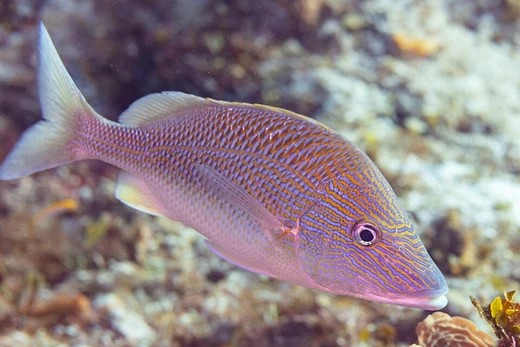
Scalemouth jobfish
The only known member of its genus, found in deep Pacific waters.
Last updated
The scalemouth jobfish, or scalemouth snapper (Parapristipomoides squamimaxillaris), is a marine ray-finned fish in the snapper family Lutjanidae. It lives in the Pacific Ocean and is the sole species in its genus.
This fish has a long, slim body, with its deepest point measuring about one-third of its standard length. Its head is small and sharply pointed, with a convex area between the eyes. The lower jaw sticks out a little, and the mouth reaches back to the pupil. The upper jaw bones are covered in scales, and each jaw has a single thin band of bristle-like teeth, plus a small oval patch of teeth on the roof of the mouth.
The dorsal fin has 10 spines and 10 soft rays, while the anal fin has 3 spines and 8 soft rays. The largest recorded length is 51.4 cm (20.2 in). Its main color is silvery pink, darker on the back. The fins are whitish, except the tail fin, which has a yellow upper lobe and a pinkish lower lobe.
The species has a scattered range in the southern Pacific, recorded from Easter Island, Rapa Iti, New Caledonia, and Tonga. It lives in relatively deep water, between 130 and 460 m (430 to 1,510 ft), and is associated with rocky bottoms, especially reefs.
American zoologist Harry T. Kami first described it in 1973 as Pristipomoides squamimaxillaris, with the type location at Easter Island. He placed it in the monotypic subgenus Parapristipomoide, but later researchers decided it was distinct enough to warrant its own genus, Parapristipomoides. The genus name means "near to Pristipomoides," and the species name squamimaxillaris means "scaly jaw," referring to its scaled jaws.
At Easter Island and Rapa Iti, this fish is caught by handline fishing and sold fresh.
Scientific classification
- KingdomAnimalia
- PhylumChordata
- ClassActinopterygii
- DivisionTeleostei
- OrderAcanthuriformes
- FamilyLutjanidae
- GenusParapristipomoides
- SpeciesParapristipomoides squamimaxillaris
Named by (Kami, 1973)
Sources: Wikipedia taxobox: Scalemouth jobfish (CC BY-SA 4.0) · differs from this box at order: WoRMS AphiaID 282103 (CC BY 4.0)
Conservation status
Least Concern (LC)
- LC▲ this species
- NT
- VU
- EN
- CR
- EW
- EX
Source: IUCN Red List assessment · GBIF copy of the Red List category
How big is it?
Largest length in the source, 0.51 m, next to a 1.8 m person.
Diagram: drawn by Codexery, schematic shapes to scale (not a likeness). Length: Wikipedia: Scalemouth jobfish
Where the scalemouth jobfish has been recorded
Map: drawn by Codexery. Data: Natural Earth basemap (public domain) · place coordinates: Wikipedia (CC BY-SA 4.0)
Frequently Asked Questions
What is the scalemouth jobfish?
The scalemouth jobfish (Parapristipomoides squamimaxillaris) is a deep-water snapper belonging to the family Lutjanidae. It stands out taxonomically as the only species in its genus, making it a true one-of-a-kind within the Pacific snapper group.
Where does the scalemouth jobfish live?
This species occupies the Pacific Ocean at depths between roughly 130 and 460 meters (about 430 to 1,510 feet). Its type locality is Easter Island, the site where the original specimens were gathered.
Who first described the scalemouth jobfish and when?
The species was formally named in 1973 by Harry T. Kaminski. It has remained the sole representative of the genus Parapristipomoides ever since its original description.
Ranked in
More in Snappers
Elsewhere in Snappers and Grunts
Test yourself
Three questions drawn from this entry’s sources. Pick an answer to check it.
Answers checked against the source article
Sources
Compiled from Wikipedia and the sources listed below. Text from Wikipedia is available under CC BY-SA 4.0; this entry is adapted from it.
- Wikipedia: Scalemouth jobfish (CC BY-SA 4.0).
- Classification: the source article's taxobox; compare WoRMS, the World Register of Marine Species (CC BY 4.0).
- Conservation status: IUCN Red List assessment.
- Occurrence records: GBIF (CC0 / CC BY). Basemap: Natural Earth (public domain).
- Word definitions: the Codexery glossary, each quoted from its Wikipedia article.
Spotted an error? Know more?
Reader corrections go straight into our review queue. Suggest an edit · How this site is sourced