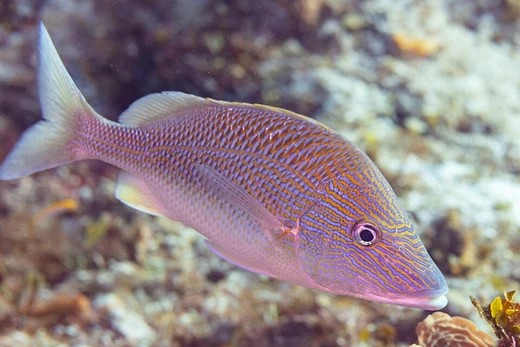
African forktail snapper
A dark-bodied snapper of the eastern Atlantic, found on reefs.
Last updated
The African forktail snapper, known scientifically as Apsilus fuscus, is a marine fish from the snapper family Lutjanidae. Its range is the eastern Atlantic Ocean, running along Africa’s western coast from Mauritania down to Namibia, and includes the Cape Verde Islands. When first described, it was the sole member of its genus, making it the type species of Apsilus by monotypy.
Description
This fish has a moderately long, spindle-shaped body. Its mouth extends back to the front of the eye, and all its teeth are bristle-like, with a V-shaped patch on the vomer. The space between its eyes is wide and rounded.
Its tail fin is forked. The dorsal fin has 10 spines and 10 soft rays, while the anal fin has 3 spines and 8 soft rays. The upper body and sides are dark brown, fading to lighter shades on the belly, chin, and throat. It can reach a total length of 75 cm (30 in), though 60 cm (24 in) is more common.
Habitat and biology
The snapper lives at depths between 15 and 300 m (49 to 984 ft), but is usually found deeper than 50 m (160 ft). It prefers rocky or coral substrates, often on reefs, and is seen alone or in small groups. A predator, it feeds on small fish, crustaceans, and cephalopods.
Distribution
In Nigeria, it has been reported in estuaries, and off Ghana, gatherings in waters shallower than 40 m (130 ft) may be linked to seasonal upwellings. It is rare in the northern part of its range and is very uncommonly caught off Senegal. Reports from the Indian Ocean are considered misidentifications.
Utilisation
The fish is considered potentially valuable to fisheries because its flesh is of good quality. It is caught with handlines, set nets, and bottom trawls, and sold fresh.
It also turns up as bycatch in commercial octopus fisheries. The species was first formally described in 1830 by French zoologist Achille Valenciennes, who gave the type locality as Porto Praya in the Cape Verde Islands. Its specific name, fuscus, means "dark" or "dusky," referencing its brown color.
Scientific classification
- KingdomAnimalia
- PhylumChordata
- ClassActinopterygii
- DivisionTeleostei
- OrderAcanthuriformes
- FamilyLutjanidae
- GenusApsilus
- SpeciesApsilus fuscus
Named by Valenciennes, 1830
Close relatives
Other species of Apsilus with a Codexery entry.
- Apsilus dentatus Apsilus dentatus
Sources: Wikipedia taxobox: African forktail snapper (CC BY-SA 4.0) · differs from this box at order: WoRMS AphiaID 212548 (CC BY 4.0)
Conservation status
Least Concern (LC)
- LC▲ this species
- NT
- VU
- EN
- CR
- EW
- EX
Source: IUCN Red List assessment · GBIF copy of the Red List category
How big is it?
Largest length in the source, 0.75 m, next to a 1.8 m person.
Diagram: drawn by Codexery, schematic shapes to scale (not a likeness). Length: Wikipedia: African forktail snapper
Where the african forktail snapper has been recorded
Each dot is a place where the species has been observed and reported (641 records, half-degree grid) — not a modelled range. 35 inland records left out (institution coordinates). 1 isolated far-off record not drawn.
Map: drawn by Codexery. Data: GBIF occurrence search (records CC0 / CC BY) · Natural Earth basemap (public domain)
Ranked in
More in Snappers
Elsewhere in Snappers and Grunts
Test yourself
Three questions drawn from this entry’s sources. Pick an answer to check it.
Answers checked against the source article
Sources
Compiled from Wikipedia and the sources listed below. Text from Wikipedia is available under CC BY-SA 4.0; this entry is adapted from it.
- Wikipedia: African forktail snapper (CC BY-SA 4.0).
- Classification: the source article's taxobox; compare WoRMS, the World Register of Marine Species (CC BY 4.0).
- Conservation status: IUCN Red List assessment.
- Occurrence records: GBIF (CC0 / CC BY). Basemap: Natural Earth (public domain).
- Word definitions: the , each quoted from its Wikipedia article.
Spotted an error? Know more?
Reader corrections go straight into our review queue. Suggest an edit · How this site is sourced