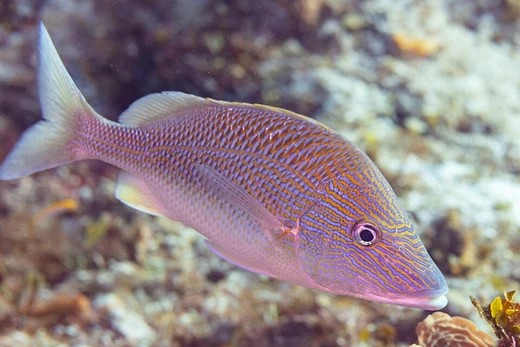
Lutjanus lutjanus
Type species of the genus Lutjanus, found in Indo-West Pacific.
Last updated
The bigeye snapper (Lutjanus lutjanus) is a species of marine ray-finned fish in the family Lutjanidae. It is notable as the type species of the genus Lutjanus, originally described by Marcus Elieser Bloch in 1790.
Scientific classification
- KingdomAnimalia
- PhylumChordata
- ClassActinopterygii
- DivisionTeleostei
- OrderAcanthuriformes
- FamilyLutjanidae
- GenusLutjanus
- SpeciesLutjanus lutjanus
Named by Bloch, 1790
Close relatives
Other species of Lutjanus with a Codexery entry.
- African brown snapper Lutjanus dentatus
- Blackfin snapper Lutjanus buccanella
- Blue and gold snapper Lutjanus viridis
- Bluestriped snapper Lutjanus notatus
- Brazilian snapper Lutjanus alexandrei
- Common bluestripe snapper Lutjanus kasmira
- Cubera snapper Lutjanus cyanopterus
- Dog snapper Lutjanus jocu
Sources: Wikipedia taxobox: Bigeye snapper (CC BY-SA 4.0) · differs from this box at order: WoRMS AphiaID 218495 (CC BY 4.0)
Conservation status
Least Concern (LC)
- LC▲ this species
- NT
- VU
- EN
- CR
- EW
- EX
Source: IUCN Red List assessment · GBIF copy of the Red List category
How big is it?
Largest length in the source, 0.35 m, next to a 1.8 m person.
Diagram: drawn by Codexery, schematic shapes to scale (not a likeness). Length: Wikipedia: Bigeye snapper
Where the lutjanus lutjanus has been recorded
Each dot is a place where the species has been observed and reported (43,758 records, half-degree grid) — not a modelled range. 27 inland records left out (institution coordinates). 1 isolated far-off record not drawn.
Map: drawn by Codexery. Data: GBIF occurrence search (records CC0 / CC BY) · Natural Earth basemap (public domain) · place coordinates: Wikipedia (CC BY-SA 4.0)
Background
The bigeye snapper was first formally described in 1790 by German physician and zoologist Marcus Elieser Bloch, with a type locality given as Japan, though this is thought to be erroneous and actually Indonesia. Bloch named the genus Lutjanus when describing this species, and it became the type species by tautonymy. The name lutjanus derives from the local Indonesian name for snappers, ikhan Lutjang.
The species has a fusiform, slender body with a standard length 2.9 to 3.3 times the body's deepest points. It has a gently sloped forehead, weakly developed preopercular incision and knob, and vomerine teeth arranged in a triangular patch with a central rearward extension. The tongue has a patch of grain-like teeth.
The dorsal fin has 10-12 spines and 12 soft rays, the anal fin 3 spines and 8 soft rays, and the pectoral fins 16-17 rays. The caudal fin is truncate or weakly emarginate. The upper back is golden-brown with silvery-white flanks, a brown to yellow stripe from snout to caudal peduncle, oblique golden lines above the lateral line, and horizontal stripes below. The dorsal, anal, and caudal fins are vivid yellow.
It is found in the Indian Ocean and western Pacific Ocean, from the Red Sea and eastern Africa to Japan and Australia, at depths of 1 to 96 m over coral reefs and inshore soft substrates. It is often observed in large aggregations with congeners and preys on fishes and crustaceans. Spawning has been reported in the Gulf of Aden in March, off eastern Africa in November, and in the Gulf of Suez between January and June.
Frequently Asked Questions
How big does Lutjanus lutjanus get and where does it live?
Adults top out at roughly 35 cm (about 14 in) in total length. The species ranges across the Indo-West Pacific, occupying depths from just 1 m down to around 96 m.
Who originally described Lutjanus lutjanus and when?
The species was first formally described by the naturalist Marcus Elieser Bloch back in 1790. That 18th-century publication is what anchors its place as the type species of the genus.
Ranked in
More in Snappers
Elsewhere in Snappers and Grunts
Test yourself
Three questions drawn from this entry’s sources. Pick an answer to check it.
Answers checked against the source article
Sources
Compiled from Wikipedia and the sources listed below. Text from Wikipedia is available under CC BY-SA 4.0; this entry is adapted from it.
- Wikipedia: Bigeye snapper (CC BY-SA 4.0).
- Classification: the source article's taxobox; compare WoRMS, the World Register of Marine Species (CC BY 4.0).
- Conservation status: IUCN Red List assessment.
- Occurrence records: GBIF (CC0 / CC BY). Basemap: Natural Earth (public domain).
- Word definitions: the , each quoted from its Wikipedia article.
Spotted an error? Know more?
Reader corrections go straight into our review queue. Suggest an edit · How this site is sourced