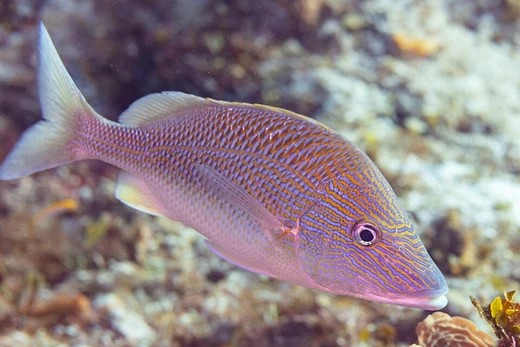
Haemulinae
New World-origin grunts with short dorsal fins of 13–16 soft rays.
Last updated
Haemulinae is a subfamily of the family Haemulidae, comprising genera regarded as being of New World origin, though they are now widespread. It is distinguished from the other haemulid subfamily, Plectorhynchinae, by having a short dorsal fin containing 13–16 soft rays, whereas Plectorhynchinae has a long dorsal fin with 17–26 soft rays.
Scientific classification
- KingdomAnimalia
- PhylumChordata
- ClassActinopterygii
- DivisionTeleostei
- OrderAcanthuriformes
- FamilyHaemulidae
Named by Gill, 1885
Sources: Wikipedia taxobox: Haemulinae (CC BY-SA 4.0)
Quick Facts
- Family
- Haemulidae
- Dorsal fin soft rays
- 13–16
- Contrasting subfamily
- Plectorhynchinae
- Number of genera listed
- 17
Facts from the source article.
Background
The subfamily Haemulinae consists of genera that are regarded as being of New World origin, although they are now widespread. It is distinguished from the subfamily Plectorhynchinae by having a short dorsal fin containing 13–16 soft rays, as opposed to the long dorsal fin with 17–26 soft rays of Plectorhynchinae.
Genera included in Haemulinae by Eschmeyer's Catalog of Fishes include Anisotremus, Boridia, Brachydeuterus, Brachygenys, Conodon, Emmelichthyops, Haemulon, Haemulopsis, Isacia, Microlepidotus, Orthopristis, Parakuhlia, Paranisotremus, Pomadasys, Rhencus, Rhonciscus, and Xenichthys. The genus Brachygenys is recognized by some authorities because Haemulon was determined to be paraphyletic in molecular studies, which showed Haemulon chrysargyreum clustered with Xenistius californianus; Brachygenys also includes species from the former genera Xenistius and Xenocys.
Similarly, molecular studies resolved Pomadasys as paraphyletic, leading to the revival of the genera Rhencus and Rhonciscus to solve this paraphyly. The eastern Pacific species P. macracanthus and P. panamensis are placed in Rhencus, while Rhonciscus contains the eastern Pacific species P. bayanus and the western Atlantic species P. crocro. These changes are recognized by Catalog of Fishes but not yet by Fishbase. Additionally, Anisotremus moricandi makes Anisotremus paraphyletic if included and has been placed in the monotypic genus Paranisotremus.
More in Grunts
Elsewhere in Snappers and Grunts
Sources
Compiled from Wikipedia and the sources listed below. Text from Wikipedia is available under CC BY-SA 4.0; this entry is adapted from it.
- Wikipedia: Haemulinae (CC BY-SA 4.0).
- Word definitions: the , each quoted from its Wikipedia article.
Spotted an error? Know more?
Reader corrections go straight into our review queue. Suggest an edit · How this site is sourced