Lutjanus
A genus of predatory snappers found in tropical and subtropical waters worldwide.
Last updated
Lutjanus is a genus of marine ray-finned fish known as snappers, part of the family Lutjanidae. These predatory fish inhabit tropical and subtropical reefs and mangrove forests across the Atlantic, Indian, and Pacific Oceans. Two species within this genus are found exclusively in fresh and brackish waters.
Description
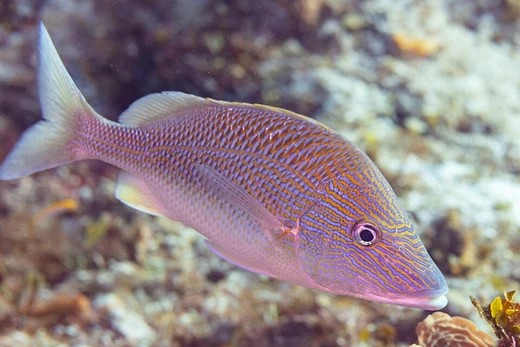
Snappers in this genus range from small to large, with oblong bodies that can be deep, slender, or fusiform. Their coloration varies widely, often featuring a reddish, yellow, grey, or brown base with darker stripes or bars. Many have a prominent blackish spot on the upper sides below the front soft rays of the dorsal fin. They possess relatively large, protractable mouths.
Their jaws contain one or more rows of pointed, conical teeth, with the outer row including canine-like teeth, the front ones enlarged into obvious fangs. Vomerine teeth form patches that may be chevron, triangular, or lunate, sometimes with a rear extension or arranged in a rhombus. The space between the eyes is convex, and the preopercle is serrated with a deep notch on its lower edge. Some species have a bony knob between the operculum and preopercle, most noticeable in those with a deep preopercle notch.
The dorsal fin is continuous, often with a slight notch between the spiny and soft-rayed sections. The spiny part typically has 10 or 11 spines, while the soft-rayed part has 11 to 16 rays.
The anal fin has three spines and seven to ten soft rays, and the pectoral fins have 15 to 18 soft rays. Both dorsal and anal fins are covered in scales. The caudal fin may be emarginate, truncated, or rarely forked.
Larger Lutjanus species are commercially important and prized as food fish in tropical regions. They are caught using handlines, traps, spears, nets, and trawling gear, and are mainly sold fresh, though they may be frozen or dry-salted.
Biology
These snappers have a circumtropical and subtropical distribution. The mangrove red snapper and dory snapper have been recorded in the Mediterranean as possible Lessepsian migrants from the Red Sea via the Suez Canal, while the dog snapper, a western Atlantic species, has appeared in the Ligurian Sea.
Many species are associated with coral reefs and are conspicuous members of the reef fish community. Some larger red snapper species descend to depths of at least 200 meters. Two species, L. fuscescens and L.
Scientific classification
- KingdomAnimalia
- PhylumChordata
- ClassActinopterygii
- DivisionTeleostei
- OrderAcanthuriformes
- FamilyLutjanidae
- GenusLutjanus
Named by Bloch, 1790
Sources: Wikipedia taxobox: Lutjanus (CC BY-SA 4.0)
Quick Facts
- Type species
- Lutjanus lutjanus
Facts from the source article.
Background
Lutjanus was created in 1790 by German physician and zoologist Marcus Elieser Bloch, with Lutjanus lutjanus as its type species by tautonymy. The name is derived from a local Indonesian name for snappers, ikhan Lutjang.
Bloch erroneously stated that the type locality for L. lutjanus was Japan, when the name he gave it suggested that it was collected in the East Indies. A taxonomic study of snappers within the subfamily Lutjaninae in the tropical western Atlantic Ocean indicated that the monotypic genera Ocyurus and Rhomboplites sit within the genus Lutjanus. Lutjanus ambiguus is considered by some authorities to most likely be a hybrid between L. synagris and Ocyurus chrysurus, supporting the close relation between the two genera.
Lutjanus snappers are small to large in size with oblong-shaped bodies, which vary from deep to slender and fusiform. These snappers are extremely variable in colour, frequently having a background colour of reddish, yellow, grey, or brown overlain with a pattern of darker stripes or bars. They are often marked with a large, blackish spot on the upper flanks underneath the front soft rays of the dorsal fin. They have relatively large mouths which are protractable.
The teeth are arranged in one or more rows in the jaws and are pointed and conical in shape, with the outer row consisting of canine-like teeth with the anterior ones enlarged into more obvious canine-like fangs. The vomerine teeth are arranged in patches, which may be chevron, triangular, or lunate and may or may not have a posterior extension or be arranged in a rhombus. The space between the eyes is convex, and they have a serrated preopercle, which has a deep incision on its lower margin. They sometimes have a bony knob between the operculum and the preopercle that is most obvious in those species with a deep incision in the preopercle.
Lutjanus species have continuous dorsal fins, frequently with a slight incision between the spiny portion and the soft-rayed portion. The spiny part of the dorsal fin may have 10 or 11 spines, while the soft-rayed part may have 11 to 16 rays. The anal fin has three spines and between seven and 10 soft rays, while the pectoral fins have between 15 and 18 soft rays. The dorsal and anal fins are scaled, while the caudal fin may be emarginated, truncated, or rarely, forked.
Frequently Asked Questions
Where does Lutjanus live?
This genus occupies tropical and subtropical reef and mangrove habitats spanning the Atlantic, Indian, and Pacific Oceans. Two species are unique to the group in that they live exclusively in fresh or brackish water rather than the open sea.
What do Lutjanus look like?
Most species display a reddish, yellow, grey, or brown base color accented by darker stripes or bars, and many bear a conspicuous dark spot on the upper flank. They carry 10 or 11 dorsal-fin spines, a key feature for distinguishing them from other snappers.
Who named Lutjanus and when?
The genus was established by the naturalist Marcus Elieser Bloch in 1790, with Lutjanus lutjanus serving as the type species. It has remained the type genus of both the subfamily Lutjaninae and the broader family Lutjanidae ever since.
More in Snappers
Elsewhere in Snappers and Grunts
Sources
Compiled from Wikipedia and the sources listed below. Text from Wikipedia is available under CC BY-SA 4.0; this entry is adapted from it.
- Wikipedia: Lutjanus (CC BY-SA 4.0).
- Word definitions: the , each quoted from its Wikipedia article.
Spotted an error? Know more?
Reader corrections go straight into our review queue. Suggest an edit · How this site is sourced