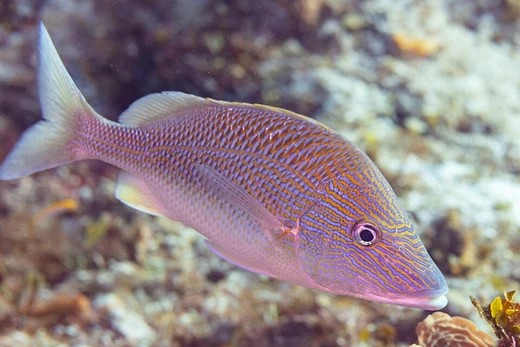
Lutjanidae
A family of marine fishes, many economically important as food.
Last updated
The snappers and fusiliers, known scientifically as Lutjanidae, are a family of percomorph fishes. While most species live in saltwater, some can be found in estuaries, and a few, like Lutjanus goldiei, even inhabit freshwater. The family contains roughly 113 species. Many of these are caught for food and hold significant economic value.
Across the globe, various species from different genera, including Lutjanus and Pristipomoides, are locally called "red snapper." Snappers are found in tropical, subtropical, and warm-temperate waters of every ocean. Most grow to about one meter (3.3 feet) in length, though the cubera snapper can reach up to 1.52 meters (5 feet). These fish are generally active carnivores, feeding on crustaceans or other fish, but a few species feed on plankton. While they can be kept in aquariums, they usually grow too quickly to be popular choices.
The majority live near coral reefs at depths up to 100 meters (330 feet), though some species are found as deep as 500 meters (1,600 feet). Like other fish, snappers can host parasites. A detailed study in New Caledonia found that coral reef-associated snappers typically host around nine species of parasites per fish species.
The classification below follows Eschmeyer's Catalog of Fishes. Known fossil genera include: †Goujetia (Early Eocene, Italy), †Hypsocephalus (Late Eocene, Florida, USA), †Lessinia (Early Eocene, Italy), †Ottaviania (Early Eocene, Italy), and †Veranichthys (Early Eocene, Italy). A fossil species, †"Caesio" breviuscula (earliest Eocene, Turkmenistan), is also recognized. The genus †Parapelates (2008) is likely closely related to snappers, though its family-level classification remains uncertain.
A well-preserved skeleton of a possible lutjanid or cichlid from the Middle Eocene of Cuba represents one of the earliest Caribbean records of the group. The former family Caesionidae (the fusiliers) was once treated as separate due to its distinct morphology. However, it is now known to be paraphyletic with respect to Lutjanidae, and its genera are now placed within the subfamily Lutjaninae. The following cladogram is based on a 2007 study using Bayesian inference on a combined dataset of 16S and cyt b genes.
Scientific classification
- KingdomAnimalia
- PhylumChordata
- ClassActinopterygii
- DivisionTeleostei
- OrderAcanthuriformes
- FamilyLutjanidae
Named by T. N. Gill, 1861
Sources: Wikipedia taxobox: Lutjanidae (CC BY-SA 4.0)
More in Snappers
Elsewhere in Snappers and Grunts
Sources
Compiled from Wikipedia and the sources listed below. Text from Wikipedia is available under CC BY-SA 4.0; this entry is adapted from it.
- Wikipedia: Lutjanidae (CC BY-SA 4.0).
- Word definitions: the , each quoted from its Wikipedia article.
Spotted an error? Know more?
Reader corrections go straight into our review queue. Suggest an edit · How this site is sourced