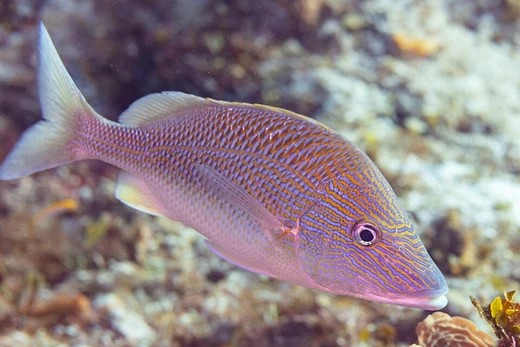
Blackfin snapper
A commercially important snapper with a dark comma at the pectoral fin.
Last updated
The blackfin snapper (Lutjanus buccanella) goes by many names—blackspot snapper, blackfin red snapper, gun-mouth backfin, gun-mouth snapper, redfish, and wrenchman. This marine ray-finned fish belongs to the snapper family Lutjanidae and lives in the western Atlantic Ocean. It is important to commercial fisheries, but people should be aware that it has been linked to ciguatera poisoning.
Taxonomy
French zoologist Georges Cuvier first described the species in 1828, calling it Mesoprion buccanella. He listed the type locations as Martinique and St. Thomas Island in the West Indies. The species name comes from the local Martinique name for the fish, boucanella.
Description
The blackfin snapper has the typical almond-shaped, deep, and laterally compressed body of Lutjanus snappers. Its dorsal fin is continuous but split into two lobes, the tail fin is blunt, the pectoral fins are long, and the anal fin is rounded. The mouth is large, with a slightly protrusible upper jaw that tucks under the cheekbone when closed.
Each jaw has at least one row of pointed, conical teeth, some of which are enlarged into canines. The vomerine teeth form a chevron shape with a rear extension down the roof of the mouth, and there is a single tooth patch on each side. The preopercular notch and knob are not well developed.
Scale rows on the back run diagonally from the lateral line. The dorsal fin has 10 spines and 14 soft rays, with a slight notch after the spines; the anal fin has 3 spines and 8 soft rays. The largest recorded total length is 75 cm (30 in), though 50 cm (20 in) is more typical, and the maximum published weight is 14.0 kg (30.9 lb). Overall, the fish is red, fading to silvery-red on the belly.
The tail, anal, and pelvic fins are yellowish. A dark, comma-shaped mark at the base of the pectoral fins gives the fish its most common name. Juveniles look like adults but have a bright yellow patch on the upper part of the tail stalk.
Distribution and habitat
This species is found in the western Atlantic, from Bermuda and North Carolina south along the U.S. coast to the Bahamas, then west into the Gulf of Mexico from the Florida Keys, the Flower Garden Banks, and nearby areas to Veracruz, Mexico, south to the northern Yucatán Peninsula and northwestern Cuba. It also lives throughout the Caribbean Sea and along the South American coast as far south as São Paulo, Brazil.
Scientific classification
- KingdomAnimalia
- PhylumChordata
- ClassActinopterygii
- DivisionTeleostei
- OrderAcanthuriformes
- FamilyLutjanidae
- GenusLutjanus
- SpeciesLutjanus buccanella
Named by (G. Cuvier, 1828)
Close relatives
Other species of Lutjanus with a Codexery entry.
- African brown snapper Lutjanus dentatus
- Blue and gold snapper Lutjanus viridis
- Bluestriped snapper Lutjanus notatus
- Brazilian snapper Lutjanus alexandrei
- Common bluestripe snapper Lutjanus kasmira
- Cubera snapper Lutjanus cyanopterus
- Dog snapper Lutjanus jocu
- Golden African snapper Lutjanus fulgens
Sources: Wikipedia taxobox: Blackfin snapper (CC BY-SA 4.0) · differs from this box at order: WoRMS AphiaID 159794 (CC BY 4.0)
Conservation status
Data Deficient (DD)
Data Deficient: there is not enough information to place this species on the risk scale.
Source: IUCN Red List assessment · GBIF copy of the Red List category
How big is it?
Largest length in the source, 0.75 m, next to a 1.8 m person.
Diagram: drawn by Codexery, schematic shapes to scale (not a likeness). Length: Wikipedia: Blackfin snapper
Where the blackfin snapper has been recorded
- Atlantic Ocean
- Saint Thomas, U.S. Virgin Islands
- Bermuda
- Gulf of Mexico
- Florida Keys
- Flower Garden Banks National Marine Sanctuary
Each dot is a place where the species has been observed and reported (18,415 records, half-degree grid) — not a modelled range. 4 inland records left out (institution coordinates). 1 isolated far-off record not drawn.
Map: drawn by Codexery. Data: GBIF occurrence search (records CC0 / CC BY) · Natural Earth basemap (public domain) · place coordinates: Wikipedia (CC BY-SA 4.0)
More in Snappers
Elsewhere in Snappers and Grunts
Test yourself
Three questions drawn from this entry’s sources. Pick an answer to check it.
Answers checked against the source article
Sources
Compiled from Wikipedia and the sources listed below. Text from Wikipedia is available under CC BY-SA 4.0; this entry is adapted from it.
- Wikipedia: Blackfin snapper (CC BY-SA 4.0).
- Classification: the source article's taxobox; compare WoRMS, the World Register of Marine Species (CC BY 4.0).
- Conservation status: IUCN Red List assessment.
- Occurrence records: GBIF (CC0 / CC BY). Basemap: Natural Earth (public domain).
- Word definitions: the , each quoted from its Wikipedia article.
Spotted an error? Know more?
Reader corrections go straight into our review queue. Suggest an edit · How this site is sourced