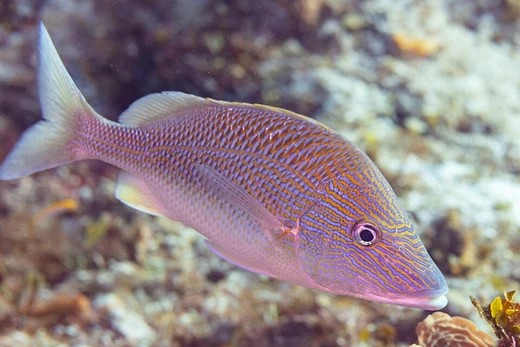
Aphareus furca
A tropical snapper with a forked tail and yellow fins.
Last updated
Aphareus furca, also called the small toothed jobfish, blue smalltooth jobfish, fork-tailed snapper, or snapper jobbyfish, is a marine ray-finned fish in the snapper family Lutjanidae. Its scientific name, furca, means "fork," referring to its deeply forked tail fin.
Taxonomy
The species was first described in 1801 as Labrus furca, with the type location given as Mauritius. In 1913, David Starr Jordan, John Otterbein Snyder, and Shigeho Tanaka designated Aphareus caerulescens as the type species for the genus Aphareus, which Georges Cuvier had created in 1830 with only that species. A. caerulescens is a synonym of A. furca.
Description
Adults have a bronze to blue-gray body, yellow fins, and long filaments at the tips of the tail fin. Males may show yellow on the head. The dorsal fin has 10 spines and usually 11 soft rays (sometimes 10), the anal fin has 3 spines and 8 soft rays, and the pectoral fins have 15 to 16 rays. The fish reaches a maximum length of 70 cm, but is more commonly around 25 cm.
Distribution
This species is found across the Indo-Pacific region, from south of Hawaii to the Pitcairn Islands, and from West to East Africa. Its range also extends from the Gulf of Mannar to southern Japan and southward to Australia. It has been collected at depths from 1 to 122 meters, with reports as deep as 302 meters. In the late 1990s, it appeared at 38.6% of sampling sites and made up 2.5% of the recorded biomass.
Between 2008 and 2014, density estimates in Pacific coral reef areas ranged from 2.5 to 41.2 individuals per hectare. Population size is affected by fishing; where fishing pressure was reduced, populations increased. The highest densities were recorded in the Line Islands (19.4 per hectare) and Phoenix Islands (63 per hectare). Lower densities, from 0.3 to 17.2 per hectare, were found in the Federated States of Micronesia, the Solomon Islands, remote islands near the Solomon Islands, Fiji, and Raja Ampat.
Habitat
Aphareus furca is a benthopelagic and pelagic species, typically inhabiting inshore coral and rocky reef areas, rocky bottoms, and clear water lagoons. It is piscivorous and is usually found alone or in small groups. Though most common at depths of 1 to 120 meters, it has been reported at depths of 300 meters.
The species is vulnerable to population declines from fishing.
Scientific classification
- KingdomAnimalia
- PhylumChordata
- ClassActinopterygii
- DivisionTeleostei
- OrderAcanthuriformes
- FamilyLutjanidae
- GenusAphareus
- SpeciesAphareus furca
Named by (Lacépède, 1801)
Close relatives
Other species of Aphareus with a Codexery entry.
- Aphareus rutilans
Sources: Wikipedia taxobox: Aphareus furca (CC BY-SA 4.0) · differs from this box at order: WoRMS AphiaID 218470 (CC BY 4.0)
Conservation status
Least Concern (LC)
- LC▲ this species
- NT
- VU
- EN
- CR
- EW
- EX
Source: IUCN Red List assessment · GBIF copy of the Red List category
Where the aphareus furca has been recorded
Each dot is a place where the species has been observed and reported (9,317 records, half-degree grid) — not a modelled range. 14 inland records left out (institution coordinates).
Map: drawn by Codexery. Data: GBIF occurrence search (records CC0 / CC BY) · Natural Earth basemap (public domain) · place coordinates: Wikipedia (CC BY-SA 4.0)
More in Snappers
Elsewhere in Snappers and Grunts
Sources
Compiled from Wikipedia and the sources listed below. Text from Wikipedia is available under CC BY-SA 4.0; this entry is adapted from it.
- Wikipedia: Aphareus furca (CC BY-SA 4.0).
- Classification: the source article's taxobox; compare WoRMS, the World Register of Marine Species (CC BY 4.0).
- Conservation status: IUCN Red List assessment.
- Occurrence records: GBIF (CC0 / CC BY). Basemap: Natural Earth (public domain).
- Word definitions: the , each quoted from its Wikipedia article.
Spotted an error? Know more?
Reader corrections go straight into our review queue. Suggest an edit · How this site is sourced