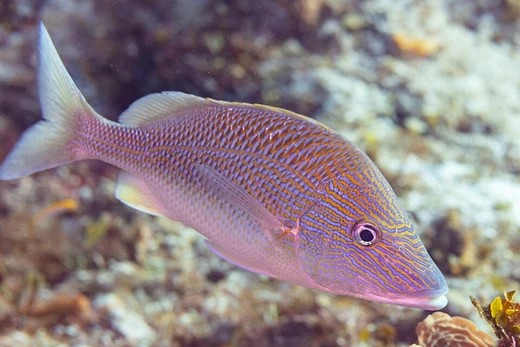
Apsilus dentatus
A snapper with distinct canine teeth and violet-brown coloration.
Last updated
The black snapper (Apsilus dentatus) is a marine ray-finned fish in the snapper family Lutjanidae, found across the western Atlantic Ocean. Its range includes the Caribbean Sea, the Gulf of Mexico, the Florida Keys, the Bahamas, the West Indies, and islands off Venezuela and Belize; in the Gulf, it has been recorded at the Flower Garden Banks. Scientists believe the species is even more widely distributed than these records show.
Description
This fish has an elongated, oval body. The area between its eyes is convex, and its upper jaw can protrude moderately, slipping under the cheek bone for much of its length when the mouth is closed. Its jaws feature distinct canine-like teeth, with an inner band of simple teeth and an outer band of conical teeth.
Small conical teeth line the front and sides of the palate, and there is a triangular or V-shaped patch of teeth at the center. The preoperculum is serrated. The dorsal fin is continuous, with no notch between the spiny and soft-rayed sections; the bases of both the dorsal and anal fins are scaleless. The dorsal fin has 10 spines and 9–10 soft rays, while the anal fin has 3 spines and 8 soft rays.
Adults have violet or dark brown backs and upper flanks, darker on the head, with paler lower flanks and abdomen. Juveniles are bright blue, with a black-margined bronze iris, dark fins (the caudal fin has a pale rear margin), and sometimes blue on the fins. The species reaches a maximum total length of 65 cm (26 in), though 40 cm (16 in) is more typical; the heaviest recorded weight is 3.2 kg (7.1 lb).
Habitat and biology
The black snapper inhabits depths from 12 to 300 m (39–984 ft), usually deeper than 40 m (130 ft), though young fish are occasionally found near the surface. It prefers rocky substrates. A predator, it feeds on fishes and benthic invertebrates such as cephalopods and tunicates. Spawning occurs nearly year-round, with peaks from February to April, in September and October, and off Jamaica in November.
Systematics and etymology
French zoologist Alphonse Guichenot first formally described the species in 1853, giving Havana as the type locality. The specific name dentatus means “toothed,” referring to the prominent canine teeth on the upper front jaw.
Utilisation
The black snapper is of limited interest to fisheries, though its flesh is considered good quality.
Scientific classification
- KingdomAnimalia
- PhylumChordata
- ClassActinopterygii
- DivisionTeleostei
- OrderAcanthuriformes
- FamilyLutjanidae
- GenusApsilus
- SpeciesApsilus dentatus
Named by Guichenot, 1853
Close relatives
Other species of Apsilus with a Codexery entry.
- African forktail snapper Apsilus fuscus
Sources: Wikipedia taxobox: Apsilus dentatus (CC BY-SA 4.0) · differs from this box at order: WoRMS AphiaID 277617 (CC BY 4.0)
Conservation status
Least Concern (LC)
- LC▲ this species
- NT
- VU
- EN
- CR
- EW
- EX
Source: IUCN Red List assessment · GBIF copy of the Red List category
How big is it?
Largest length in the source, 0.65 m, next to a 1.8 m person.
Diagram: drawn by Codexery, schematic shapes to scale (not a likeness). Length: Wikipedia: Apsilus dentatus
Where the apsilus dentatus has been recorded
Each dot is a place where the species has been observed and reported (59 records, half-degree grid) — not a modelled range. 2 inland records left out (institution coordinates).
Map: drawn by Codexery. Data: GBIF occurrence search (records CC0 / CC BY) · Natural Earth basemap (public domain) · place coordinates: Wikipedia (CC BY-SA 4.0)
Ranked in
More in Snappers
Elsewhere in Snappers and Grunts
Test yourself
Three questions drawn from this entry’s sources. Pick an answer to check it.
Answers checked against the source article
Sources
Compiled from Wikipedia and the sources listed below. Text from Wikipedia is available under CC BY-SA 4.0; this entry is adapted from it.
- Wikipedia: Apsilus dentatus (CC BY-SA 4.0).
- Classification: the source article's taxobox; compare WoRMS, the World Register of Marine Species (CC BY 4.0).
- Conservation status: IUCN Red List assessment.
- Occurrence records: GBIF (CC0 / CC BY). Basemap: Natural Earth (public domain).
- Word definitions: the , each quoted from its Wikipedia article.
Spotted an error? Know more?
Reader corrections go straight into our review queue. Suggest an edit · How this site is sourced