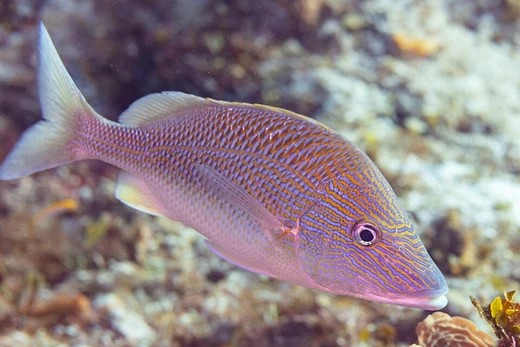
Black and white snapper
A predatory snapper found in Indo-Pacific reefs, prized as food.
Last updated
The black and white snapper (Macolor niger)—also called the black and white seaperch or black snapper—is a marine fish in the snapper family Lutjanidae. It lives in the Indian Ocean and the western Pacific Ocean, typically on steep outer slopes of lagoon reefs, in channels, and on seaward slopes, at depths from 2 to 90 meters.
Taxonomy
Swedish-speaking Finnish explorer Peter Forsskål first described it in 1775 as Sciaena nigra, based on a specimen from Jeddah. Its species name niger means "black," referring to the adult's dark color. When Dutch scientist Pieter Bleeker created the genus Macolor in 1860, he used the name tautonymously for the type species, which was Cuvier's Diacope macolor, and unnecessarily renamed it Macolor typus.
Distribution and habitat
This species has a broad Indo-Pacific range. In the Indian Ocean, it appears from the Red Sea down the eastern African coast to South Africa, plus the Seychelles, Mozambique Channel islands, Madagascar, the western Mascarenes, the Maldives, Laccadives, Chagos, Cocos (Keeling) Islands, Christmas Island, and Sri Lanka. In the Pacific, it occurs from western Malaysia, western Indonesia, and the Andaman Sea east to the Marshall Islands, Samoa, and Tonga, south to Australia, and north to central Japan. It has also been recorded from Niue and the Cook Islands.
Description
Adults can reach 75 cm in total length, but most are under 35 cm. Its fins and eyes are black, while the body ranges from light grey to black depending on age. Juveniles are striped, turning completely black as adults.
The body is relatively deep, with a convex head profile and a large mouth that reaches to the front of the eye. Each jaw has an outer band of conical teeth, enlarged into canine-like teeth at the front, with inner bands of bristle-like teeth. The vomerine teeth form a rough chevron without a rear extension. The preoperculum has a deep notch on its lower edge.
The dorsal fin has 10 spines and 13–15 soft rays; the anal fin has 3 spines and 10–11 soft rays. Both dorsal and anal fins have clearly pointed rear tips. The long pectoral fins reach the anus and have 17–18 rays; the caudal fin is emarginate.
Biology
Juveniles are solitary, while adults gather in large schools. It is a predator of fish and crustaceans. It spawns in aggregations. This species is often confused with the midnight snapper (Macolor macularis), and the two sometimes form mixed schools.
Scientific classification
- KingdomAnimalia
- PhylumChordata
- ClassActinopterygii
- DivisionTeleostei
- OrderAcanthuriformes
- FamilyLutjanidae
- GenusMacolor
- SpeciesMacolor niger
Named by (Forsskål, 1775)
Close relatives
Other species of Macolor with a Codexery entry.
- Macolor macularis Macolor macularis
Sources: Wikipedia taxobox: Black and white snapper (CC BY-SA 4.0) · differs from this box at order: WoRMS AphiaID 218501 (CC BY 4.0)
Conservation status
Least Concern (LC)
- LC▲ this species
- NT
- VU
- EN
- CR
- EW
- EX
Source: IUCN Red List assessment · GBIF copy of the Red List category
How big is it?
Largest length in the source, 0.75 m, next to a 1.8 m person.
Diagram: drawn by Codexery, schematic shapes to scale (not a likeness). Length: Wikipedia: Black and white snapper
Where the black and white snapper has been recorded
Each dot is a place where the species has been observed and reported (3,997 records, half-degree grid) — not a modelled range. 19 inland records left out (institution coordinates).
Map: drawn by Codexery. Data: GBIF occurrence search (records CC0 / CC BY) · Natural Earth basemap (public domain) · place coordinates: Wikipedia (CC BY-SA 4.0)
Ranked in
More in Snappers
Elsewhere in Snappers and Grunts
Test yourself
Three questions drawn from this entry’s sources. Pick an answer to check it.
Answers checked against the source article
Sources
Compiled from Wikipedia and the sources listed below. Text from Wikipedia is available under CC BY-SA 4.0; this entry is adapted from it.
- Wikipedia: Black and white snapper (CC BY-SA 4.0).
- Classification: the source article's taxobox; compare WoRMS, the World Register of Marine Species (CC BY 4.0).
- Conservation status: IUCN Red List assessment.
- Occurrence records: GBIF (CC0 / CC BY). Basemap: Natural Earth (public domain).
- Word definitions: the , each quoted from its Wikipedia article.
Spotted an error? Know more?
Reader corrections go straight into our review queue. Suggest an edit · How this site is sourced