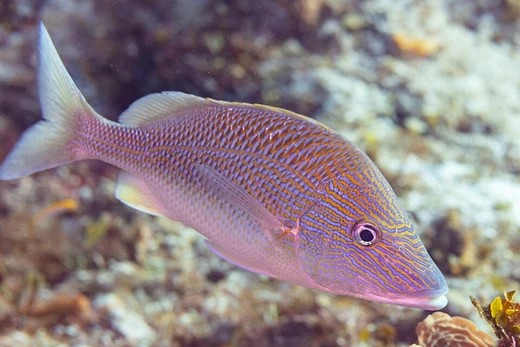
Green jobfish
A robust Indo-Pacific snapper, important for fisheries and game fishing.
Last updated
The green jobfish (Aprion virescens), also called the gray jobfish, gray snapper, slender snapper, or uku in Hawaiian, is a type of snapper in the family Lutjanidae. It is the only species in its genus and lives across the Indo-Pacific region. This fish is found in various reef habitats, from the surface down to 120 meters deep. It is highly valued in local commercial fisheries and is a popular target for sport fishing, though it can carry ciguatera toxin.
Description
This fish has a sturdy, elongated body that is round in cross-section. Its head is long with a blunt snout, and a noticeable groove runs from the snout to the eye. The tail fin is deeply forked. The jaws have bands of teeth with two distinct canines at the front, and the vomerine teeth form a crescent-shaped patch.
The dorsal fin has 10 spines and 11 soft rays, while the anal fin has 3 spines and 8 soft rays. The body is dark green to bluish, fading toward the belly, and the spiny part of the dorsal fin has black spots at the base of the last five spines. It can reach a maximum length of 112 cm (44 in), though 90 cm (35 in) is more typical, and a top weight of 15.4 kg (34 lb).
Distribution
The green jobfish has a wide range across the Indo-Pacific, from the Red Sea and eastern Africa down to northeastern South Africa, across the Indian Ocean, and into the Pacific as far north as southern Japan, south to Australia and Rapa Iti, and east to Hawaii. In Australia, it appears from Ningaloo Reef to Rowley Shoals, Scott Reef, and the Ashmore and Cartier Islands in the Timor Sea, as well as from the northern Great Barrier Reef south to Wooli in New South Wales. It is also found at Lord Howe Island, Middleton Reef, Christmas Island, and the Cocos (Keeling) Islands.
Habitat and biology
This species is a benthopelagic fish that lives in open waters of deep lagoons, channels, or seaward reefs from the surface down to 120 m. It is usually seen alone but may form small schools.
Its diet consists mainly of fish, but it also eats crustaceans, cephalopods, and zooplankton. Off Hawaii, spawning has been observed from May to October, and the fish spawns multiple times. Females reach sexual maturity at about 4.5 years old, when they are around 40 cm (16 in) long.
Taxonomy
The green jobfish was first formally described in 1830 by French zoologist Achille Valenciennes, with the type location given as the Seychelles.
Scientific classification
- KingdomAnimalia
- PhylumChordata
- ClassActinopterygii
- DivisionTeleostei
- OrderAcanthuriformes
- FamilyLutjanidae
- GenusAprion
- SpeciesAprion virescens
Named by Valenciennes, 1830
Sources: Wikipedia taxobox: Green jobfish (CC BY-SA 4.0) · differs from this box at order: WoRMS AphiaID 212546 (CC BY 4.0)
Conservation status
Least Concern (LC)
- LC▲ this species
- NT
- VU
- EN
- CR
- EW
- EX
Source: IUCN Red List assessment
How big is it?
Largest length in the source, 1.12 m, next to a 1.8 m person.
Diagram: drawn by Codexery, schematic shapes to scale (not a likeness). Length: Wikipedia: Green jobfish
Where the green jobfish has been recorded
Map: drawn by Codexery. Data: Natural Earth basemap (public domain) · place coordinates: Wikipedia (CC BY-SA 4.0)
Ranked in
More in Snappers
Elsewhere in Snappers and Grunts
Test yourself
Three questions drawn from this entry’s sources. Pick an answer to check it.
Answers checked against the source article
Sources
Compiled from Wikipedia and the sources listed below. Text from Wikipedia is available under CC BY-SA 4.0; this entry is adapted from it.
- Wikipedia: Green jobfish (CC BY-SA 4.0).
- Classification: the source article's taxobox; compare WoRMS, the World Register of Marine Species (CC BY 4.0).
- Conservation status: IUCN Red List assessment.
- Word definitions: the , each quoted from its Wikipedia article.
Spotted an error? Know more?
Reader corrections go straight into our review queue. Suggest an edit · How this site is sourced