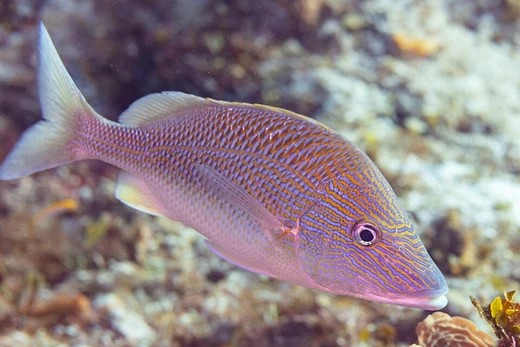
Northern red snapper
A commercially and recreationally important snapper of the western Atlantic.
Last updated
The northern red snapper (Lutjanus campechanus) is a marine fish from the snapper family Lutjanidae. It lives in the western Atlantic Ocean, Caribbean Sea, and Gulf of Mexico, typically around reefs. This fish is both commercially valuable and popular with sport anglers. It is a close relative of the southern red snapper (Lutjanus purpureus), and the two were once thought to be the same species.
Taxonomy
Cuban zoologist Felipe Poey first described the northern red snapper in 1860, naming it Mesoprion campechanus after the Mexican state of Campeche, where the type specimen came from.
Characteristics
The fish has a body shape similar to other snappers—like the mangrove, mutton, lane, and dog snappers—with a sloping profile, medium-to-large scales, a spiny dorsal fin, and a flattened body. Its teeth are short, sharp, and needle-like, but it lacks the prominent upper canines seen in mutton, dog, and mangrove snappers. Northern red snappers are large and red.
They reach maturity at about 39 cm (15 inches) long. Adults commonly grow to 60 cm (24 inches), but can reach 100 cm (39 inches). The heaviest recorded individual weighed 50 pounds 4 ounces (22.79 kg), and the oldest known lived over 57 years.
Their color is light red, darker on the back. They have 10 dorsal spines, 14 soft dorsal rays, three anal spines, and eight to nine soft anal rays. Juveniles under 30–35 cm often have a dark spot on their side below the front soft dorsal rays, which disappears as they age.
Distribution
Northern red snappers are found from 30 to 620 feet deep in the Gulf of Mexico, Caribbean Sea, and along the southeastern Atlantic coast of Mexico and the United States, and much less commonly as far north as Massachusetts. In Latin American Spanish, they are called mero, huachinango, pargo, or chillo. They usually live in waters 9–60 meters (30–200 feet) deep, but can occasionally be caught at 90 meters (300 feet). They stay near the bottom, favoring rocky areas, ledges, ridges, and artificial reefs like oil rigs and shipwrecks.
Like most snappers, they are social and form large schools of similarly sized fish around wrecks and reefs. Their preferred habitat changes as they grow: newly hatched fish spread over open bottom areas, then move to low-relief spots like oyster beds. Around one year old, they shift to intermediate-relief habitats as older fish move to high-relief reefs.
Scientific classification
- KingdomAnimalia
- PhylumChordata
- ClassActinopterygii
- DivisionTeleostei
- OrderAcanthuriformes
- FamilyLutjanidae
- GenusLutjanus
- SpeciesLutjanus campechanus
Named by (Poey, 1860)
Close relatives
Other species of Lutjanus with a Codexery entry.
- Dog snapper Lutjanus jocu
- Lane snapper Lutjanus synagris
- Lutjanus johnii Lutjanus johnii
- Lutjanus purpureus Lutjanus purpureus
- Lutjanus russellii Lutjanus russellii
- Mutton snapper Lutjanus analis
- African brown snapper Lutjanus dentatus
- Blackfin snapper Lutjanus buccanella
Sources: Wikipedia taxobox: Northern red snapper (CC BY-SA 4.0) · differs from this box at order: WoRMS AphiaID 159795 (CC BY 4.0)
Conservation status
Vulnerable (VU)
- LC
- NT
- VU▲ this species
- EN
- CR
- EW
- EX
Source: IUCN Red List assessment · GBIF copy of the Red List category
How big is it?
Largest length in the source, 1 m, next to a 1.8 m person.
Diagram: drawn by Codexery, schematic shapes to scale (not a likeness). Length: Wikipedia: Northern red snapper
Where the northern red snapper has been recorded
Each dot is a place where the species has been observed and reported (3,249 records, half-degree grid) — not a modelled range. 36 inland records left out (institution coordinates). 2 isolated far-off records not drawn.
Map: drawn by Codexery. Data: GBIF occurrence search (records CC0 / CC BY) · Natural Earth basemap (public domain) · place coordinates: Wikipedia (CC BY-SA 4.0)
Frequently Asked Questions
What is the northern red snapper?
The northern red snapper (Lutjanus campechanus) is a reef-associated marine fish in the family Lutjanidae, found throughout the western Atlantic, Caribbean Sea, and Gulf of Mexico. It is a popular target for both commercial harvest and recreational sport fishing.
How big and old can a northern red snapper get?
Adults commonly measure around 60 cm (24 in), with a maximum recorded length of 100 cm (39 in) and a heaviest published weight of 50 lb, 4 oz (22.79 kg). The oldest documented individual has been estimated at over 57 years of age.
How is the northern red snapper different from the southern red snapper?
The two are very close relatives that were long lumped together as a single species before being formally separated. The northern red snapper (Lutjanus campechanus) is now recognized as distinct from the southern red snapper (Lutjanus purpureus) based on modern taxonomic revisions.
More in Snappers
Elsewhere in Snappers and Grunts
Test yourself
Three questions drawn from this entry’s sources. Pick an answer to check it.
Answers checked against the source article
Sources
Compiled from Wikipedia and the sources listed below. Text from Wikipedia is available under CC BY-SA 4.0; this entry is adapted from it.
- Wikipedia: Northern red snapper (CC BY-SA 4.0).
- Classification: the source article's taxobox; compare WoRMS, the World Register of Marine Species (CC BY 4.0).
- Conservation status: IUCN Red List assessment.
- Occurrence records: GBIF (CC0 / CC BY). Basemap: Natural Earth (public domain).
- Word definitions: the Codexery glossary, each quoted from its Wikipedia article.
Spotted an error? Know more?
Reader corrections go straight into our review queue. Suggest an edit · How this site is sourced