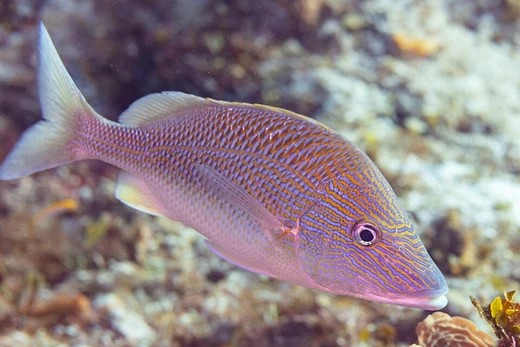
Lane snapper
A western Atlantic snapper with two color phases.
Last updated
The lane snapper (Lutjanus synagris)—also called the Mexican snapper, redtail snapper, or spot snapper—is a marine ray-finned fish in the snapper family Lutjanidae. It lives in the western Atlantic Ocean.
Taxonomy
First formally described in 1758 by Carl Linnaeus in the 10th edition of Systema Naturae, it was originally named Sparus synagris, with the type locality given as the Bahamas. The species name synagris comes from an Ancient Greek name for the common dentex, which the lane snapper was thought to resemble.
Description
The fish has an oblong, compressed body and a sharply pointed snout. Its nostrils are simple holes, with one pair in front and one behind. The mouth is relatively large, with a moderately protrusible upper jaw that sits mostly below the cheekbone when closed.
Each jaw holds one or more rows of sharp, conical teeth, some enlarged into canines. On the roof of the mouth, the vomerine teeth form an anchor-shaped patch with a short rearward extension, and there are tooth patches on each side of the palate. The preopercle is serrated, with a weak notch and knob. The continuous dorsal fin has 10 spines and 12–13 soft rays, sometimes with a slight notch between them; the anal fin has 3 spines and 8–9 soft rays.
The pectoral fins are relatively short, not reaching the anus, with 15–16 rays. The caudal fin is emarginate. Maximum total length is 60 cm (24 in), though 25 cm (9.8 in) is more typical, and the heaviest recorded weight is 3.5 kg (7.7 lb).
This species has two color phases. In deeper water, the fish is darker and more distinct; in shallower water, it is paler. In both phases, the upper sides and back are pink to red, with a greenish tint on the back. The lower sides and belly are silver with a yellow hue.
The head has 3–4 yellow stripes running from the snout to the eye. The flanks show 8–10 yellow to pink longitudinal stripes, with 3–4 more beneath the front dorsal fin ray. There is an indistinct black spot under the soft-rayed part of the dorsal fin. The fins range from yellow to red.
Distribution and habitat
The lane snapper ranges from North Carolina and Bermuda south through the Gulf of Mexico and the Caribbean Sea, along the South American coast to Santa Catarina, Brazil. It lives over reefs and sandy bottoms with algae or seagrass at depths of 30 to 122 m (98–400 ft). Juveniles stay in sheltered inshore waters.
Scientific classification
- KingdomAnimalia
- PhylumChordata
- ClassActinopterygii
- DivisionTeleostei
- OrderAcanthuriformes
- FamilyLutjanidae
- GenusLutjanus
- SpeciesLutjanus synagris
Named by (Linnaeus, 1758)
Close relatives
Other species of Lutjanus with a Codexery entry.
- African brown snapper Lutjanus dentatus
- Blackfin snapper Lutjanus buccanella
- Blue and gold snapper Lutjanus viridis
- Bluestriped snapper Lutjanus notatus
- Brazilian snapper Lutjanus alexandrei
- Common bluestripe snapper Lutjanus kasmira
- Cubera snapper Lutjanus cyanopterus
- Dog snapper Lutjanus jocu
Sources: Wikipedia taxobox: Lane snapper (CC BY-SA 4.0) · differs from this box at order: WoRMS AphiaID 159800 (CC BY 4.0)
Conservation status
Near Threatened (NT)
- LC
- NT▲ this species
- VU
- EN
- CR
- EW
- EX
Source: IUCN Red List assessment · GBIF copy of the Red List category
How big is it?
Largest length in the source, 0.6 m, next to a 1.8 m person.
Diagram: drawn by Codexery, schematic shapes to scale (not a likeness). Length: Wikipedia: Lane snapper
Where the lane snapper has been recorded
Each dot is a place where the species has been observed and reported (35,010 records, half-degree grid) — not a modelled range. 55 inland records left out (institution coordinates).
Map: drawn by Codexery. Data: GBIF occurrence search (records CC0 / CC BY) · Natural Earth basemap (public domain) · place coordinates: Wikipedia (CC BY-SA 4.0)
Frequently Asked Questions
Where do lane snappers live?
This species is native to the western Atlantic Ocean, where it can be encountered at depths ranging from roughly 30 to 122 meters (about 98 to 400 feet).
What does a lane snapper look like?
It has an oblong, laterally compressed body with a sharply pointed snout, and it displays two distinct color phases. Its dorsal fin carries 10 spines followed by 12 to 13 soft rays, while the anal fin has 3 spines and 8 to 9 soft rays.
Ranked in
More in Snappers
Elsewhere in Snappers and Grunts
Test yourself
Three questions drawn from this entry’s sources. Pick an answer to check it.
Answers checked against the source article
Sources
Compiled from Wikipedia and the sources listed below. Text from Wikipedia is available under CC BY-SA 4.0; this entry is adapted from it.
- Wikipedia: Lane snapper (CC BY-SA 4.0).
- Classification: the source article's taxobox; compare WoRMS, the World Register of Marine Species (CC BY 4.0).
- Conservation status: IUCN Red List assessment.
- Occurrence records: GBIF (CC0 / CC BY). Basemap: Natural Earth (public domain).
- Word definitions: the , each quoted from its Wikipedia article.
Spotted an error? Know more?
Reader corrections go straight into our review queue. Suggest an edit · How this site is sourced