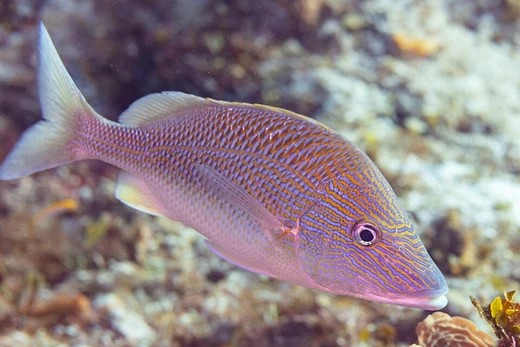
Lutjanus russellii
A western Pacific snapper targeted by fisheries and aquaculture.
Last updated
Lutjanus russellii goes by several common names, including Russell's snapper, Moses snapper, fingermark bream, Moses seaperch, and Russell's sea-perch. This marine ray-finned fish belongs to the snapper family Lutjanidae and is found in the western Pacific Ocean.
Taxonomy
The species was first formally described in 1849 by Dutch physician and ichthyologist Pieter Bleeker, who named it Mesoprion russellii. The type specimen came from Jakarta, Java, in Indonesia. Its specific name honors Patrick Russell, a Scottish surgeon and herpetologist who illustrated the fish in 1803 without formally naming it. Within the genus Lutjanus, this species is most closely related to the Indian Ocean Lutjanus indicus.
Description
The body of Lutjanus russellii ranges from moderately deep to slender, with a standard length about 2.6 to 2.8 times its depth. The forehead may be steep or moderately sloped, and the preopercle has poorly developed knob and incision. The vomerine teeth form either a triangular patch with a rearward extension or a rhombus shape, and there is a small patch of tiny teeth on the tongue.
The dorsal fin has 10 spines and 14 soft rays, while the anal fin has 3 spines and 8 soft rays; both fins have rounded rear edges, though the anal fin tip can be pointed. The pectoral fins have 16 to 17 rays, and the caudal fin is either truncate or weakly emarginate. Maximum total length is 50 cm (20 in), though 30 cm (12 in) is more typical. Coloration is whitish to silvery greyish-pink with a brownish back.
An indistinct black spot, sometimes very faint, appears on the lateral line below the front part of the dorsal fin. The dorsal and caudal fins are reddish, while the other fins are yellow. Juveniles are white with four brown to blackish longitudinal stripes along the flanks (which may be interrupted) and a horizontally elongated black spot or ocellus on the lateral line.
Distribution and habitat
This species mainly occurs in the western Pacific, from the Gulf of Thailand and Sumatra east to Tonga, north to southern Japan, and south to Australia. In Australian waters, it ranges from Shark Bay and offshore reefs in Western Australia, Ashmore Reef in the Timor Sea, around the northern and eastern coasts down to Wollongong, and possibly to Jervis Bay in New South Wales. It inhabits depths between 3 and 80 m (9.8 and 262.5 ft) on offshore coral reefs as well as inshore rocky and coral reefs.
Scientific classification
- KingdomAnimalia
- PhylumChordata
- ClassActinopterygii
- DivisionTeleostei
- OrderAcanthuriformes
- FamilyLutjanidae
- GenusLutjanus
- SpeciesLutjanus russellii
Named by (Bleeker, 1849)
Close relatives
Other species of Lutjanus with a Codexery entry.
- Lutjanus indicus Lutjanus indicus
- African brown snapper Lutjanus dentatus
- Blackfin snapper Lutjanus buccanella
- Blue and gold snapper Lutjanus viridis
- Bluestriped snapper Lutjanus notatus
- Brazilian snapper Lutjanus alexandrei
- Common bluestripe snapper Lutjanus kasmira
- Cubera snapper Lutjanus cyanopterus
Sources: Wikipedia taxobox: Lutjanus russellii (CC BY-SA 4.0) · differs from this box at order: WoRMS AphiaID 218473 (CC BY 4.0)
Conservation status
Least Concern (LC)
- LC▲ this species
- NT
- VU
- EN
- CR
- EW
- EX
Source: IUCN Red List assessment · GBIF copy of the Red List category
How big is it?
Largest length in the source, 0.5 m, next to a 1.8 m person.
Diagram: drawn by Codexery, schematic shapes to scale (not a likeness). Length: Wikipedia: Lutjanus russellii
Where the lutjanus russellii has been recorded
Each dot is a place where the species has been observed and reported (5,294 records, half-degree grid) — not a modelled range. 78 inland records left out (institution coordinates). 2 isolated far-off records not drawn.
Map: drawn by Codexery. Data: GBIF occurrence search (records CC0 / CC BY) · Natural Earth basemap (public domain) · place coordinates: Wikipedia (CC BY-SA 4.0)
Ranked in
More in Snappers
Elsewhere in Snappers and Grunts
Test yourself
Three questions drawn from this entry’s sources. Pick an answer to check it.
Answers checked against the source article
Sources
Compiled from Wikipedia and the sources listed below. Text from Wikipedia is available under CC BY-SA 4.0; this entry is adapted from it.
- Wikipedia: Lutjanus russellii (CC BY-SA 4.0).
- Classification: the source article's taxobox; compare WoRMS, the World Register of Marine Species (CC BY 4.0).
- Conservation status: IUCN Red List assessment.
- Occurrence records: GBIF (CC0 / CC BY). Basemap: Natural Earth (public domain).
- Word definitions: the , each quoted from its Wikipedia article.
Spotted an error? Know more?
Reader corrections go straight into our review queue. Suggest an edit · How this site is sourced