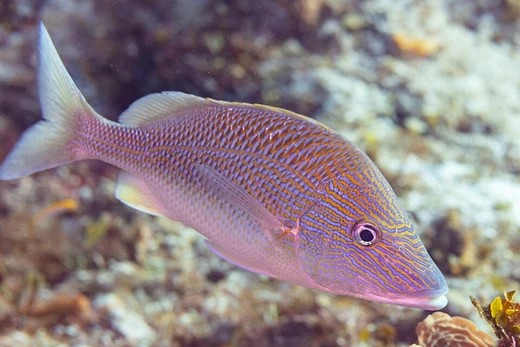
Dog snapper
A commercially important snapper with visible canine-like teeth.
Last updated
The dog snapper (Lutjanus jocu) goes by several common names, including dogtooth snapper, pargue, and snaggletooth snapper. This marine ray-finned fish belongs to the snapper family Lutjanidae and is found in the Atlantic Ocean. It holds commercial value as a food fish and is also frequently kept in public aquariums.
Taxonomy
German naturalists Marcus Elieser Bloch and Johann Gottlob Schneider first described the species in 1801, naming it Anthias jocu. No specific location was given for the type specimen, though it is believed to have come from Havana. The species name jocu comes from the local Cuban name for the fish, as recorded by Portuguese naturalist Antonio Parra.
Description
The body of the dog snapper is relatively deep and compressed. It has long pectoral fins, a slightly forked tail fin, a rounded anal fin, and a dorsal fin divided into two lobes. Its nostrils are simple tubes arranged in front and rear pairs. The mouth is fairly large, with an upper jaw that can be pushed forward slightly and slides under the cheekbone when closed.
Two enlarged, canine-like teeth in the upper jaw remain visible even when the mouth is shut. The teeth on the vomer bone form a chevron or crescent shape, with a long extension toward the rear that gives an anchor-like appearance. Additional tooth patches sit on each side of the roof of the mouth. The preoperculum has a weakly developed notch and knob.
The dorsal fin has 10 spines and 14 to 15 soft rays, while the anal fin has 3 spines and 8 soft rays. The long pectoral fin reaches as far as the anus and contains 16 to 17 rays. The maximum recorded total length is 128 cm (50 in), though 60 cm (24 in) is more typical, and the heaviest published weight is 28.6 kg (63 lb). Adults have olive green upper flanks and backs, sometimes marked with thin, light-colored bars.
The lower flanks and belly are pale red and copper. A white triangular bar sits beneath each eye. The pectoral, pelvic, and anal fins, along with the outer parts of the soft-rayed portion of the dorsal fin and the tail fin, are reddish; the rest of the dorsal and tail fins are olive green. Juveniles have a blue line running lengthwise under the eye and onto the gill cover, which breaks into a line of spots in adults.
Distribution and habitat
In the western Atlantic, the dog snapper ranges from Massachusetts south to São Paulo, Brazil, including Bermuda, the Caribbean Sea, and the Gulf of Mexico.
Scientific classification
- KingdomAnimalia
- PhylumChordata
- ClassActinopterygii
- DivisionTeleostei
- OrderAcanthuriformes
- FamilyLutjanidae
- GenusLutjanus
- SpeciesLutjanus jocu
Named by (Bloch & J. G. Schneider, 1801)
Close relatives
Other species of Lutjanus with a Codexery entry.
- Cubera snapper Lutjanus cyanopterus
- African brown snapper Lutjanus dentatus
- Blackfin snapper Lutjanus buccanella
- Blue and gold snapper Lutjanus viridis
- Bluestriped snapper Lutjanus notatus
- Brazilian snapper Lutjanus alexandrei
- Common bluestripe snapper Lutjanus kasmira
- Golden African snapper Lutjanus fulgens
Sources: Wikipedia taxobox: Dog snapper (CC BY-SA 4.0) · differs from this box at order: WoRMS AphiaID 159798 (CC BY 4.0)
Conservation status
Data Deficient (DD)
Data Deficient: there is not enough information to place this species on the risk scale.
Source: IUCN Red List assessment · GBIF copy of the Red List category
How big is it?
Largest length in the source, 1.28 m, next to a 1.8 m person.
Diagram: drawn by Codexery, schematic shapes to scale (not a likeness). Length: Wikipedia: Dog snapper
Where the dog snapper has been recorded
Each dot is a place where the species has been observed and reported (32,945 records, half-degree grid) — not a modelled range. 36 inland records left out (institution coordinates).
Map: drawn by Codexery. Data: GBIF occurrence search (records CC0 / CC BY) · Natural Earth basemap (public domain) · place coordinates: Wikipedia (CC BY-SA 4.0)
Background
The dog snapper was first formally described in 1801 by German naturalists Marcus Elieser Bloch and Johann Gottlob Schneider as Anthias jocu, with no type locality given, though it is thought to be Havana. The specific name jocu is the local Cuban name for this species, according to Portuguese naturalist Antonio Parra. The species has a relatively deep, compressed body, long pectoral fins, and a pair of very enlarged canine-like teeth in the upper jaw that remain visible when the mouth is closed.
Adults have olive green upper flanks and backs, sometimes marked with slender light-colored bars, while the lower flanks and abdomen are pale red and copper. A white triangular bar is present beneath the eyes. Juveniles have a longitudinal blue line under the eye that breaks into a line of spots in adults.
The dog snapper is mainly found in the western Atlantic from Massachusetts south to São Paulo, Brazil, including Bermuda, the Caribbean Sea, and the Gulf of Mexico, and in the eastern Atlantic from Saint Paul's Rocks south to Principe. A first single record was reported in the Mediterranean Sea in 2005 in Ligurian waters, Italy.
Adults are generally found around rocky outcrops or coral reefs, while juveniles remain primarily within estuaries and occasionally within rivers. They occur at depths in excess of 100 m but are more frequent at 5 to 30 m. Dog snappers tend to be solitary, aggregating to spawn in early spring.
More in Snappers
Elsewhere in Snappers and Grunts
Test yourself
Three questions drawn from this entry’s sources. Pick an answer to check it.
Answers checked against the source article
Sources
Compiled from Wikipedia and the sources listed below. Text from Wikipedia is available under CC BY-SA 4.0; this entry is adapted from it.
- Wikipedia: Dog snapper (CC BY-SA 4.0).
- Classification: the source article's taxobox; compare WoRMS, the World Register of Marine Species (CC BY 4.0).
- Conservation status: IUCN Red List assessment.
- Occurrence records: GBIF (CC0 / CC BY). Basemap: Natural Earth (public domain).
- Word definitions: the , each quoted from its Wikipedia article.
Spotted an error? Know more?
Reader corrections go straight into our review queue. Suggest an edit · How this site is sourced