Chinamanfish
A Western Pacific snapper with filamentous fins and ciguatera risk.
Last updated
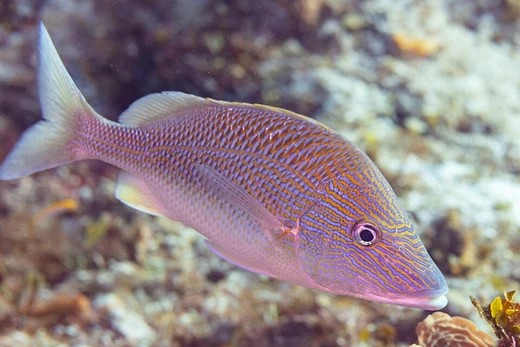
The Chinamanfish (Symphorus nematophorus) goes by several common names, including Chinaman snapper, galloper, and thread-finned sea perch. This marine ray-finned fish belongs to the snapper family Lutjanidae and inhabits the Western Pacific Ocean. Its most distinctive feature is the long, thread-like extensions on the front spines of its dorsal fin, which are especially prominent in younger fish. In some regions, the species is also known for the risk of ciguatera poisoning.
Pieter Bleeker, a Dutch ichthyologist, first scientifically described the Chinamanfish in 1860, giving it the name Mesoprion nematophorus based on a specimen from Badjoa on Sulawesi. Later, in 1872, the German-born British ichthyologist Albert Günther placed it in the genus Symphorus.
This genus is one of two within the subfamily Paradicichthyinae of the snapper family Lutjanidae. The genus name Symphorus may combine sym ("together with") and phorus ("bearer"), possibly referring to the fish's undivided dorsal fin. The species name nematophorus combines nemato ("thread") and phorus, pointing to the filamentous projections on the dorsal fin rays of younger specimens.
Description
The body of the Chinamanfish is deep and compressed from side to side, with a steeply sloping forehead. A deep slit runs between the eyes and the nostrils. The mouth reaches back to the center of the eye. The preoperculum lacks any notch or bump.
The jaws hold thin bands of teeth, with the outer band containing enlarged teeth that become canine-like at the front of the upper jaw. There is no patch of teeth on the vomer, but a patch of granular teeth sits on the tongue. The dorsal fin has 10 spines and 15 to 16 soft rays, while the anal fin has 3 spines and 9 soft rays. In juveniles and sub-adults, at least one of the front dorsal fin rays extends into a long filament.
The pectoral fins are long, reaching the level of the anus, and contain 16 rays. The caudal fin is slightly forked. This species can reach a total length of 100 cm (39 inches), though 35 cm (14 inches) is more typical, and a maximum published weight of 13.2 kg (29 lb). Overall, the fish is greyish-brown to reddish, often broken by thick, irregular light and dark vertical bars on the sides.
Scientific classification
- KingdomAnimalia
- PhylumChordata
- ClassActinopterygii
- DivisionTeleostei
- OrderAcanthuriformes
- FamilyLutjanidae
- GenusSymphorus
- SpeciesSymphorus nematophorus
Named by (Bleeker, 1860)
Sources: Wikipedia taxobox: Chinamanfish (CC BY-SA 4.0) · differs from this box at order: WoRMS AphiaID 282915 (CC BY 4.0)
Conservation status
Least Concern (LC)
- LC▲ this species
- NT
- VU
- EN
- CR
- EW
- EX
Source: IUCN Red List assessment · GBIF copy of the Red List category
How big is it?
Largest length in the source, 1 m, next to a 1.8 m person.
Diagram: drawn by Codexery, schematic shapes to scale (not a likeness). Length: Wikipedia: Chinamanfish
Where the chinamanfish has been recorded
Each dot is a place where the species has been observed and reported (1,858 records, half-degree grid) — not a modelled range. 8 inland records left out (institution coordinates). 1 isolated far-off record not drawn.
Map: drawn by Codexery. Data: GBIF occurrence search (records CC0 / CC BY) · Natural Earth basemap (public domain) · place coordinates: Wikipedia (CC BY-SA 4.0)
Ranked in
More in Snappers
Elsewhere in Snappers and Grunts
Test yourself
Three questions drawn from this entry’s sources. Pick an answer to check it.
Answers checked against the source article
Sources
Compiled from Wikipedia and the sources listed below. Text from Wikipedia is available under CC BY-SA 4.0; this entry is adapted from it.
- Wikipedia: Chinamanfish (CC BY-SA 4.0).
- Classification: the source article's taxobox; compare WoRMS, the World Register of Marine Species (CC BY 4.0).
- Conservation status: IUCN Red List assessment.
- Occurrence records: GBIF (CC0 / CC BY). Basemap: Natural Earth (public domain).
- Word definitions: the , each quoted from its Wikipedia article.
Spotted an error? Know more?
Reader corrections go straight into our review queue. Suggest an edit · How this site is sourced