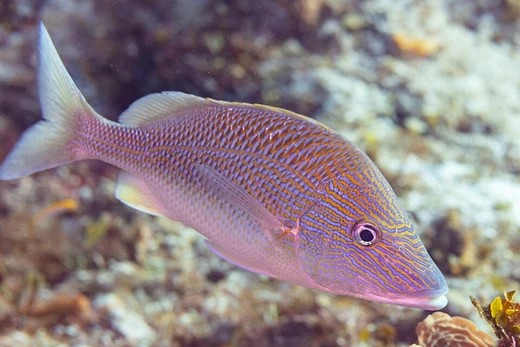
Mutton snapper
A Western Atlantic snapper prized for its flesh and vulnerable spawning aggregations.
Last updated
The mutton snapper (Lutjanus analis) is a marine ray-finned fish belonging to the snapper family Lutjanidae, inhabiting the western Atlantic Ocean. French zoologist Georges Cuvier first formally described it in 1828, with the type locality recorded as Santo Domingo in the Dominican Republic. Its specific name refers to the red, sharply pointed anal fin.
Description
This species has a moderately deep, almond-shaped body and a nearly lunate caudal fin. The dorsal fin appears almost two-lobed, while the anal fin is sharply pointed. Its long pectoral fin extends just past the anal fin’s origin. Both pairs of nostrils are simple holes.
The fish has small eyes, a straight forehead profile, and a relatively large terminal mouth with a protrusible upper jaw mostly covered by the cheek bone when closed. The jaws contain one to two rows of conical teeth, with some outer teeth enlarged into canine-like forms. Vomerine teeth form a chevron-shaped patch, with additional tooth patches on each side of the palate. The dorsal fin has 10–11 spines and 13–14 soft rays; the anal fin has 3 spines and 7–8 soft rays.
The pectoral fin typically has 16 rays (range 15–17). Coloration includes olive green on the back and upper flanks, shading to reddish on the lower flanks and abdomen. A black spot sits between the lateral line and the spiny part of the dorsal fin. Two blue stripes run beneath the eyes, with the higher one continuing onto the operculum.
The caudal fin has a black margin. When resting, the fish displays 10 to 12 dark vertical bars that merge into a solid color when swimming. All fins are red. Small juveniles (around 15 mm) have transparent fins and yellowish-brown bands; larger juveniles show yellow bands and a more prominent black spot than adults. Maximum total length reaches 94 cm (37 in), though 50 cm (20 in) is typical, and the maximum published weight is 15.6 kg (34 lb).
Distribution and habitat
The mutton snapper ranges from Massachusetts south to Brazil, being most common in warmer waters off Florida, the Bahamas, the Caribbean Sea, and the Gulf of Mexico. It inhabits comparatively shallow, clear waters at depths of 25 to 95 m (82–312 ft), where temperatures range from 18.9 to 27.8 °C (66.0–82.0 °F).
Scientific classification
- KingdomAnimalia
- PhylumChordata
- ClassActinopterygii
- DivisionTeleostei
- OrderAcanthuriformes
- FamilyLutjanidae
- GenusLutjanus
- SpeciesLutjanus analis
Named by (G. Cuvier, 1828)
Close relatives
Other species of Lutjanus with a Codexery entry.
- African brown snapper Lutjanus dentatus
- Blackfin snapper Lutjanus buccanella
- Blue and gold snapper Lutjanus viridis
- Bluestriped snapper Lutjanus notatus
- Brazilian snapper Lutjanus alexandrei
- Common bluestripe snapper Lutjanus kasmira
- Cubera snapper Lutjanus cyanopterus
- Dog snapper Lutjanus jocu
Sources: Wikipedia taxobox: Mutton snapper (CC BY-SA 4.0) · differs from this box at order: WoRMS AphiaID 159792 (CC BY 4.0)
Conservation status
Near Threatened (NT)
- LC
- NT▲ this species
- VU
- EN
- CR
- EW
- EX
Source: IUCN Red List assessment · GBIF copy of the Red List category
How big is it?
Largest length in the source, 0.94 m, next to a 1.8 m person.
Diagram: drawn by Codexery, schematic shapes to scale (not a likeness). Length: Wikipedia: Mutton snapper
Where the mutton snapper has been recorded
Each dot is a place where the species has been observed and reported (39,597 records, half-degree grid) — not a modelled range. 41 inland records left out (institution coordinates). 3 isolated far-off records not drawn.
Map: drawn by Codexery. Data: GBIF occurrence search (records CC0 / CC BY) · Natural Earth basemap (public domain) · place coordinates: Wikipedia (CC BY-SA 4.0)
Anatomy and Coloration
The mutton snapper presents a strikingly ornate appearance that sets it apart among its snapper relatives. Its body is moderately deep and almond-shaped, capped by a nearly crescent-shaped tail fin. The dorsal fin takes on an almost two-lobed profile, while the anal fin tapers to a sharp point — a feature that actually inspired the species' scientific name.
The pectoral fin stretches long enough to reach just beyond where the anal fin begins. Small eyes sit beneath a straight forehead, and a comparatively large terminal mouth houses one to two rows of conical teeth, some of which swell into prominent canine-like fangs. A chevron-shaped patch of vomerine teeth sits on the palate. Coloration shifts with activity: at rest, ten to twelve dark vertical bars stripe the body, but these dissolve into a uniform olive-green-to-reddish gradient once the fish is in motion.
A distinctive black spot marks the flank between the lateral line and the spiny dorsal section, while two blue stripes run beneath the eyes. The fins glow red, and the tail carries a black border. Adults can reach 94 centimeters and 15.6 kilograms, though 50 centimeters is far more typical.
Reproductive Rituals and Life History
The mutton snapper's reproductive strategy is both spectacular and ecologically consequential. Each year, at a fixed point tied to the lunar calendar, large transient aggregations form — with the northeastern Caribbean serving as the principal spawning ground in February, while other regions see spawning shift to summer months. Females release up to 1.4 million pelagic eggs into the water column, where males fertilize them externally. Within roughly 20 hours those eggs hatch, and the resulting larvae reach shallow-water habitats within 48 hours, carried along by ocean currents.
The species' diet transforms dramatically across its life: larvae graze on surface plankton, settled juveniles shift to larger plankton and tiny invertebrates among turtle grass, and adults become active predators of crustaceans, gastropods, and small fishes such as grunts and mullets. They forage throughout the day, and their body coloration shifts — the dark barred pattern appears specifically when feeding near the seabed. After spawning concludes, adults retreat to deeper offshore waters and adopt a sedentary existence. A mutton snapper can live as long as forty years.
Geographic Range and Habitat Preferences
Native to the western Atlantic, the mutton snapper ranges from the coast of Massachusetts southward to Brazil, though it is most abundant in the warmer waters of Florida, the Bahamas, the Caribbean Sea, and the Gulf of Mexico. The species favors comparatively shallow, clear water at depths between 25 and 95 meters, where temperatures hover between 18.9 and 27.8 degrees Celsius. Habitat use differs markedly by life stage. Larger adults congregate around offshore reefs and scattered rock rubble, while juveniles remain in inshore environments where they can become remarkably abundant — tidal mangrove creeks, canals, and shallow protected bays all serve as nursery grounds.
Turtle grass beds in particular provide critical shelter for young snappers. This division of habitat between deep adult territories and shallow juvenile refuges means the species depends on a wide mosaic of ecosystems across its range, from open reef structures to vegetated coastal shallows. The clarity and temperature constraints of its preferred waters further limit where it can thrive, making it a relatively specialized inhabitant of the subtropical and tropical western Atlantic.
Economic Value and Conservation Pressures
The mutton snapper occupies a prominent position in recreational, commercial, and artisanal fisheries across its range. Its flesh is regarded as very high quality and commands premium prices, with the cheek and throat meat of larger specimens particularly prized as a gourmet delicacy. Anglers in Florida, especially around Cape Canaveral, target it avidly, while commercial operations employ hook-and-line, seines, gill nets, bottom longlines, traps, and spearfishing.
Yet the species' predictable spawning aggregations make it acutely vulnerable to overfishing, and juvenile populations are also harvested in some areas, compounding the pressure. In the northern portion of its range, commercial landings have fallen by more than 60 percent, though reduced fishing effort means the stock is not yet classified as overfished. In Cuba, the known spawning aggregation has shrunk.
Parts of Brazil and Colombia face heavy exploitation. The IUCN estimates biomass has declined by at least 20 percent over 30 to 60 years, earning the species a Near Threatened listing. The organization urges precautionary management, better fisheries data, and protection of spawning sites, warning that without intervention the status could deteriorate to Vulnerable.
Ranked in
More in Snappers
Elsewhere in Snappers and Grunts
Test yourself
Three questions drawn from this entry’s sources. Pick an answer to check it.
Answers checked against the source article
Sources
Compiled from Wikipedia and the sources listed below. Text from Wikipedia is available under CC BY-SA 4.0; this entry is adapted from it.
- Wikipedia: Mutton snapper (CC BY-SA 4.0).
- Classification: the source article's taxobox; compare WoRMS, the World Register of Marine Species (CC BY 4.0).
- Conservation status: IUCN Red List assessment.
- Occurrence records: GBIF (CC0 / CC BY). Basemap: Natural Earth (public domain).
- Word definitions: the , each quoted from its Wikipedia article.
Spotted an error? Know more?
Reader corrections go straight into our review queue. Suggest an edit · How this site is sourced