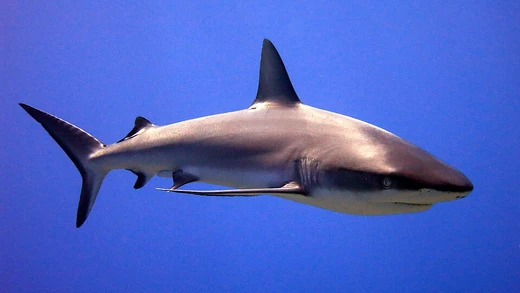
Spadenose shark
A small shark with the most advanced placental viviparity in fish.
Last updated

Hariprasad Shetty10 · via Wikipedia: Spadenose shark · CC0
The spadenose shark belongs to the requiem shark family and lives in the tropical Indian and western Pacific Oceans.[1] It is named for its distinctively flattened, triangular snout and often forms large schools in shallow water.[1]
Scientific classification
- KingdomAnimalia
- PhylumChordata
- ClassChondrichthyes
- SubclassElasmobranchii
- DivisionSelachii
- OrderCarcharhiniformes
- FamilyCarcharhinidae
- GenusScoliodon
- SpeciesScoliodon laticaudus
Named by J. P. Müller & Henle, 1838
Sources: Wikipedia taxobox: Spadenose shark (CC BY-SA 4.0) · order, family and genus agree with WoRMS AphiaID 217364 (CC BY 4.0)
Conservation status
Near Threatened (NT)
- LC
- NT▲ this species
- VU
- EN
- CR
- EW
- EX
Source: IUCN Red List assessment · GBIF copy of the Red List category
How big is it?
Largest length in the source, 0.74 m, next to a 1.8 m person.
Diagram: drawn by Codexery, schematic shapes to scale (not a likeness). Length: Wikipedia: Spadenose shark
Where the spadenose shark has been recorded
Each dot is a place where the species has been observed and reported (228 records, half-degree grid) — not a modelled range. 27 inland records left out (institution coordinates).
Map: drawn by Codexery. Data: GBIF occurrence search (records CC0 / CC BY) · Natural Earth basemap (public domain) · place coordinates: Wikipedia (CC BY-SA 4.0)
Description
The spadenose shark is small and stocky, reaching a maximum known length of 74 cm.[1][2] It has a broad head with a highly flattened, trowel-shaped snout, and its eyes and nostrils are small.[2] Each tooth is a single slender, blade-like cusp without serrations. The upper jaw has 25 to 33 rows of teeth, and the lower jaw has 24 to 34 rows.[2] You’ll find the mouth’s corners sitting well behind the eyes, and those corners have only weak furrows.[2]
This shark’s back is a bronze-gray color, its belly is white, and the fins are plain but can look darker than the rest of the body.[2]
Biology and ecology
This shark has the most advanced form of placental viviparity known in fish, with newly ovulated eggs only 1 mm in diameter and embryos becoming dependent on the mother at a length of just 3 mm.[3] The stalk connecting the mother to the embryo has a column-like shape, covered with long finger-like projections that hold a dense web of tiny blood vessels for gas exchange.[3] Nutrients move from the mother's bloodstream into the placenta through a special structure called the trophonematal cup.[3] Litter size ranges from six to 18 pups, born at a length of 12 to 15 cm.[4]
Females likely mate at least once a year, breed all year round, and carry their pups for 5 to 6 months.[4] Scientists think these sharks reach maturity somewhere between 6 months and 2 years old, and males might live about 5 years while females live about 6.[4]
Distribution and habitat
People often spot this shark in the lower parts of rivers in Malaysia, Sumatra, and Borneo, but we’re not sure if it can handle fresh water because we don’t have salinity data from those spots.[5]
Human interactions
Its relatively short reproductive cycle may help it handle fishing pressure better than other sharks, but its low number of pups still calls for caution.[6] The spadenose shark doesn’t pose any danger to people.[7] Because it lives so close to shore, coastal development might also hurt this shark.[6]
Taxonomy and phylogeny
The generic name Scoliodon comes from the Greek skolex, meaning "worm," and odon, meaning "tooth."[2] The species name laticaudus comes from Latin: latus means “broad” or “wide,” and cauda means “tail.”.[2]
References
- Wikipedia, "Spadenose shark" (CC BY-SA 4.0), which cites: "Good Goan Food: Local (Konkani) names for Common Fish in Goa", 25 November 2011 (we also read that source) en.wikipedia.org
- Wikipedia, "Spadenose shark" (CC BY-SA 4.0), which cites: Compagno, L.J.V., "Sharks of the World: An Annotated and Illustrated Catalogue of Shark Species Known to Date", Food and Agricultural Organization, 1984, p. 533–535 (we also read that source) en.wikipedia.org
- Wikipedia, "Spadenose shark" (CC BY-SA 4.0), which cites: Wourms, J.P., "Maximization of evolutionary trends for placental viviparity in the spadenose shark, Scoliodon laticaudus", Environmental Biology of Fishes, 1993, p. 269–294 (we also read that source) en.wikipedia.org
- Wikipedia, "Spadenose shark" (CC BY-SA 4.0), which cites: Fowler, S.L., "Sharks, Rays and Chimaeras: The Status of the Chondrichthyan Fishes", International Union for Conservation of Nature and Natural Resources, 2005, p. 313 (we also read that source) en.wikipedia.org
- Wikipedia, "Spadenose shark" (CC BY-SA 4.0), which cites: Compagno, L.J.V., "Sharks of the World: An Annotated and Illustrated Catalogue of Shark Species Known to Date", Food and Agricultural Organization, 1984, p. 533–535; (we also read that source) en.wikipedia.org
- Wikipedia, "Spadenose shark" (CC BY-SA 4.0), which cites: Dulvy, N.K., "Scoliodon laticaudus", 2021; Perry-Jones R., "TRAFFIC report on shark fisheries and trade in the People's Republic of China. The World Trade in Sharks: a Compendium of TRAFFIC's regional studies", TRAFFIC Network, 1996, p. 42–44; Fowler, S.L., "Sharks, Rays and Chimaeras: The Status of the Chondrichthyan Fishes", International Union for Conservation of Nature and Natural Resources, 2005, p. 313; ; Dulvy, N.K., "Scoliodon laticaudus", 2021; Fowler, S.L., "Sharks, Rays and Chimaeras: The Status of the Chondrichthyan Fishes", en.wikipedia.org
- Wikipedia, "Spadenose shark" (CC BY-SA 4.0), which cites: Compagno, L.J.V., "Sharks of the World: An Annotated and Illustrated Catalogue of Shark Species Known to Date", Food and Agricultural Organization, 1984, p. 533–535; Davidson, A., "Seafood of South-East Asia: A Comprehensive Guide With Recipes", Ten Speed Press, 2003, p. 125; Sen, D.P., "Advances in Fish Processing Technology", Allied Publishers, 2005, p. 499 (we also read that source) en.wikipedia.org
Each numbered sentence above was checked against the source it cites before publication. Sentences citing Wikipedia adapt text from the English Wikipedia article Spadenose shark (contributors), used under CC BY-SA 4.0; this entry is available under the same licence. Other sources were used for facts only; no text or images are copied from them.
More in Reef sharks
Elsewhere in Sharks
Test yourself
Three questions drawn from this entry’s sources. Pick an answer to check it.
Answers checked against the source article
Sources
Compiled from Wikipedia and the sources listed below. Text from Wikipedia is available under CC BY-SA 4.0; this entry is adapted from it.
- Wikipedia: Spadenose shark (CC BY-SA 4.0).
- Classification: the source article's taxobox; order, family and genus checked against WoRMS, the World Register of Marine Species (CC BY 4.0).
- Conservation status: IUCN Red List assessment.
- Occurrence records: GBIF (CC0 / CC BY). Basemap: Natural Earth (public domain).
- Word definitions: the Codexery glossary, each quoted from its Wikipedia article.
Spotted an error? Know more?
Reader corrections go straight into our review queue. Suggest an edit · How this site is sourced