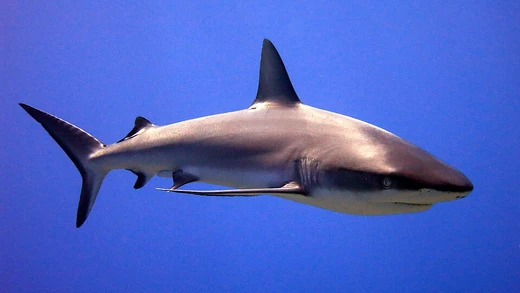
Pacific sharpnose shark
Small viviparous shark migrating along Mexico's Pacific coast.
Last updated

D Ross Robertson · via Wikipedia: Pacific sharpnose shark · Public domain
People fish for this shark commercially, especially off the coast of Mexico.[1]
Scientific classification
- KingdomAnimalia
- PhylumChordata
- ClassChondrichthyes
- SubclassElasmobranchii
- DivisionSelachii
- OrderCarcharhiniformes
- FamilyCarcharhinidae
- GenusRhizoprionodon
- SpeciesRhizoprionodon longurio
Named by (D. S. Jordan & C. H. Gilbert, 1882)
Close relatives
Other species of Rhizoprionodon with a Codexery entry.
- Atlantic sharpnose shark Rhizoprionodon terraenovae
- Brazilian sharpnose shark Rhizoprionodon lalandii
- Milk shark Rhizoprionodon acutus
Sources: Wikipedia taxobox: Pacific sharpnose shark (CC BY-SA 4.0) · order, family and genus agree with WoRMS AphiaID 271327 (CC BY 4.0)
Conservation status
Vulnerable (VU)
- LC
- NT
- VU▲ this species
- EN
- CR
- EW
- EX
Source: IUCN Red List assessment · GBIF copy of the Red List category
How big is it?
Largest length in the source, 1.08 m, next to a 1.8 m person.
Diagram: drawn by Codexery, schematic shapes to scale (not a likeness). Length: Wikipedia: Pacific sharpnose shark
Where the pacific sharpnose shark has been recorded
Each dot is a place where the species has been observed and reported (572 records, half-degree grid) — not a modelled range. 39 inland records left out (institution coordinates). 1 isolated far-off record not drawn.
Map: drawn by Codexery. Data: GBIF occurrence search (records CC0 / CC BY) · Natural Earth basemap (public domain)
Description
Female Pacific sharpnose sharks tend to reach bigger sizes than the males do.[1]
Biology and ecology
This shark eats mostly crustaceans and fish.[1] Females carry their young for about 10 to 12 months.[1] Researchers estimated the gestation period without watching the full growth cycle because these sharks migrate a lot.[1] The average number of embryos per female is around 7.4, and the sex ratio of the young is one to one.[1]
Distribution and habitat
This shark likes areas with muddy bottoms.[1] We still don't know if this shark uses coastal lagoons as nurseries or sticks to open waters for that.[1] From winter into spring, the population shifts from southern Isla Tiburón in the central Gulf of California down to the southern region of Nayarit.[1] From summer to autumn, the sharks move back in the opposite direction, either through the central Gulf of California or along the Sonora coast.[1]
Human interactions
The IUCN Red List categorizes the Pacific sharpnose shark as Vulnerable.[2] This seasonal fishing pattern happens because changes in sea temperature trigger a big movement of the sharks.[1] This shark gets caught very easily in gillnets and bottom long lines.[1] Fishers typically use fiberglass boats that are 22 to 25 feet long, with a crew of 2 to 3 people working shifts of 12 to 24 hours.[1]
Each of those boats can carry up to 1.5 tons of shark catch.[1]
Taxonomy and phylogeny
Scientists call this shark Rhizoprionodon longurio.[3] Jordan and Gilbert first described it in 1882.[3] This shark is part of the family Carcharhinidae, the order Carcharhiniformes, and the class Elasmobranchii (which includes sharks and rays).[3]
References
- Wikipedia, "Pacific sharpnose shark" (CC BY-SA 4.0), which cites: Márquez-Farias, J. F., D. Corro-Espinosa, and J. L. Castillo-Géniz. 2005. Observations on the Biology of the Pacific Sharpnose Shark (Rhizoprionodon longurio, J (we also read that source) en.wikipedia.org
- IUCN Red List assessment (category and year as redistributed in GBIF's IUCN Red List checklist). IUCN Red List terms: fact (category, year) cited, no text reused. iucnredlist.org
- World Register of Marine Species, Rhizoprionodon longurio (AphiaID 271327). CC BY 4.0. marinespecies.org
Each numbered sentence above was checked against the source it cites before publication. Sentences citing Wikipedia adapt text from the English Wikipedia article Pacific sharpnose shark (contributors), used under CC BY-SA 4.0; this entry is available under the same licence. Other sources were used for facts only; no text or images are copied from them.
More in Reef sharks
Elsewhere in Sharks
Sources
Compiled from Wikipedia and the sources listed below. Text from Wikipedia is available under CC BY-SA 4.0; this entry is adapted from it.
- Wikipedia: Pacific sharpnose shark (CC BY-SA 4.0).
- Classification: the source article's taxobox; order, family and genus checked against WoRMS, the World Register of Marine Species (CC BY 4.0).
- Conservation status: IUCN Red List assessment.
- Occurrence records: GBIF (CC0 / CC BY). Basemap: Natural Earth (public domain).
- Word definitions: the Codexery glossary, each quoted from its Wikipedia article.
Spotted an error? Know more?
Reader corrections go straight into our review queue. Suggest an edit · How this site is sourced