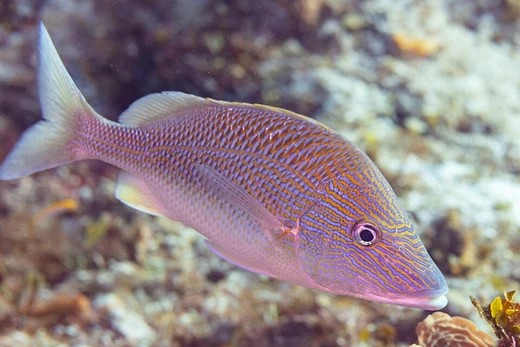
Schoolmaster snapper
A western Atlantic snapper, popular as food and known for schooling behavior.
Last updated
The schoolmaster snapper, scientifically named Lutjanus apodus, is a marine ray-finned fish in the snapper family. It lives in the western Atlantic Ocean and is commonly caught for food.
Taxonomy
German naturalist Johann Julius Walbaum first described this species in 1792, calling it Perca apoda based on an illustration from the Bahamas. Because the drawing left out the fish's pectoral fins, Walbaum gave it the species name apoda, meaning "footless."
Description
This snapper has a sturdy, slightly flattened body with a long, pointed snout and a large mouth. One pair of upper canine teeth is noticeably bigger than the lower jaw's back teeth, visible even when the mouth is shut. The vomerine teeth form a chevron or crescent shape, with a line of similar teeth extending backward from the middle.
The preoperculum has a weak notch and knob. The upper jaw can protrude and is mostly hidden by the cheek bone when closed; both nostrils are simple openings. The continuous dorsal fin has a slight notch between its spiny and soft-rayed sections, with 10 spines and 14 soft rays. The rounded anal fin has 3 spines and 8 soft rays.
Scale rows on the back run parallel to the lateral line. The tail fin is slightly forked or straight across. The pectoral fins are longer than the distance from the snout tip to the rear edge of the preopercle, reaching the anus.
Color ranges from olive gray to brownish on the upper back and sides, with yellow to reddish tones around the head. The lower sides and belly are lighter, and there is no dark spot below the front of the soft dorsal fin. Eight narrow, light vertical bars appear on the sides, though they may fade or vanish in large adults. A solid or broken blue line runs under the eye, sometimes disappearing with age.
From the upper jaw to the fleshy opercle tip, this line often breaks into dashes and spots. The fins and tail are bright yellow, yellow-green, or pale orange, and the snout has blue stripes. The fish can reach a fork length of 79.1 cm (31.1 in), though 35 cm (14 in) is more common, and the heaviest recorded weight is 10.8 kg (24 lb).
Distribution
The schoolmaster snapper lives in the western Atlantic, from Bermuda and the southeastern U.S. coast (Cape Canaveral, Florida, south to the Bahamas), into the Gulf of Mexico from the Florida Keys north to Tampa, then west along the Gulf coast to the Yucatán Peninsula and northwestern Cuba.
Scientific classification
- KingdomAnimalia
- PhylumChordata
- ClassActinopterygii
- DivisionTeleostei
- OrderAcanthuriformes
- FamilyLutjanidae
- GenusLutjanus
- SpeciesLutjanus apodus
Named by (Walbaum, 1792)
Close relatives
Other species of Lutjanus with a Codexery entry.
- African brown snapper Lutjanus dentatus
- Blackfin snapper Lutjanus buccanella
- Blue and gold snapper Lutjanus viridis
- Bluestriped snapper Lutjanus notatus
- Brazilian snapper Lutjanus alexandrei
- Common bluestripe snapper Lutjanus kasmira
- Cubera snapper Lutjanus cyanopterus
- Dog snapper Lutjanus jocu
Sources: Wikipedia taxobox: Schoolmaster snapper (CC BY-SA 4.0) · differs from this box at order: WoRMS AphiaID 159793 (CC BY 4.0)
Conservation status
Least Concern (LC)
- LC▲ this species
- NT
- VU
- EN
- CR
- EW
- EX
Source: IUCN Red List assessment · GBIF copy of the Red List category
How big is it?
Largest length in the source, 0.79 m, next to a 1.8 m person.
Diagram: drawn by Codexery, schematic shapes to scale (not a likeness). Length: Wikipedia: Schoolmaster snapper
Where the schoolmaster snapper has been recorded
Each dot is a place where the species has been observed and reported (46,681 records, half-degree grid) — not a modelled range. 37 inland records left out (institution coordinates). 1 isolated far-off record not drawn.
Map: drawn by Codexery. Data: GBIF occurrence search (records CC0 / CC BY) · Natural Earth basemap (public domain) · place coordinates: Wikipedia (CC BY-SA 4.0)
Did You Know?
- Small schoolmaster snapper less than 70 mm in length have a diet 90% composed of crustaceans, while larger specimens prefer smaller fish.
Ranked in
More in Snappers
Elsewhere in Snappers and Grunts
Test yourself
Three questions drawn from this entry’s sources. Pick an answer to check it.
Answers checked against the source article
Sources
Compiled from Wikipedia and the sources listed below. Text from Wikipedia is available under CC BY-SA 4.0; this entry is adapted from it.
- Wikipedia: Schoolmaster snapper (CC BY-SA 4.0).
- Classification: the source article's taxobox; compare WoRMS, the World Register of Marine Species (CC BY 4.0).
- Conservation status: IUCN Red List assessment.
- Occurrence records: GBIF (CC0 / CC BY). Basemap: Natural Earth (public domain).
- Word definitions: the , each quoted from its Wikipedia article.
Spotted an error? Know more?
Reader corrections go straight into our review queue. Suggest an edit · How this site is sourced