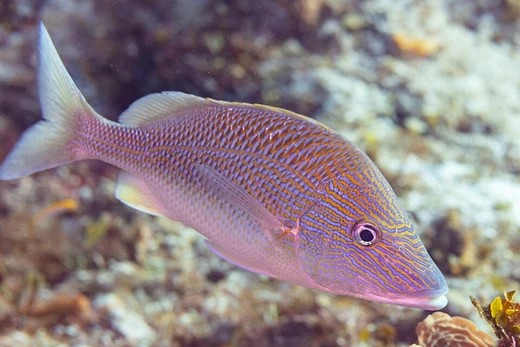
Blue and gold snapper
A yellow snapper with blue stripes, important to subsistence fisheries.
Last updated
The blue-and-gold snapper (Lutjanus viridis) is a marine fish in the snapper family, found in the eastern Pacific Ocean and valued in local subsistence fisheries.
Taxonomy
This species was first scientifically described in 1846 by French zoologist Achille Valenciennes, who named it Diacope viridis. The specific name means "green," as Valenciennes depicted the fish with a greenish body and darker green stripes, though it is actually bright yellow with bluish-white stripes edged in black. The type location is the Galápagos Islands.
Description
The fish has an oblong body and a pointed snout with simple nostril holes. Its mouth is relatively large with protractile jaws. Teeth are conical to canine-like, with front teeth often enlarged into fang-like shapes. The vomerine teeth form a V-shape without rearward extension, and there are tooth patches on each side of the palate but none on the tongue.
The preoperculum has a weakly developed notch and knob. The continuous dorsal fin has 10 spines and 14–15 soft rays; the anal fin has 3 spines and 8 soft rays. The rear of these fins may be rounded or pointed.
Pectoral fins have 16–17 rays, and the caudal fin is truncate or slightly notched. Maximum total length is 30 cm (12 in). The body is bright yellow, sometimes darker, with five blue stripes bordered in black along the sides. The belly is paler, marked with thin orange to yellow lines, and the face often appears reddish.
Distribution and habitat
This snapper has a patchy distribution in the eastern Pacific. It occurs at the mouth of the Gulf of California, southern Baja California, and along Mexico’s western coast, from southern Guatemala to Panama and Colombia. It is also found at the Revillagigedo Islands, Clipperton Island, Cocos Island, Malpelo Island, and the Galápagos Islands. It inhabits rocky substrates and coral reefs down to at least 55 m (180 ft).
Biology
During the day, the blue-and-gold snapper sometimes gathers in large aggregations on rocky or coral reefs. In Panama’s Gulf of Chiriquí, it is limited to areas with madreporite branching corals. At night, it forages for crabs, mollusks, cephalopods, shrimp, and small fish, seeking shelter during daylight.
Subsistence fishers target this species using hooks and lines, and the catch is mostly sold fresh.
Scientific classification
- KingdomAnimalia
- PhylumChordata
- ClassActinopterygii
- DivisionTeleostei
- OrderAcanthuriformes
- FamilyLutjanidae
- GenusLutjanus
- SpeciesLutjanus viridis
Named by (Valenciennes, 1846)
Close relatives
Other species of Lutjanus with a Codexery entry.
- African brown snapper Lutjanus dentatus
- Blackfin snapper Lutjanus buccanella
- Bluestriped snapper Lutjanus notatus
- Brazilian snapper Lutjanus alexandrei
- Common bluestripe snapper Lutjanus kasmira
- Cubera snapper Lutjanus cyanopterus
- Dog snapper Lutjanus jocu
- Golden African snapper Lutjanus fulgens
Sources: Wikipedia taxobox: Blue and gold snapper (CC BY-SA 4.0) · differs from this box at order: WoRMS AphiaID 276552 (CC BY 4.0)
Conservation status
Least Concern (LC)
- LC▲ this species
- NT
- VU
- EN
- CR
- EW
- EX
Source: IUCN Red List assessment · GBIF copy of the Red List category
How big is it?
Largest length in the source, 0.3 m, next to a 1.8 m person.
Diagram: drawn by Codexery, schematic shapes to scale (not a likeness). Length: Wikipedia: Blue and gold snapper
Where the blue and gold snapper has been recorded
Each dot is a place where the species has been observed and reported (2,557 records, half-degree grid) — not a modelled range. 7 inland records left out (institution coordinates). 1 isolated far-off record not drawn.
Map: drawn by Codexery. Data: GBIF occurrence search (records CC0 / CC BY) · Natural Earth basemap (public domain) · place coordinates: Wikipedia (CC BY-SA 4.0)
Ranked in
More in Snappers
Elsewhere in Snappers and Grunts
Test yourself
Three questions drawn from this entry’s sources. Pick an answer to check it.
Answers checked against the source article
Sources
Compiled from Wikipedia and the sources listed below. Text from Wikipedia is available under CC BY-SA 4.0; this entry is adapted from it.
- Wikipedia: Blue and gold snapper (CC BY-SA 4.0).
- Classification: the source article's taxobox; compare WoRMS, the World Register of Marine Species (CC BY 4.0).
- Conservation status: IUCN Red List assessment.
- Occurrence records: GBIF (CC0 / CC BY). Basemap: Natural Earth (public domain).
- Word definitions: the , each quoted from its Wikipedia article.
Spotted an error? Know more?
Reader corrections go straight into our review queue. Suggest an edit · How this site is sourced