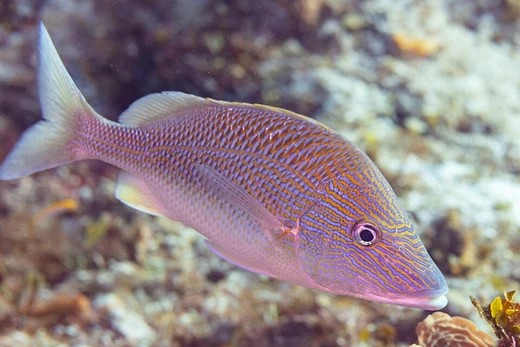
Brazilian snapper
A Brazilian endemic snapper described in 2007.
Last updated
The Brazilian snapper (Lutjanus alexandrei) is a snapper species found in the tropical Atlantic waters along Brazil's coast. It was officially described as a new species in 2007 by Brazilian marine biologist Rodrigo Leão de Moura and American marine scientist Kenyon C. Lindeman, with the type specimen collected at Camurupim Reef near Tamandaré in Pernambuco State, Brazil. Its scientific name honors Alexandre Rodrigues Ferreira, a pioneering Brazilian naturalist.
Description
This fish has a fairly deep body, with a depth averaging about 40% of its standard length. It features a long, pointed snout and a large, protractile mouth. Each jaw holds a row of conical teeth; the front pair in the upper jaw are enlarged into fang-like teeth that are visible even when the mouth is shut. The lower jaw also has pairs of pointed, canine-like conical teeth.
The vomerine teeth form an anchor-shaped patch with a noticeable extension behind its center. The dorsal fin is continuous, with 10 spines in front and 14 soft rays behind, separated by a slight notch. The anal fin has three spines and eight soft rays.
The preoperculum is serrated and has a poorly developed notch and knob. Color varies, but the fish is usually reddish with more or less clear vertical bands on the body and sometimes a diagonal band across the eyes. Blue spots on the face help distinguish it from similar species: an irregular line runs from the corner of the mouth to the edge of the operculum, with another short row behind the eye and a few scattered spots on the cheek. The largest recorded standard length is 24.3 cm (9.6 in), and the heaviest published weight is 199.9 g (7.05 oz).
Distribution and habitat
The Brazilian snapper is endemic to Brazil's coast in the western Atlantic, recorded from Maranhão state south to the southern coast of Bahia in the Northeast Region. It lives from tidal shallows down to 54 m (177 ft) deep, inhabiting coral reefs, rocky shores, brackish coastal lagoons, mangroves, and other shallow-water areas with a mix of soft and hard substrates. Juveniles are more common in mangroves and other shallow habitats, often schooling with juvenile dog snapper (L. jocu).
Biology
Like other snappers, it is a nocturnal predator. During the day, adults are found alone or in groups on reefs, often mixed with dog snappers.
Scientific classification
- KingdomAnimalia
- PhylumChordata
- ClassActinopterygii
- DivisionTeleostei
- OrderAcanthuriformes
- FamilyLutjanidae
- GenusLutjanus
- SpeciesLutjanus alexandrei
Named by R. L. Moura & Lindeman, 2007
Close relatives
Other species of Lutjanus with a Codexery entry.
- Dog snapper Lutjanus jocu
- African brown snapper Lutjanus dentatus
- Blackfin snapper Lutjanus buccanella
- Blue and gold snapper Lutjanus viridis
- Bluestriped snapper Lutjanus notatus
- Common bluestripe snapper Lutjanus kasmira
- Cubera snapper Lutjanus cyanopterus
- Golden African snapper Lutjanus fulgens
Sources: Wikipedia taxobox: Brazilian snapper (CC BY-SA 4.0) · differs from this box at order: WoRMS AphiaID 276521 (CC BY 4.0)
How big is it?
Largest length in the source, 0.24 m, next to a 1.8 m person.
Diagram: drawn by Codexery, schematic shapes to scale (not a likeness). Length: Wikipedia: Brazilian snapper
Where the brazilian snapper has been recorded
Each dot is a place where the species has been observed and reported (373 records, half-degree grid) — not a modelled range. 21 inland records left out (institution coordinates).
Map: drawn by Codexery. Data: GBIF occurrence search (records CC0 / CC BY) · Natural Earth basemap (public domain) · place coordinates: Wikipedia (CC BY-SA 4.0)
Ranked in
More in Snappers
Elsewhere in Snappers and Grunts
Test yourself
Three questions drawn from this entry’s sources. Pick an answer to check it.
Answers checked against the source article
Sources
Compiled from Wikipedia and the sources listed below. Text from Wikipedia is available under CC BY-SA 4.0; this entry is adapted from it.
- Wikipedia: Brazilian snapper (CC BY-SA 4.0).
- Classification: the source article's taxobox; compare WoRMS, the World Register of Marine Species (CC BY 4.0).
- Occurrence records: GBIF (CC0 / CC BY). Basemap: Natural Earth (public domain).
- Word definitions: the , each quoted from its Wikipedia article.
Spotted an error? Know more?
Reader corrections go straight into our review queue. Suggest an edit · How this site is sourced