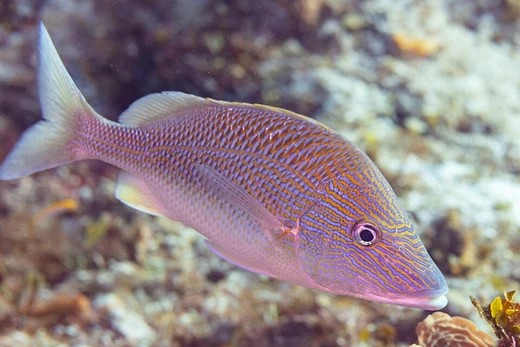
Common bluestripe snapper
A widespread snapper introduced to Hawaii in the 1950s.
Last updated
The common bluestripe snapper (Lutjanus kasmira) goes by many names: bluestripe snapper, bluebanded snapper, bluestripe sea perch, fourline snapper, blue-line snapper, and moonlighter. It belongs to the snapper family, Lutjanidae. Its natural range stretches from the coast of Africa and the Red Sea, across the Indian Ocean, to the central Pacific. People catch it for food, for sport, and for the aquarium trade.
Taxonomy
The species was first formally described in 1775 as Sciaena kasmira, with no specific location given, though the Red Sea is considered likely. FishBase credits the description to Peter Forsskål, but the Catalog of Fishes attributes it to J. C. Fabricius, writing in Niebuhr (based on Forsskål) in 1775. The valid scientific name is Lutjanus kasmira (Fabricius, 1775). The name kasmira comes from the Arabic word for this fish in the Red Sea.
Description
The body is moderately deep, with a steeply sloping head profile and a well-developed notch and knob on the preopercle. The first gill arch has 13 or 14 rakers on the lower limb and 20 to 22 total. The dorsal fin has 10 spines followed by 14 or 15 soft rays, while the anal fin has 3 spines and 7 or 8 soft rays.
Pectoral fins have 15 or 16 rays, and the caudal fin is slightly forked. Scales on the back rise obliquely above the lateral line, which holds 48 to 51 scales. The fish can reach 40 cm (16 in) in length, but most are under 25 cm (9.8 in).
Its color is the most obvious feature: the back and sides are bright yellow, fading to white on the lower sides and underside of the head. Four bright-blue stripes run lengthwise along the side, with faint greyish stripes below. Most fins are yellow.
Range and habitat
This is one of the most widespread snapper species, found from Egypt’s Red Sea coast south to Madagascar, and east to India, China, Southeast Asia, Australia, and many Pacific islands. Like other snappers, it lives around coral reefs, in shallow lagoons and on outer reef slopes down to at least 60 m (200 ft). In the Marquesas Islands it reaches 180 m (590 ft), and in the Red Sea, 265 m (869 ft).
In Hawaii, it also spends time over seagrasses and sandy bottoms. During the day, it often gathers in large groups near coral formations, caves, or wrecks. Young fish school over sandy areas, while larger fish are more solitary and live on deeper reefs.
Scientific classification
- KingdomAnimalia
- PhylumChordata
- ClassActinopterygii
- DivisionTeleostei
- OrderAcanthuriformes
- FamilyLutjanidae
- GenusLutjanus
- SpeciesLutjanus kasmira
Named by (Forsskål, 1775)
Close relatives
Other species of Lutjanus with a Codexery entry.
- African brown snapper Lutjanus dentatus
- Blackfin snapper Lutjanus buccanella
- Blue and gold snapper Lutjanus viridis
- Bluestriped snapper Lutjanus notatus
- Brazilian snapper Lutjanus alexandrei
- Cubera snapper Lutjanus cyanopterus
- Dog snapper Lutjanus jocu
- Golden African snapper Lutjanus fulgens
Sources: Wikipedia taxobox: Common bluestripe snapper (CC BY-SA 4.0) · differs from this box at order: WoRMS AphiaID 218482 (CC BY 4.0)
Conservation status
Least Concern (LC)
- LC▲ this species
- NT
- VU
- EN
- CR
- EW
- EX
Source: IUCN Red List assessment · GBIF copy of the Red List category
How big is it?
Largest length in the source, 0.4 m, next to a 1.8 m person.
Diagram: drawn by Codexery, schematic shapes to scale (not a likeness). Length: Wikipedia: Common bluestripe snapper
Where the common bluestripe snapper has been recorded
Each dot is a place where the species has been observed and reported (8,533 records, half-degree grid) — not a modelled range. 24 inland records left out (institution coordinates).
Map: drawn by Codexery. Data: GBIF occurrence search (records CC0 / CC BY) · Natural Earth basemap (public domain) · place coordinates: Wikipedia (CC BY-SA 4.0)
More in Snappers
Elsewhere in Snappers and Grunts
Test yourself
Three questions drawn from this entry’s sources. Pick an answer to check it.
Answers checked against the source article
Sources
Compiled from Wikipedia and the sources listed below. Text from Wikipedia is available under CC BY-SA 4.0; this entry is adapted from it.
- Wikipedia: Common bluestripe snapper (CC BY-SA 4.0).
- Classification: the source article's taxobox; compare WoRMS, the World Register of Marine Species (CC BY 4.0).
- Conservation status: IUCN Red List assessment.
- Occurrence records: GBIF (CC0 / CC BY). Basemap: Natural Earth (public domain).
- Word definitions: the , each quoted from its Wikipedia article.
Spotted an error? Know more?
Reader corrections go straight into our review queue. Suggest an edit · How this site is sourced